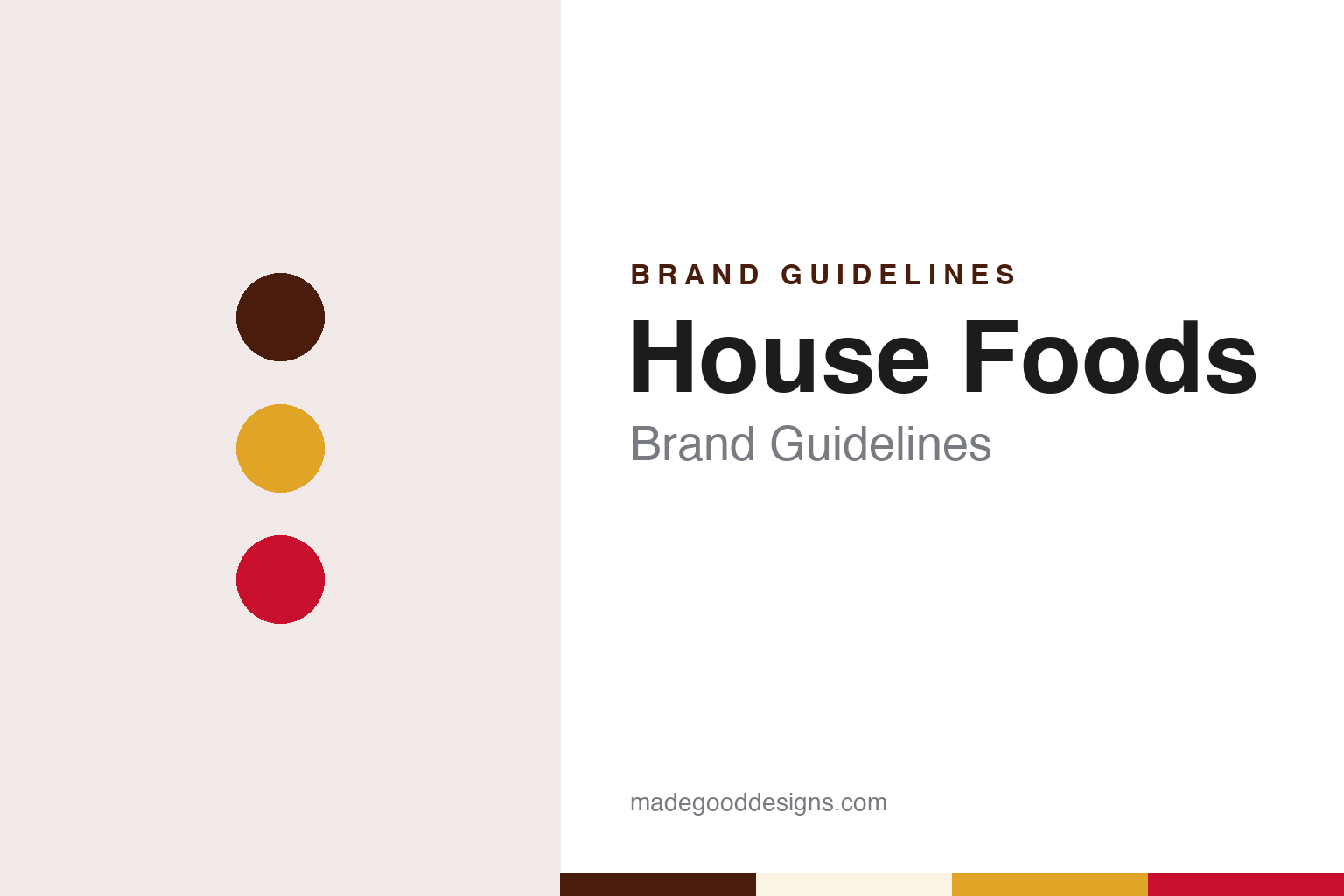
House Foods Brand Guidelines
The Osaka curry maker behind Vermont Curry.
Aa
Two constants: a roux brown, curry gold and apple red palette and a clean gothic sans register. Abstract homage — not a House Foods product or mark; no pack, logo or product is reproduced.
Urakami Shoten
A herbal-medicine dealer in Osaka turns to curry.
House Foods began in Osaka in 1913, and not as a food company. The group’s own history says that Seisuke Urakami opened Urakami Shoten that year as a dealer in herbal medicines and chemical raw materials; English Wikipedia dates the opening to 11 November 1913. In 1926, the company says, it began making and selling its own curry powder, and in 1928 it launched House Curry, a name the company later took for itself.
The company was rebuilt after the Second World War. Japanese Wikipedia says it was incorporated on 7 June 1947 as Urakami Ryoshoku Kogyosho, which the company calls a fresh start after the war. English Wikipedia traces the names that followed: House Foods Urakami Shoten from 1949, House Food Industrial from 1960, House Foods Corporation from 1993 and, since a reorganisation in 2013, House Foods Group Inc. The group says that change, made in its centenary year, turned it into a holding company; Japanese Wikipedia dates the switch to 1 October 2013. House Foods Corporation and House Wellness Foods now run the main businesses beneath it, and the group’s registered head office is in Higashiōsaka, the city bordering Osaka to the east, with a second office in Tokyo. Its shares trade on the Tokyo Stock Exchange; the company says it first listed, on the second sections in Tokyo and Osaka, in 1971.
The year 1960 also brought the product that set the shape of the business. The company says it launched Indian Curry, its first solid curry roux, that year. English Wikipedia calls House Foods the world’s largest maker of Japanese curry, citing the company.
Colour
Apples, honey and a curry for children.
The brand most people know is Vermont Curry, launched in October 1963. The company says its idea was a curry that children would like too, and that it became a big hit by overturning the common wisdom about curry. Japanese Wikipedia explains that until then curry was widely seen in Japan as food for adults, and that the new roux was made with apples and honey so that one dish could serve the whole family. The name came from America: Japanese Wikipedia says it borrowed from the “Vermont health method” of apple cider vinegar and honey, a fashion in Japan in the early 1960s that grew out of the American doctor D. C. Jarvis’s 1958 book on Vermont folk remedies.
Advertising built the name. Japanese Wikipedia lists the singer and actress Ayumi Ishida as an early face of the brand from 1965 to 1968, and the pop singer Hideki Saijo from 1973 to 1985, whose television commercials ended on the catchphrase “Hideki, kangeki!” — roughly “Hideki is thrilled!” — and its variations. The same source names the actress Kanna Hashimoto as the brand’s face from 2024. Vermont Curry was followed in 1968 by Java Curry, according to Japanese Wikipedia.
The company spread far beyond curry. Its own timeline lists Prin Mix, a pudding mix, in 1964; an instant stew in 1966; the retort-pouch Kukure stew in 1970 and Kukure Curry in 1971; Shanmen instant noodles in 1973 and the Kyushu-style Umakacchan noodles in 1979; and, after a potato chip, the cone-shaped corn snack Tongari Corn in 1978. Rokko-no-oishii-mizu, which the company calls the first mineral water for home use, followed in 1983. Other names arrived through acquisitions: the spice company Gaban, an alliance partner from 2004 and a subsidiary from 2016, and Malony, the cellophane-noodle maker, in 2017, the company says. In 2013 a House Foods research paper on onions that do not make the eyes water won an Ig Nobel Prize, which the company lists in its own history.
Typography
Design and documentation.
The seven brands in this group all make snacks, sweets or food, and all of them come from Japan: Calbee, Lotte, Kracie, Bourbon, Tohato, Kameda Seika and House Foods. Japanese snack, confectionery and food brands in general sit at many different points in the trade, from firms that still carry a founder’s surname to names that now belong to much larger food groups, and a single brand can be sold everywhere from a convenience store to a supermarket shelf.
A food brand’s identity is usually carried less by a single product than by a pack, a name and the snack or meal it promises, because the company behind the name may have changed hands, moved its factory or grown far beyond the town where it started. That makes the questions behind each name worth asking plainly: who started it, who owns it now, and where its products are actually made and packed.
Each guide separates what independent sources record from what the company says about itself — its founding story, its owners over time, where its products are made and how its packaging has changed — and marks plainly what rests only on the company’s own word.
Aa
A clean gothic sans for a curry maker from Osaka. (Specimen set in Zen Kaku Gothic New, a sans STAND-IN; NOT the House Foods logo.)
House Foods
Tofu in America and curry restaurants worldwide.
House Foods went abroad through tofu as well as curry. The company says it opened a Los Angeles office in 1981 and in 1983 set up House Foods & Yamauchi, now House Foods America Corporation, to make tofu in the United States. English Wikipedia, citing a 2011 soyfoods history by William Shurtleff and Akiko Aoyagi, describes it as the largest tofu provider in the US, with plants in California and New Jersey; the Louisville television station WDRB reported in April 2021 that it planned a plant in Kentucky. In 2022, the group says, it took ownership of Keystone Natural Holdings to build its presence in the American tofu and plant-based food market.
Curry restaurants are the other half of the international story. Curry House CoCo Ichibanya was founded in 1978 in Nishibiwajima, Aichi, by Toshio and Naomi Munetsugu, and Japanese Wikipedia says it used House roux from the start. On 30 October 2015 House Foods announced a tender offer to raise its stake in Ichibanya to 51%, Japanese Wikipedia says, and the chain became a consolidated subsidiary; the company also dates the acquisition to 2015. English Wikipedia lists CoCo Ichibanya outlets in Japan and across Asia, the US and the UK, and the company says the first British branch opened in Leicester Square in 2018 and the first in India in 2020.
The curry itself travels too. The group says it launched a Chinese version of Vermont Curry in 2005, with the aim of making curry and rice a national dish in China, and that Zhejiang House Foods began operating in 2018 as its third factory in China. It has also set up companies in Taiwan, South Korea, Thailand and Vietnam since 2000, and in 2022 an intermediate holding company for Southeast Asia, according to its own timeline.
For a design guide, House Foods shows how a roux brand named after an American folk remedy, and sold to children with apples and honey, can carry an Osaka herbal-medicine dealer for more than a century. Compare Glico, another Osaka food maker, and Kikkoman, the Japanese soy-sauce brand. For this guide we use roux brown, a curry gold and an apple red with a gothic sans, an unofficial interpretation; no product or logo is reproduced.
Explore & save
Keep House Foods’s identity on hand — save it to a board in the Made Good inspiration library.
House Foods identity set
Pin the House Foods roux brown, curry gold and apple red palette and the clean gothic sans register to your own board.