Philadelphia Brand Guidelines
The cream cheese from Chester, New York, named after a city it never came from.
Aa
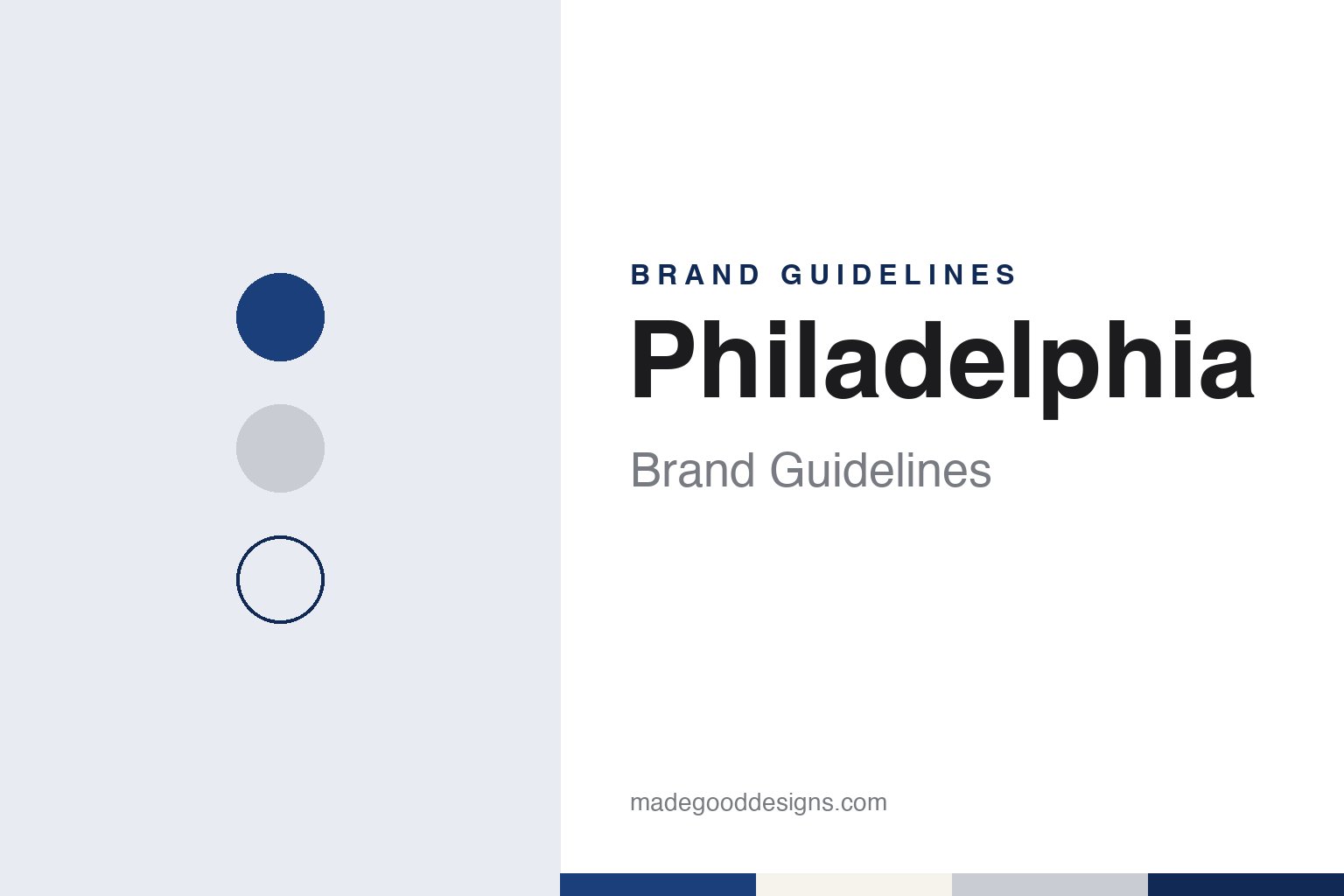
Two constants: a Philly blue, foil silver and cream white palette and a soft editorial serif register. Abstract homage — not a Philadelphia product or mark; no pack, logo or foil block is reproduced.
Chester, not Philadelphia
A New York dairyman, a distributor and a borrowed city name.
Philadelphia cream cheese has never come from Philadelphia. Its story starts in Chester, a village in Orange County, New York, with a dairyman named William A. Lawrence (1842–1911). English Wikipedia says that in 1872 Lawrence, trying to make Neufchâtel, a soft cheese then popular in Europe, added extra cream and produced a richer, more spreadable cheese. Charlene Mires, writing in the Encyclopedia of Greater Philadelphia in 2018, gives a slightly different chronology: Lawrence opened his business in Orange County in 1862 and in 1875 became the first to produce cream cheese in a factory. Both accounts place the start of factory-made cream cheese in Lawrence’s corner of New York State.
The name came from a salesman. In 1880 Lawrence joined forces with Alvah Reynolds (1830–1925), a New York cheese distributor, who chose to sell the cheese as “Philadelphia.” The city and the farmland around it had a reputation for high-quality dairy products, and the name was meant to borrow that reputation, both the Encyclopedia of Greater Philadelphia and English Wikipedia say. English Wikipedia adds that the name went on foil-wrapped blocks of the cheese. Mires writes that Reynolds made Philadelphia cream cheese himself from 1882 until 1903, when he sold the brand to the Phenix Cheese Company of New York; English Wikipedia places Phenix in South Edmeston, in the dairy country of upstate New York.
The brand’s longest relationship began in 1928, when Phenix merged with the Chicago cheese company Kraft to form the Kraft-Phenix Cheese Company. Mires writes that the cheese was first sold as a round disc and that foil-wrapped blocks came in the late 1920s, once stabilising ingredients had been added to the recipe; by the late twentieth century the brand was sold in a range of flavours. Her essay also records a 1948 advertisement in the Ladies’ Home Journal aimed at housewives, and, in the twenty-first century, campaigns such as “The Real Women of Philadelphia,” a video contest, and the slogan “It Must Be Philly.”
Colour
Angels, a cowboy and a recycled pack.
Philadelphia’s advertising has often played on the idea of heaven. In Canada a series of television commercials from 1994 showed angels finding ways to bring “Philly” into their lives, and the Montreal-born actor Linda Kash became known as the Philadelphia cream cheese angel; The Canadian Encyclopedia dates her first appearance in the role to 1994, and English Wikipedia calls it the role she is best known for. The angel outlived her tenure: in February 2020 the Canadian marketing magazine Strategy reported that Kraft Heinz was looking for the next Philly angel.
In the United States the newest campaign brings a different character. In February 2026 Kraft Heinz launched a platform called “Really Philly Good,” built around Phillyboy, a cowboy-like figure who turns up to help home cooks, Marketing Dive reported. The agency Johannes Leonardo developed the 19 spots, which Marketing Dive described as the brand’s first creative refresh since 2021 and its largest marketing investment to date, with PR from Zeno Group, media from Carat and social work from The Kitchen, Kraft Heinz’s in-house agency. Angie Madigan, Kraft Heinz’s vice president of marketing for its taste-elevation brands, said the aim was to reintroduce Philadelphia “as an everyday cooking staple, not just a spread.” Marketing Dive put the brand’s reach at more than 131 million US households.
Outside North America the brand is run by Mondelēz International, which has made its own changes to the pack. In 2020 Mondelēz began using recycled plastic processed by the packaging company Berry Global in Philadelphia packaging, Food Dive reported, as part of a pledge to make all of its packaging recyclable by 2025. Philadelphia has also become a sponsor of Italy’s top football league, Serie A, from the 2023–24 season, with the deal renewed in December 2024 for two more seasons, English Wikipedia says.
Typography
Design and documentation.
The seven brands in this group all sell butter, cheese or other dairy products, and they come from Denmark, Ireland, France, the United States and Britain: Lurpak, Kerrygold, Président, Babybel, Philadelphia, Cathedral City and Yeo Valley. Dairy brands in general sit at many different points in the trade, from farmer-owned co-operatives and family firms to names that now belong to much larger food groups, and a single brand can be sold everywhere from a corner shop to a supermarket chiller.
A dairy brand’s identity is usually carried less by a single product than by a pack, a name and the kitchen or table it promises, because the company behind the name may have changed hands, licensed its name to another maker or grown far beyond the place where it started. That makes the questions behind each name worth asking plainly: who started it, who owns it now, and where its butter, cheese or yoghurt is actually made and packed.
Each guide separates what independent sources record from what the company says about itself — its founding story, its owners over time, where its products are made and how its packaging has changed — and marks plainly what rests only on the company’s own word.
Aa
A soft editorial serif for a cream cheese with a borrowed city name. (Specimen set in Fraunces, a serif STAND-IN; NOT the Philadelphia logo.)
Philadelphia
One brand name, two owners.
Philadelphia today has two owners. Kraft, which took on the brand in 1928, grew into Kraft Foods Inc., and in October 2012 that company spun off its North American grocery business as Kraft Foods Group and renamed the rest of the business, including its international operations, Mondelēz International. The Philadelphia brand was divided along the same line. Just Food reported in 2021 that Kraft Heinz owns the brand in the United States, while Mondelēz has the rights to market it in Europe, and English Wikipedia lists both companies as owners. Kraft Foods Group merged with H.J. Heinz in 2015 to create Kraft Heinz, which sells Philadelphia in the US and Canada.
Production follows the split. The Encyclopedia of Greater Philadelphia noted in 2018 that the cheese was being made in Lowville, in upstate New York. For Europe, Mondelēz makes Philadelphia at Bad Fallingbostel in Lower Saxony, Germany, a plant founded in 1957 that the company calls the biggest meals plant in its worldwide network and the home of Philadelphia fresh cheese. In 2021 Mondelēz invested €12 million there to make more Philadelphia spreads and Miracel Whip, Just Food reported, adding that the site, with about 600 staff, makes more than 250 products for Europe, the Middle East and Africa.
Kraft Heinz has also weighed splitting itself again. In September 2025 it announced plans to separate into two companies, with Philadelphia placed alongside Heinz and Kraft Mac & Cheese in a “Global Taste Elevation” business, and the separation was expected to close by the end of 2026. In February 2026 the new chief executive, Steve Cahillane, who took over in January, paused the plan and committed US$600 million to marketing, sales and research, with the taste-elevation brands, Philadelphia among them, a focus of the spending, FoodIngredientsFirst reported.
For a design guide, Philadelphia shows how a borrowed city name and a foil-wrapped block can carry one cream cheese across two owners and more than 150 years. Compare Grey Poupon, another Kraft Heinz name in the US, and Ritz, the Mondelēz cracker. For this guide we use a Philly blue, a foil silver and a cream white with a serif, an unofficial interpretation; no product or logo is reproduced.
Explore & save
Keep Philadelphia’s identity on hand — save it to a board in the Made Good inspiration library.
Philadelphia identity set
Pin the Philadelphia blue, foil silver and cream white palette and the soft editorial serif register to your own board.