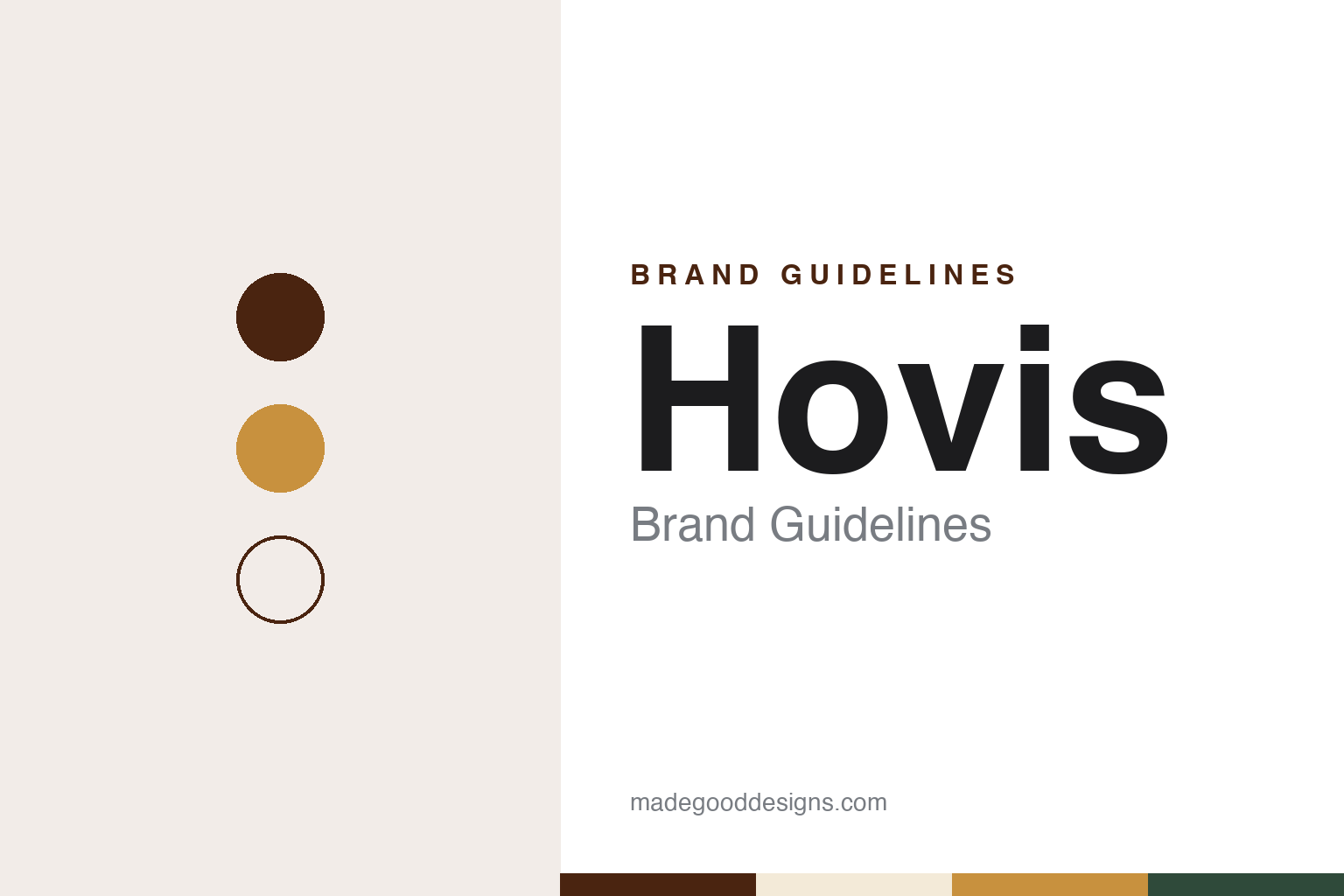
Hovis Brand Guidelines
The strength of man, the boy on the bike and a hill in Dorset.
Aa
Two constants: a wholemeal brown, wheat gold and flour palette and a heritage display serif register. Abstract homage — not a Hovis product or mark; no pack, logo or loaf is reproduced.
Hominis vis
A Stone miller, a Macclesfield mill and a prize-winning name.
Hovis began as a milling process before it was a loaf. Its inventor was Richard “Stoney” Smith (1836–1900), a miller at Stone in Staffordshire. The company dates his discovery of a way to separate the wheatgerm from the flour to 1886, and says the process was registered in 1887 as “Smith’s Patent Process Germ Flour”; English Wikipedia gives the patent date as 6 October 1887. Smith joined S. Fitton & Sons, a larger milling firm in Macclesfield, Cheshire, which milled the flour and, English Wikipedia says, sold it to other bakers together with branded baking tins.
The flour needed a name. In 1890 Fitton’s ran a national competition, which was won by a London student, Herbert Grime, English Wikipedia says. His entry, for which he received a £25 prize, was Hovis, a contraction of the Latin hominis vis, “the strength of man.” The business became the Hovis Bread Flour Company Limited in 1898.
Early marketing reached well beyond the bakery. In 1899 the company produced eight books of maps covering England and Wales, designed for cyclists, and in 1920 it published a road map of England, Wales and Scotland that was reprinted several times, English Wikipedia says. Hovis’ own timeline adds that it supplied bread to the Royal family from 1896, began annual baking competitions for bakers in 1900, published recipe booklets from 1926, and in 1941 donated a Spitfire to the RAF, named “Hominis Vis.”
Colour
From McDougall and Rank to ABF.
For most of the twentieth century Hovis belonged to ever larger flour and bread groups. In 1957 it merged with McDougall, a flour business founded in 1864, to form Hovis McDougall, and in 1962 Joseph Rank Ltd acquired that company to create Ranks Hovis McDougall (RHM), English Wikipedia says; RHM also owned the Mother’s Pride bread brand. RHM was in turn bought by Premier Foods in 2007.
Premier then reduced its stake. In April 2014 the American investment firm The Gores Group completed the purchase of a 51% controlling stake in the bread business for £30m, with Premier keeping 49%, according to the companies’ announcement and reports in The Grocer and Campaign. The joint venture, Hovis Limited, was based in High Wycombe, Buckinghamshire, and was reported at the time to employ about 3,000 people at a flour mill and eight bakeries. In November 2020 both owners sold their stakes to Endless LLP, a private equity firm based in Leeds, the Northern Financial Review and The Irish News reported.
The most recent change brought Hovis together with an old rival. In August 2025 Associated British Foods (ABF), whose Allied Bakeries business makes Kingsmill, agreed to buy Hovis Group from Endless, Insider Media reported; Sky News had put the value at about £75m, Bakery and Snacks reported. The Competition and Markets Authority opened an in-depth investigation in January 2026 and cleared the deal unconditionally on 16 June 2026. ABF completed the purchase on 8 July 2026 and combined Allied Bakeries and Hovis as Hovis Bakeries, which brings together Hovis, Kingsmill, Allinson’s and Sunblest, with Sarah Arrowsmith as chief executive, Grocery Gazette reported. ABF’s chief executive, George Weston, said the combined business could “return to growth.”
Typography
Design and documentation.
The seven brands in this group all sell bread, cake or other bakery goods, and all of them come from Britain: Warburtons, Hovis, Kingsmill, Allinson, Soreen, Mr Kipling and Genius. British bakery brands in general sit at many different points in the trade, from family firms that still carry a founder’s surname to names that now belong to much larger food groups, and a single brand can be sold everywhere from a corner shop to a supermarket shelf.
A bakery brand’s identity is usually carried less by a single product than by a pack, a name and the loaf or cake it promises, because the company behind the name may have changed hands, moved its bakeries or grown far beyond the town where it started. That makes the questions behind each name worth asking plainly: who started it, who owns it now, and where its products are actually baked and packed.
Each guide separates what independent sources record from what the company says about itself — its founding story, its owners over time, where its products are made and how its packaging has changed — and marks plainly what rests only on the company’s own word.
Aa
A warm heritage serif for a Victorian flour name. (Specimen set in DM Serif Display, a serif STAND-IN; NOT the Hovis logo.)
Hovis
A boy, a bike and a hill in Dorset.
Hovis’ most famous advert lasts 47 seconds. In 1973 the agency Collett Dickenson Pearce made “The Bike Ride,” better known as “Boy on the Bike,” directed by Ridley Scott before his career in feature films. A delivery boy pushes a heavily laden baker’s bike up a steep cobbled street to make the last drop of his round, then freewheels back down, to the slow movement of Dvořák’s “New World” Symphony arranged for brass. The boy was played by Carl Barlow, then 13, English Wikipedia says.
The street is Gold Hill in Shaftesbury, Dorset. The writer Sam Delaney noted in 2007, as English Wikipedia records, that viewers tend to imagine the advert is set in the north of England, although it was filmed in Dorset and the boy speaks with a West Country accent; Gold Hill has since become a destination for fans of the film. The advert has topped polls for decades: The Independent reported in 2006 that it had been voted the nation’s favourite advert, and a 2019 Kantar survey of more than 1,000 UK consumers named it the most iconic and heart-warming advert of the previous 60 years. After that result Ridley Scott Associates and the British Film Institute made a 4K digital restoration, which ITV aired from 3 June 2019, The Drum reported.
Hovis returned to history for its next celebrated film. “Go On Lad,” made for Premier Foods by the agency Miles Calcraft Briginshaw Duffy and directed by Ringan Ledwidge, followed a boy carrying a loaf through 122 years of British history in 122 seconds. It premiered on 12 September 2008 as part of a relaunch worth about £15m, English Wikipedia says, and in December 2009 it was voted ITV’s Ad of the Decade, Campaign reported.
For a design guide, Hovis shows how a Latin coinage, a cyclists’ map and a Dorset hill can make a bread brand feel older than any of its owners. Compare Kingsmill, now its stablemate at Hovis Bakeries, and Bisto, which also passed from RHM to Premier Foods. For this guide we use a wholemeal brown, a wheat gold and a flour cream with a serif, an unofficial interpretation; no product or logo is reproduced.
Explore & save
Keep Hovis’s identity on hand — save it to a board in the Made Good inspiration library.
Hovis identity set
Pin the Hovis wholemeal brown, wheat gold and flour palette and the heritage display serif register to your own board.