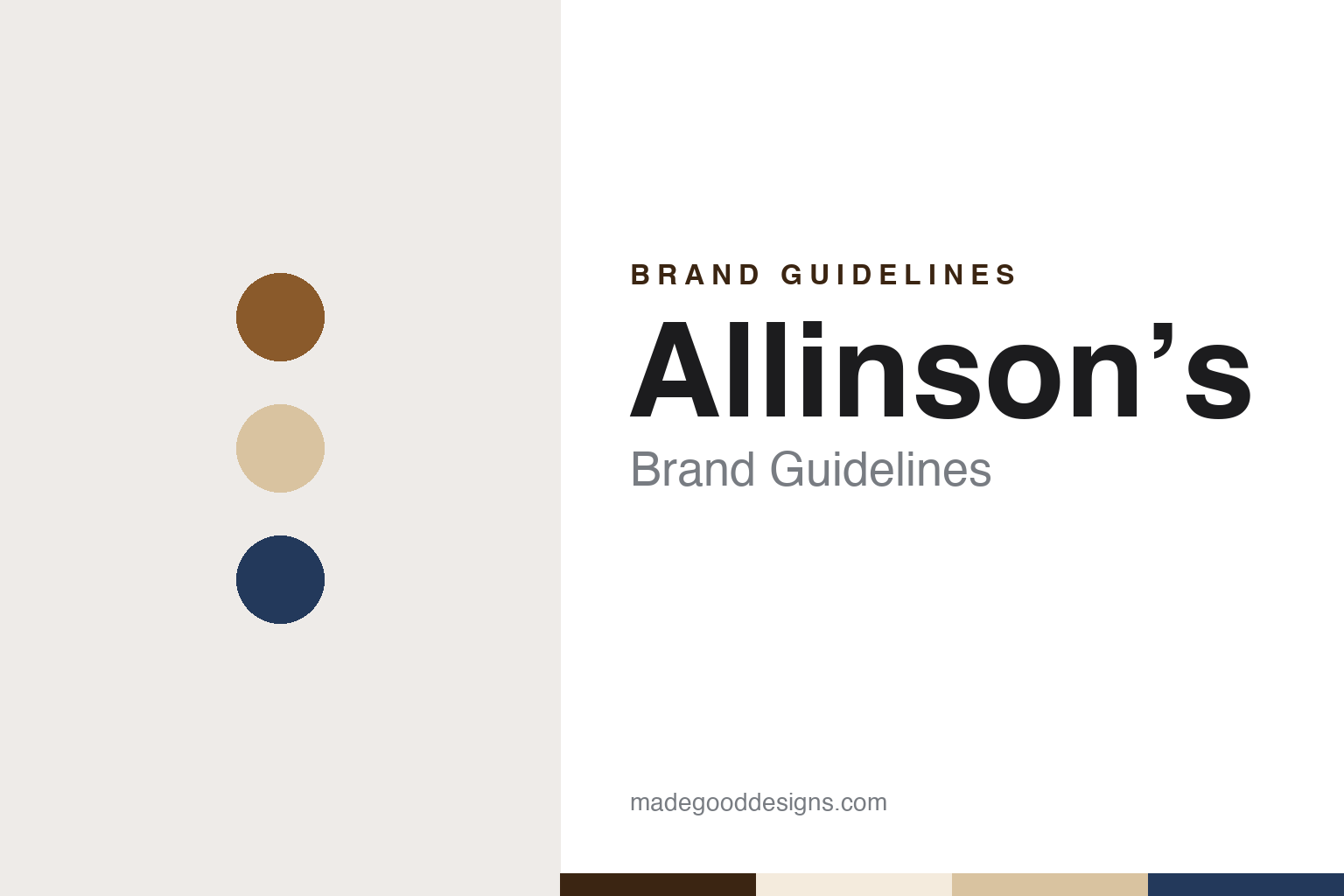
Allinson’s Brand Guidelines
Dr Allinson’s 1892 wholemeal mill and its two brands today.
Aa
Two constants: a wholemeal brown, kraft paper and mill blue palette and a Victorian bookish serif register. Abstract homage — not an Allinson’s product or mark; no pack, logo, windmill or loaf is reproduced.
The Natural Food Company
A Manchester-born doctor, a pamphlet and a mill in east London.
Allinson’s is named after a man, and an unusual one. Thomas Richard Allinson was born in Hulme, Manchester, in 1858, trained in medicine in Edinburgh and qualified in 1879, according to English Wikipedia, which draws on his entry in the Oxford Dictionary of National Biography and articles in medical-history journals. He set up a practice in Marylebone in 1885 and wrote prolifically for a general readership, including more than a thousand articles as medical editor of the Weekly Times and Echo.
His ideas, which he called “hygienic medicine,” centred on diet, exercise and fresh air, and on vegetarian food and bread made from the whole grain. In 1889 he published a pamphlet titled The Advantages of Wholemeal Bread. His views and his habit of promoting them in the press brought him into conflict with the medical establishment, and in 1892 he was struck off the Medical Register, English Wikipedia says. In 1891 he had walked from Edinburgh to London, covering about 28 miles a day, as a public demonstration of his vegetarian diet.
The business began in the same year he was struck off. In 1892 Allinson bought a stone-grinding flour mill in Bethnal Green, in east London, and founded the Natural Food Company, later adding a bakery, according to English Wikipedia and the University of Edinburgh’s archive catalogue, which holds his papers. He had other ventures too: in 1911 he bought the magazine Vanity Fair, which he could not revive. Allinson died in Marylebone in 1918.
Colour
Newport, Castleford and the biggest stoneground mill.
The company grew after its founder’s death. The University of Edinburgh’s archive catalogue says that demand for wholemeal bread kept rising after 1918 and that two more mills were acquired, in Newport, Monmouthshire, and Castleford, Yorkshire.
Castleford became the company’s best-known site. Its Queen’s Mill on the River Aire, renamed in 1887 for Queen Victoria’s Golden Jubilee, had stood empty after a fire before Allinson bought and restored it in 1921, English Wikipedia says, citing Maurice Baren’s 1992 book on brand histories, How It All Began. In 1979 and 1980 Allinson enlarged the mill and centralised its stoneground wheat-flour milling there, making it, by that account, the world’s largest stoneground flour mill, with 20 pairs of millstones. After a series of mergers the mill passed to ADM Milling, which closed it in 2010. Castleford Heritage Trust bought the building in 2013 and began milling flour there on a small scale in 2015.
Ownership of the name changed more than once over the 20th century. When the Allinson Papers were given to the University of Edinburgh in June 1987, the donor was Booker Health Foods, one of whose trade names was Allinson, part of the Booker McConnell group, the university’s catalogue says; the same catalogue says the flour later became part of the range of Allied Mills.
Flour packs have their own design history. In January 2013 the branding agency Family (and friends) redesigned Allinson flour with a pattern inspired by flour sacks and brought back the brand’s original windmill trademark, Design Week reported. Today the Allinson’s flour website, which says the brand has been milling since 1892, is run by The Silver Spoon Company, a division of British Sugar, itself part of Associated British Foods.
Typography
Design and documentation.
The seven brands in this group all sell bread, cake or other bakery goods, and all of them come from Britain: Warburtons, Hovis, Kingsmill, Allinson, Soreen, Mr Kipling and Genius. British bakery brands in general sit at many different points in the trade, from family firms that still carry a founder’s surname to names that now belong to much larger food groups, and a single brand can be sold everywhere from a corner shop to a supermarket shelf.
A bakery brand’s identity is usually carried less by a single product than by a pack, a name and the loaf or cake it promises, because the company behind the name may have changed hands, moved its bakeries or grown far beyond the town where it started. That makes the questions behind each name worth asking plainly: who started it, who owns it now, and where its products are actually baked and packed.
Each guide separates what independent sources record from what the company says about itself — its founding story, its owners over time, where its products are made and how its packaging has changed — and marks plainly what rests only on the company’s own word.
Aa
A bookish Victorian serif for a name begun by a pamphleteering doctor. (Specimen set in Libre Baskerville, a serif STAND-IN; NOT the Allinson’s logo.)
Allinson’s
A wholemeal loaf, clear bags and then paper.
The bread carrying the Allinson name is made and sold by a different part of ABF from the flour. For decades it was a brand of Allied Bakeries, the group’s bread business, and since July 2026, when ABF completed its purchase of Hovis Group, it has belonged to the merged Hovis Bakeries, alongside Kingsmill, Sunblest and Hovis, Food Manufacture reported. The Competition and Markets Authority’s June 2026 report on the deal lists Allinson’s among Allied’s brands.
Its packaging has been changed several times. In July 2003 Allied moved the Wholemeal and Hi-Bran loaves into new transparent packs to show off the bread, FoodNavigator reported, putting the brand’s value at £19 million in the year to May 2003. A bigger relaunch came in January 2017, when the London agency BrandOpus rebranded the Allinson’s range and Allied introduced a smaller 650g, 12-slice loaf in four varieties, among them Classic Wholemeal and Rustic White, Bakery and Snacks reported; Allied said the loaves were batch-baked in tins. In 2018 Allied added premium unsliced cobs, among them Honey & Wholemeal and Olive & Rosemary, and moved the whole Allinson’s range into paper packaging for a more artisan look, The Grocer reported, with Allied claiming value sales up 40% year on year after the relaunch.
Two ABF businesses now share one Victorian name: Silver Spoon’s flour, with its windmill, and Hovis Bakeries’ wholemeal and seeded loaves.
For a design guide, Allinson’s shows how a founder’s name, a windmill and a plain paper wrap can carry a wholemeal brand across more than 130 years. Compare Kingsmill, its sister loaf at Allied Bakeries, and Hovis, the other Victorian bread name now in the same group. For this guide we use wholemeal brown, kraft paper and a mill blue with a serif, an unofficial interpretation; no product or logo is reproduced.
Explore & save
Keep Allinson’s’s identity on hand — save it to a board in the Made Good inspiration library.
Allinson’s identity set
Pin the Allinson’s wholemeal brown, kraft paper and mill blue palette and the Victorian bookish serif register to your own board.