Wall’s Brand Guidelines
The sausage maker’s ice cream that found a heart.
Aa
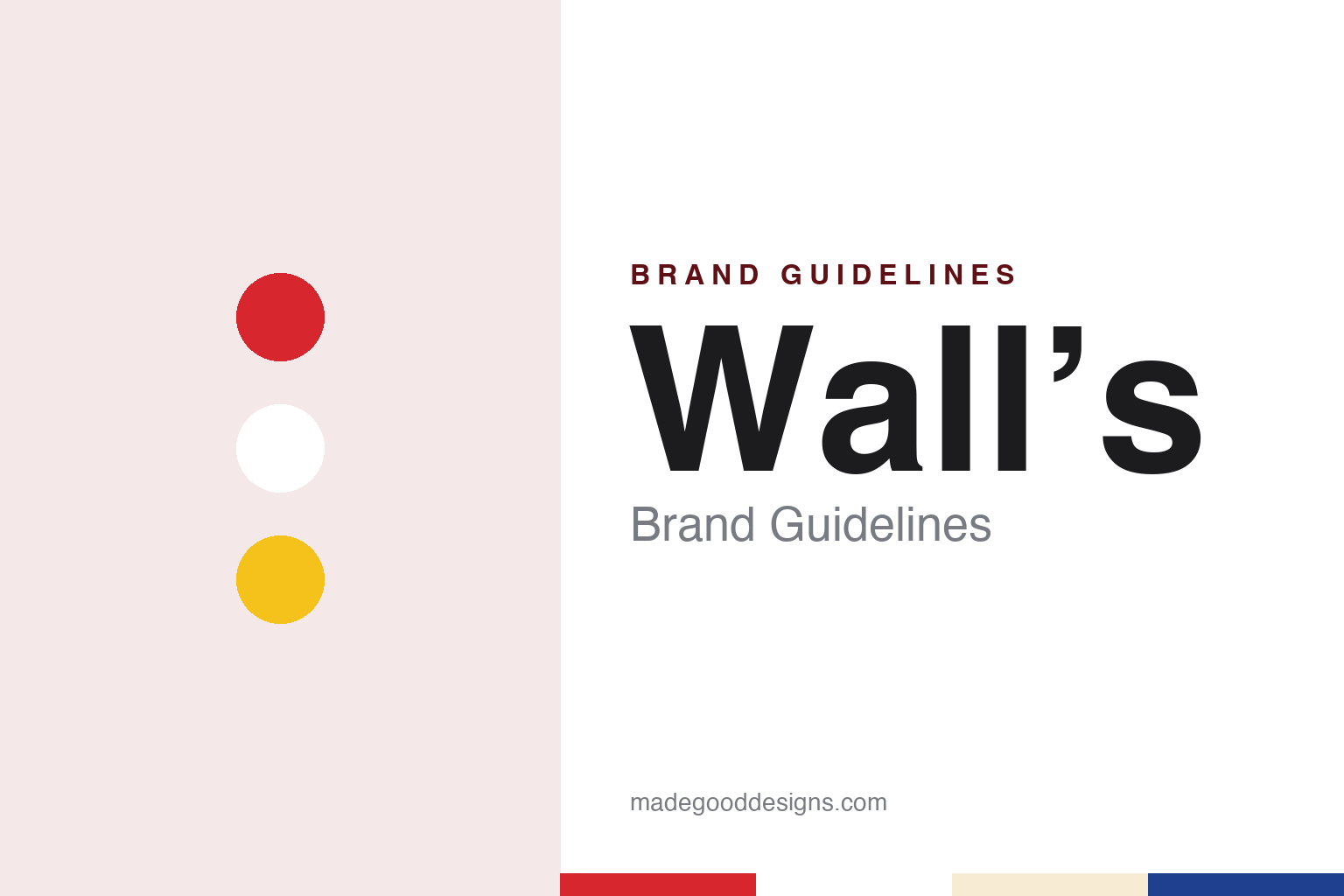
Two constants: a heart red, white and cream palette and a rounded bold sans register. Abstract homage — not a Wall’s product or mark; no pack, logo or heart is reproduced.
Sausages first
A pork butcher, a slack summer and a delayed idea.
Wall’s ice cream grew out of a meat business. English Wikipedia, citing a history published by the Thomas Wall Trust, says Richard Wall opened a butcher’s stall in St James’s Market, London, in 1786, and in 1812 received a Royal Appointment to the Prince of Wales, the future George IV, as “Purveyor of Pork.” The business moved to Jermyn Street in 1834. Richard’s son Thomas took charge after his parents died, and once Thomas’s own sons joined the board it traded as Thomas Wall and Sons, known for its sausages and pies.
The ice cream came from a seasonal problem. Summer was the slack season for sausages, pies and meat, and staff were laid off every year, so in 1913 Thomas Wall II suggested making ice cream in the warm months. The First World War put the plan on hold, English Wikipedia says, citing Pim Reinders’ world history of ice cream, Licks, Sticks and Bricks, published by Unilever in 1999. Thomas Wall II retired in 1920 and set up a trust “for the encouragement and assistance of educational work and social service,” which still makes grants today.
By then the business had changed hands. In 1920 it was sold to Mac Fisheries, which itself passed to Lever Brothers in 1922, according to English Wikipedia; Grace’s Guide, the British industrial history archive, also dates Lever Brothers’ acquisition of Wall’s to 1922. Lever Brothers became part of Unilever in 1930. Under the new management, which English Wikipedia says was led by Maxwell Holt, the old plan was revived, and ice cream production began in 1922 at a factory in Acton, in west London. Grace’s Guide says Unilever later split the firm into separate ice cream and meat companies.
Colour
“Stop me and buy one,” Gloucester and a masterbrand.
Wall’s took its ice cream to the street. Its box tricycles carried the slogan “Stop me and buy one,” and the phrase became familiar enough to enter the language: the etymology site Word Histories traces it to T. Wall & Sons and finds it in the Lancashire Daily Post as early as July 1926. Wall’s doubled its capacity in 1959 by opening a purpose-built ice cream factory in Gloucester. In 1981, Grace’s Guide says, Unilever merged the ice cream company with Birds Eye Foods to form Birds Eye Wall’s, and the Acton factory closed in 1983.
Gloucester remains the brand’s British base. In November 2025 Food Manufacture reported a £50 million upgrade of the site, which it described as the UK’s largest ice cream factory and the second-largest in Europe. The plant makes more than 600 million ice creams a year, among them Viennetta, Solero, Magnum and Calippo; it employs almost 500 people, and more than 80 per cent of its output is sold in the UK. The upgrade includes a rebuilt mix plant and new high-speed lines, and the company is aiming for a 50 per cent rise in output by 2027 compared with 2023.
In Britain Wall’s works as a masterbrand: products with their own names, such as Magnum and Cornetto, are sold under its heart. Magnum, launched in 1989 according to the BBC, comes with a story Wall’s does not endorse. The actor Roger Moore was said to have told the journalist Chrissy Iley that in the 1960s he had wished Wall’s would make a choc ice on a stick; Wall’s told the Daily Mirror it had no knowledge of his involvement and called it no more than “a brilliant story,” the BBC reported in 2017.
The names have also travelled beyond the freezer. In 2013, ConfectioneryNews reported, a licensing deal with Kinnerton Confectionery put Magnum, Cornetto and Mini Milk on chocolate bars. In 2022 Canadian Grocer reported the launch of Wall’s in Canada with a range of Asian-inspired flavours.
Typography
Design and documentation.
The seven brands in this group all make ice cream, and all of them are sold in Britain: Wall’s, Carte d’Or, Mackie’s, Kelly’s of Cornwall, Little Moons, Viennetta and Solero. Ice cream brands sold in Britain in general sit at many different points in the trade, from family firms that still carry a founder’s surname to names that now belong to much larger food groups, and a single brand can be sold everywhere from a seaside kiosk to a supermarket freezer.
An ice cream brand’s identity is usually carried less by a single product than by a pack, a name and the treat it promises, because the company behind the name may have changed hands, moved its factory or grown far beyond the place where it started. That makes the questions behind each name worth asking plainly: who started it, who owns it now, and where its ice cream is actually made and packed.
Each guide separates what independent sources record from what the company says about itself — its founding story, its owners over time, where its ice cream is made and how its packaging has changed — and marks plainly what rests only on the company’s own word.
Aa
A rounded bold sans for a brand sold from tricycles and vans. (Specimen set in Poppins, a sans STAND-IN; NOT the Wall’s logo.)
Wall’s
From a yellow signature to a shared heart.
The look has changed more than the name. Before 1998 Wall’s used a script signature on a sunny yellow background; The Independent reported in March 1998 that the logo had been in use since the 1980s, though the “signature” had been part of the image since the company began. That month Wall’s, which then held 31 per cent of the UK ice cream market, announced a new identity of red and yellow intertwining hearts, designed by the London agency Carter Wong & Partners. The company said the hearts better represented the “feelings of happiness associated with sharing Wall’s ice cream with family and friends” at any time of year. The newspaper said the rebranding of 100,000 British outlets would take until 2000, backed by about £15 million of television advertising, and that the look would be used around the world.
That mark became the Heartbrand, shared by local ice cream names such as Algida in Italy, Langnese in Germany and Ola in the Netherlands. In 2003, according to a 2016 Austrian book on the Eskimo brand cited by English Wikipedia, the heart was simplified, its yellow replaced by white, and the blue script lettering for the local names gave way to capital sans-serif letters. In 2026 the British agency Sunhouse built a global campaign identity, “Mad For,” around the heart, with a red and white flag, a “Mad For” lock-up, a modular panel system for individual products and a bespoke typeface, Transform magazine reported in May. “The Heart symbolises passion,” said Sunhouse’s Matt Van Ness.
The owner has changed too. Unilever announced in March 2024 that it would separate its ice cream business. The Magnum Ice Cream Company began operating as a Unilever subsidiary on 1 July 2025, with headquarters in Amsterdam, and was listed in Amsterdam, London and New York on 8 December 2025, Reuters reported. Wall’s ice cream belongs to it. The Wall’s sausages and pies are a separate business: Unilever sold its Wall’s meat company and a UK licence for the name to Kerry Foods in 1994, English Wikipedia says, and the Compleat Food Group now lists Wall’s Pastry among its brands. This guide is about the ice cream.
For a design guide, Wall’s shows how a local name can carry a shared international mark while its products keep their own identities. Compare Magnum and Cornetto, two of the brands sold under its heart. For this guide we use heart red, deep red and cream with a rounded sans, an unofficial interpretation; no product or logo is reproduced.
Explore & save
Keep Wall’s’s identity on hand — save it to a board in the Made Good inspiration library.
Wall’s identity set
Pin the Wall’s heart red, white and cream palette and the rounded bold sans register to your own board.