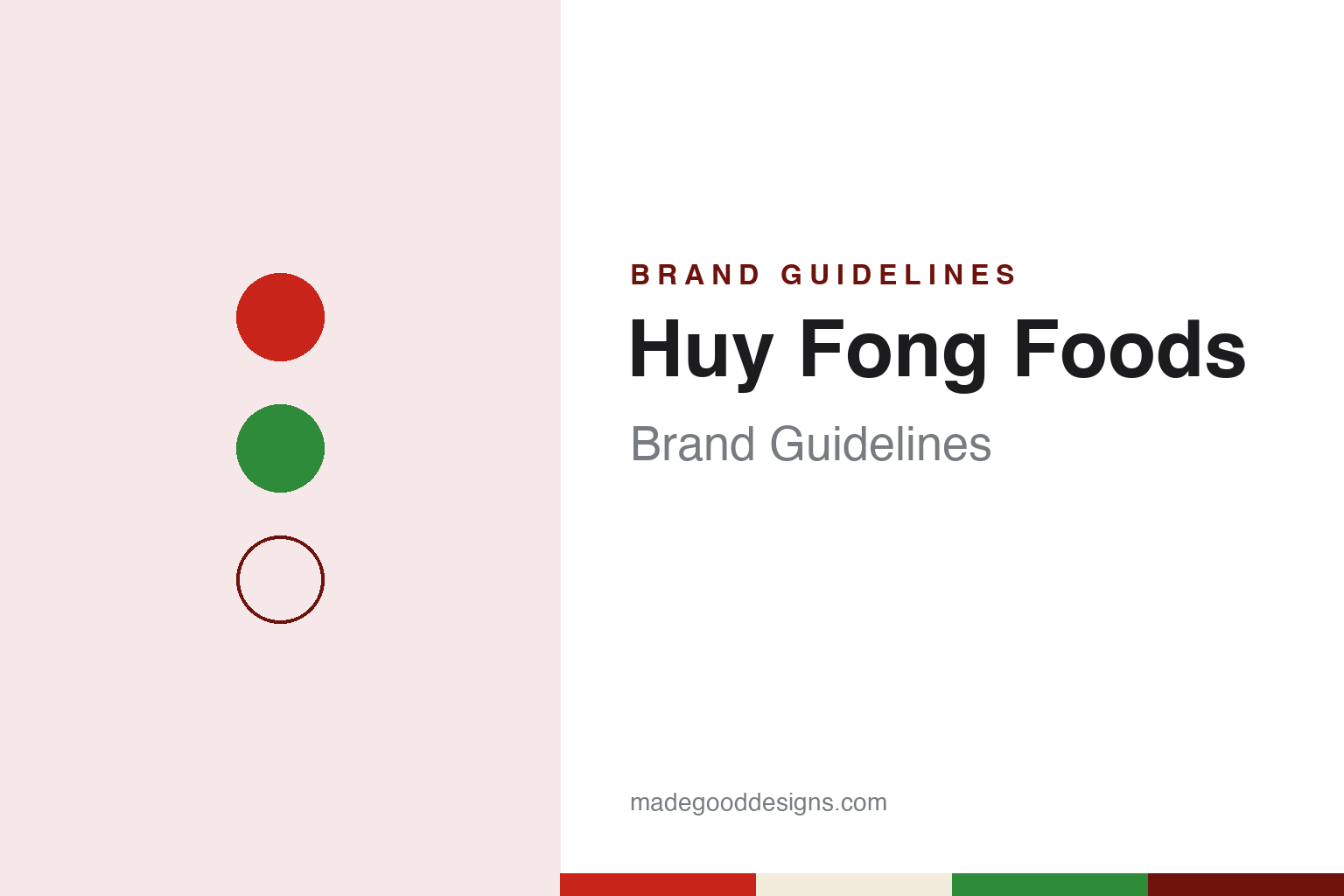
Huy Fong Foods Brand Guidelines
A refugee’s chili sauce company, still run by his family.
Aa
Two constants: a chili red, cap green and label cream palette and a bold rounded sans register. Abstract homage — not a Huy Fong Foods product or mark; no bottle, rooster or label is reproduced.
A freighter and a bucket
From an army kitchen in Vietnam to a van in Chinatown.
Huy Fong Foods is the company behind the hot sauce that most Americans picture when they hear the word sriracha, and its founder’s story is part of the brand. David Tran was a major in the South Vietnamese army, the Los Angeles Times reported in 2013, and he began making hot sauce in Vietnam in 1975, according to the company’s website and court papers cited by NBC News in 2019. After the communist victory he left the country with his family. The New York Times reported in 2009 that he arrived in Boston in 1979 before moving on to Los Angeles.
The company’s name is a souvenir of that journey. Tran named Huy Fong Foods after the Taiwanese freighter that carried him out of Vietnam, the Los Angeles Times said. He incorporated the business in February 1980, Inc. magazine reported, and started it in Los Angeles’ Chinatown. Unable to find either a job or a hot sauce he liked, Tran made his own by hand in a bucket, bottled it and drove it to customers in a van, the Times reported. The sauce spread first through the San Gabriel Valley and then across the country, the paper said.
The best-known of those sauces is his sriracha, which Tran introduced a few years after founding the company. It is his version of a hot sauce that originated in the town of Si Racha, in Thailand, and because the name belongs to a place, the company cannot trademark it, the Los Angeles Times noted in 2013. The paper counted many copycats and competitors as a result, from a New York rival with a yellow cap to sriracha-flavoured snacks. Our separate Sriracha guide looks at that bottle in detail; this guide is about the company.
The emblem is a rooster. Tran was born in the Year of the Rooster in the Chinese zodiac, The New York Times and the Los Angeles Times both reported, and the bird on the label is his sign. The sauce comes in a clear squeeze bottle with a green cap, a combination the Los Angeles Times called distinctive in 2013, and fans have long called it “rooster sauce.”
Colour
Three sauces, two towns and no advertising.
Huy Fong has kept its range short on purpose. Tran told the Los Angeles Times in 2013 that he had no interest in branching out beyond sriracha and two other sauces, Chili Garlic and Sambal Oelek, and the company’s website still lists exactly those three. Sriracha-branded snacks and gadgets sold elsewhere are made by others. His guiding principle, he told the paper, was to “make a rich man’s sauce at a poor man’s price,” and he refused advice to soften the heat or add a tomato base. “Hot sauce must be hot,” he said.
Nor has the company bought attention. Huy Fong Foods “has never spent a dollar on advertising,” the Los Angeles Times reported in 2013, and the BBC described the sauce’s rise later that year as a word-of-mouth success. Recognition came from the food press instead: English Wikipedia, citing Bon Appétit, says the magazine named Huy Fong’s sriracha its Ingredient of the Year for 2010.
The sauce is made in the Los Angeles area. From the late 1980s the company operated out of two buildings in Rosemead, in the San Gabriel Valley, the Los Angeles Times said. In 2013 it was moving into a 655,000-square-foot factory and headquarters in Irwindale, a few miles east, which could triple its capacity. The new plant soon met resistance. In October 2013 the city of Irwindale sued the company, saying odours from chili grinding were a public nuisance, NPR reported; in November a Los Angeles Superior Court judge ordered a partial shutdown, the Los Angeles Times reported. The city dropped the lawsuit on 29 May 2014, after a meeting arranged with help from the office of California’s then governor, Jerry Brown, the Times reported. That year the company opened the factory to visitors, and Forbes reported in September 2014 that the tours had made it a tourist attraction.
Typography
Design and documentation.
The seven brands in this group are pantry, sauce, snack and cultured-drink names from Japan, China, South Korea and the United States: Yakult, Calpis, Kewpie, Lao Gan Ma, Huy Fong Foods, Ottogi and Pocky. Asian pantry and drink brands in general sit at many different points in the trade, from family firms that still carry a founder’s name to product names that belong to much larger food groups, and a single brand can be sold everywhere from a neighbourhood grocer to a supermarket shelf on another continent.
A pantry or drink brand’s identity is usually carried less by a single recipe than by a bottle, a jar, a box and the name printed on it, because the company behind the name may have changed hands, licensed its product abroad or grown far beyond the city where it started. That makes the questions behind each name worth asking plainly: who started it, who owns it now, and where its products are actually made and packed.
Each guide separates what independent sources record from what the company says about itself — its founding story, its owners over time, where its products are made and how its packaging has changed — and marks plainly what rests only on the company’s own word.
Aa
A bold rounded sans for a sauce that sells on its bottle. (Specimen set in Rubik, a sans STAND-IN; NOT the Huy Fong Foods logo.)
Huy Fong Foods
A supplier, a court case and the shortages.
For most of its life Huy Fong depended on one farm. In 1988 it contracted with Underwood Ranches, a grower in Ventura County, to buy 500 tons of jalapeños, the start of a relationship that lasted 28 years, according to the California Court of Appeal’s published opinion of July 2021. By 2006, the court said, Underwood was growing 95% of Huy Fong’s peppers. The partnership broke down over the 2017 harvest. Huy Fong sued Underwood in August 2017 over what it said was an overpayment from the 2016 season, and Underwood filed a countersuit in February 2018, NBC News reported. In 2019 a unanimous jury found for the farm on its claims of breach of contract and fraud and awarded $23.3 million, made up of $13.3 million in compensatory and $10 million in punitive damages. The Court of Appeal affirmed the judgment in 2021.
The years after the split brought gaps on the shelf. In June 2022 Huy Fong told customers it was halting production for some months because of a severe shortage of chili peppers, which it attributed to weather conditions, CNN and Bloomberg reported. Production resumed later in 2022, but in April 2023 the company announced another “unprecedented inventory shortage,” and in May 2024 it said it was pausing production until at least September because of problems with its pepper supply, USA Today and The New York Times reported.
Through all of it the company has stayed in the family. Tran said in 2013 that he had turned down several offers to buy the business and repeated requests to sell shares, and that he meant to keep it a family business; his son is president and his daughter vice president, the Los Angeles Times reported. English Wikipedia names them as William Tran and Yassie Tran-Holliday. The company remains privately held, with its head office and factory in Irwindale.
For a design guide, Huy Fong Foods shows how a company can let one bottle, one bird and one colour of cap do the work that advertising does for others. Compare Sriracha, our guide to the sauce itself, and Tapatío, another Southern California hot sauce. For this guide we use a chili red, a cap green and a label cream with a bold rounded sans, an unofficial interpretation; no product or logo is reproduced.
Explore & save
Keep Huy Fong Foods’s identity on hand — save it to a board in the Made Good inspiration library.
Huy Fong Foods identity set
Pin the Huy Fong Foods chili red, cap green and label cream palette and the bold rounded sans register to your own board.