Libby’s Brand Guidelines
The Chicago canner whose name is now split four ways.
Aa
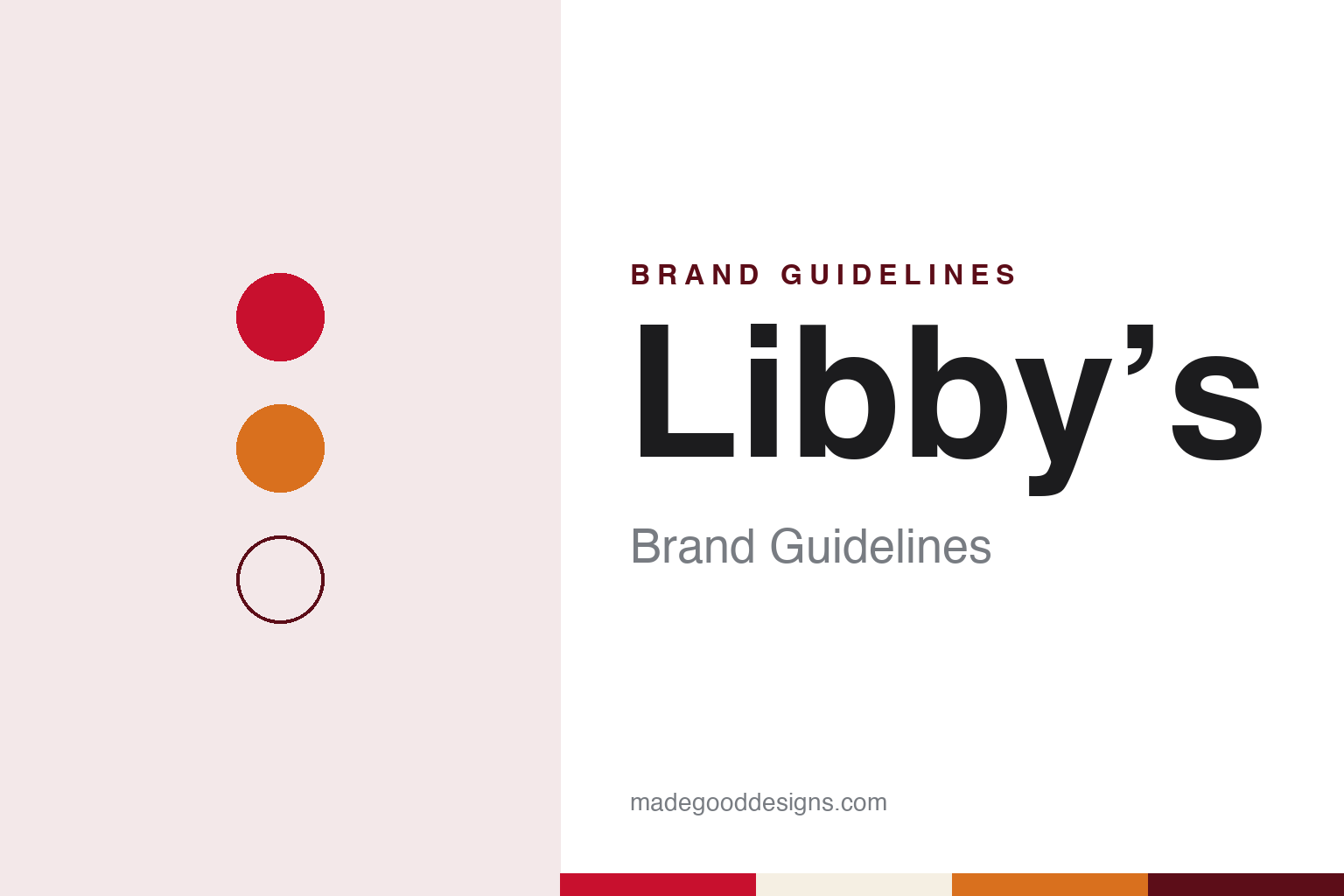
Two constants: a label red, pumpkin orange and cream palette and a label serif register. Abstract homage — not a Libby’s product or mark; no can, logo or label is reproduced.
Beef in brine
Two brothers, a partner and a can with sloping sides.
Libby’s began in the stockyards. The firm Libby, McNeill & Libby was started in Chicago by Archibald McNeill and the brothers Arthur and Charles Libby, who sold beef packed in brine. The Encyclopedia of Chicago dates the company to 1868; the brand’s present owner, in its own history, says 1869, so the two accounts differ by a year. Both agree on what made the name. In 1875 the company began canning its meat in a tapering, flat-topped tin — “pyramid-shaped,” the encyclopedia says, “trapezoid-shaped,” the company says — and the corned beef inside became its first famous product.
The business grew with Chicago meatpacking. By the 1880s, the Encyclopedia of Chicago records, it employed 1,500 people, slaughtered as many as 200,000 cattle a year at the Union Stock Yard, and sold several million dollars’ worth of canned meat annually, much of it in Europe, to civilians and soldiers alike. From 1888 to 1920 it was controlled by Swift & Co., the Chicago meatpacker, the encyclopedia says; the company’s own history puts Swift’s control “in the 1920s.” In the first years of the 20th century Libby’s moved beyond meat into canned vegetables and fruit, and by the mid-1930s it employed about 9,000 people in the Chicago area. Annual sales passed $100 million in the 1940s.
In fruit it was a brand early. Writing about the 1920s pineapple trade, the historian Richard A. Hawkins notes in The Hawaiian Journal of History that Libby, McNeill & Libby sold its Hawaiian pineapple under its own “Libby’s” brand, as California Packing Corporation sold under “Del Monte,” while the Hawaiian Pineapple Company was still packing for other people’s labels. The company says its postwar president Charles Scott Bridges, chief executive from 1953, expanded and modernised the firm, and that by 1960 it had 9,000 employees and revenues of $296 million.
Colour
A red name on a label, sold across four aisles.
The Libby’s look is a labeller’s look. The brand-holding company’s history page is mostly a gallery of old advertising: corned beef and ox tongues around 1900, evaporated milk in 1912, tomato juice in the 1930s and 1940s, juices in 1959 and a pumpkin advertisement the same year. It also shows a Libby’s corned-beef label it dates to 1870–1916 and a trademark it dates to 1919. That early habit of branding is documented elsewhere too: in the 1920s the company sold its own pineapple as Libby’s while the Hawaiian Pineapple Company was still packing for other firms’ labels.
The best-known Libby’s product in the United States now is canned pumpkin. Nestlé, which sells it, says it plants its own “LIBBY’S Proprietary Seed,” bred over generations, every May around Morton, Illinois, and that it has been in the town for more than 100 years; English Wikipedia lists a Libby’s pumpkin cannery in Morton, and the village calls itself the “Pumpkin Capital of the World,” claiming that 99 percent of the world’s canned pumpkin is produced there. The brand’s grip on the category showed in November 2009, when Libby’s warned of a canned-pumpkin shortage before Thanksgiving after poor weather on its Illinois farms, The New York Times reported. Nestlé also promotes “Our Famous Pumpkin Pie,” the recipe printed for its pumpkin.
The other Libby’s cans are made by different firms. In the US, canned vegetables and fruit under the name come from Seneca Foods, which lists a Libby’s vegetables site among its brands; canned meats such as corned beef went to ConAgra in 2000, and Conagra is named as a licensee; and the canned pineapple and tropical juices sold as Libby’s have been licensed to Niagara Trading, now NTC Marketing, since 1983. The brand-holding company in Geneva says it passes consumer enquiries on to “the licensee or packer concerned.”
Typography
Design and documentation.
The seven brands in this group are all pantry staples, and all of them come from the United States: Jell-O, Hidden Valley, Hunt’s, Del Monte, Dole, Libby’s and Skippy. American pantry brands in general sit at many different points in the trade, from names that still recall a founder or a hometown to names that now belong to much larger food groups, and a single brand can be sold everywhere from a corner store to a supermarket shelf.
A pantry brand’s identity is usually carried less by a single product than by a can, a jar, a name and the meal it promises, because the company behind the name may have changed hands, moved its factory or grown far beyond the town where it started. That makes the questions behind each name worth asking plainly: who started it, who owns it now, and where its products are actually made and packed.
Each guide separates what independent sources record from what the company says about itself — its founding story, its owners over time, where its products are made and how its packaging has changed — and marks plainly what rests only on the company’s own word.
Aa
A label serif for a name that sold from the shelf. (Specimen set in DM Serif Display, a serif STAND-IN; NOT the Libby’s logo.)
Libby’s
Nestlé, then the break-up, dated.
The company kept its independence for a century. Nestlé of Switzerland bought Libby, McNeill & Libby in 1970, the Chicago Tribune reported; by then, the Encyclopedia of Chicago says, it had annual sales of close to $500 million and about 1,300 workers in the Chicago area. Under Nestlé the Libby’s name also went on Juicy Juice, launched in 1977, which Nestlé sold to Harvest Hill Beverage, a Brynwood Partners company, in 2014.
The break-up came in stages. In 1982 Libby’s canned-vegetable business went to S. S. Pierce, now Seneca Foods, and its canned-fruit business to California Canners and Growers, The New York Times reported. The fruit side passed through Tri-Valley Growers, which went bankrupt in 2000, to Signature Fruit in 2001, and Seneca bought Signature Fruit in 2006, reuniting the two under one American owner. In 1983 Niagara Trading took a long-term licence for Libby’s canned pineapple and juices, the Associated Press reported. In 1998 Nestlé sold the canned-meat business to International Home Foods, which ConAgra bought in 2000.
The name itself left Nestlé too. English Wikipedia says Nestlé sold the Libby’s trademark in 2006 to a Swiss company that became Libby’s Brand Holding, based in Geneva, which licenses it to companies around the world, Nestlé and Conagra among them; other licensees it lists include Establecimientos Industriales Archipiélago in the Canary Islands, Spain and Portugal. So a Libby’s pumpkin, a Libby’s can of peas and a Libby’s corned beef on the same American shelf can come from three different food companies, and Libby’s drinks and preserves abroad from others again.
For a design guide, Libby’s shows how one bold name on a label can outlive the company that printed it and keep working for many owners at once. Compare Dole, the pineapple packer that once sold under other people’s labels, and Del Monte, the other big canner’s brand of the 1920s. For this guide we use a label red, a pumpkin orange and a cream with a serif, an unofficial interpretation; no product or logo is reproduced.
Explore & save
Keep Libby’s’s identity on hand — save it to a board in the Made Good inspiration library.
Libby’s identity set
Pin the Libby’s label red, pumpkin orange and cream palette and the label serif register to your own board.