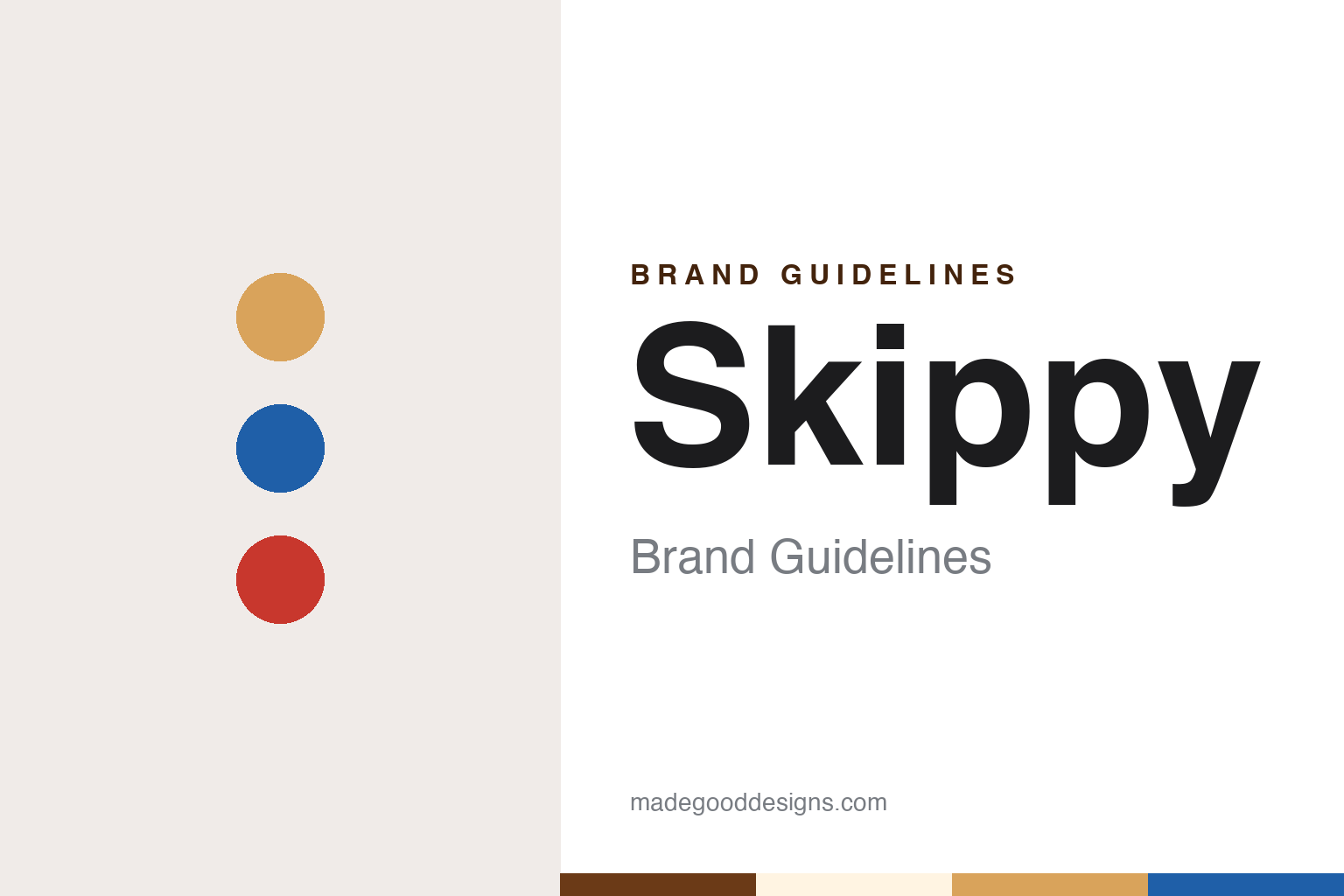
Skippy Brand Guidelines
The Alameda peanut butter with a borrowed comic-strip name.
Aa
Two constants: a roast, peanut and Alameda blue palette and a friendly slab-serif register. Abstract homage — not a Skippy product or mark; no jar, label or logo is reproduced.
From Alameda to the trademark office
A food packer, a new process and a borrowed name.
Skippy began in Alameda, California, across the bay from San Francisco, at the Rosefield Packing Company of the food packer Joseph L. Rosefield. The brand’s own history timeline, as it stood on its website in 2012, says that in 1923 Rosefield perfected a process to stop the oil in peanut butter from separating. English Wikipedia describes the method as partially hydrogenating the peanut oil so that it stayed mixed with the ground peanuts, which also let the butter be churned to a creamy texture; the company says a patent for making peanut butter was issued to Rosefield Packing in 1946.
The brand name came later. Rosefield first sold peanut butter under the Skippy name in 1932, the year Hormel Foods and The New Yorker give for the brand’s introduction, and the old company timeline says the chunk-style version arrived in the same year as that first use. The name was not his own invention. Skippy was the title of Percy Crosby’s comic strip, which ran from 1923 to 1945, English Wikipedia says; the comics historian Brian Cronin, writing for Comic Book Resources in 2009, says it began in the humour magazine Life. English Wikipedia notes that the strip was adapted into a 1929 novel, a children’s radio serial and the 1931 film Skippy, which won an Academy Award.
Crosby had registered Skippy as a trademark in 1925 for merchandise other than peanut butter, the law firm Foley Hoag’s trademark blog wrote in 2014. When Rosefield tried to register the name for peanut butter in 1933, the same blog says, Crosby successfully opposed the application; English Wikipedia dates the invalidation to 1934. Rosefield kept selling under the name, and the company timeline says Rosefield Packing obtained trademark registrations for Skippy peanut butter in all 48 states and Hawaii between 1933 and 1944. A federal registration followed after Congress passed the Lanham Act in 1946: Foley Hoag and Comic Book Resources date it to 1947, while the company’s own timeline gives 1948.
Colour
A wide-mouth jar, new plants and a corporate chain.
Packaging was part of the story early. The company timeline says the wide-mouth jar was first used for Skippy in 1935, and English Wikipedia credits Rosefield Packing with introducing the cylindrical wide-mouth jar for peanut butter that year. Production spread beyond California, to Minneapolis in 1940 and Portsmouth, Virginia, in 1945, the company says, and in 1946 the brand began sponsoring a radio programme, Skippy Hollywood Theater, which the company says ran for eleven years.
In 1955 The Best Foods, Inc., the mayonnaise maker, acquired Rosefield Packing and the Skippy brand, English Wikipedia and the company timeline both say; Jon Krampner’s history of peanut butter, Creamy and Crunchy (Columbia University Press), records the same sale. Production began at the Best Foods plant in Dallas in 1956. Under its new owner, the company says, Skippy sponsored the television shows Dennis the Menace from 1960 and You Asked For It for eight years, and in 1963 Norman Rockwell created illustrations for the brand.
The owner itself kept changing. English Wikipedia says Best Foods was acquired in 1958 by the Corn Products Refining Company, which became CPC International; in the late 1990s CPC spun off its corn-refining business and renamed itself Bestfoods, and in 2000 Bestfoods was bought by Unilever. Throughout, the name remained contested. Crosby’s daughter, Joan Crosby Tibbetts, pursued claims on behalf of his estate. Foley Hoag records that she sued CPC for trademark infringement in federal court in Virginia in 1980, where judgment went to CPC, and that the US Supreme Court declined in April 2004 to hear a petition to cancel the Skippy registration. Comic Book Resources says courts pointed to the doctrine of laches — the principle that a claim can be lost by waiting too long to pursue it.
Typography
Design and documentation.
The seven brands in this group are all pantry staples, and all of them come from the United States: Jell-O, Hidden Valley, Hunt’s, Del Monte, Dole, Libby’s and Skippy. American pantry brands in general sit at many different points in the trade, from names that still recall a founder or a hometown to names that now belong to much larger food groups, and a single brand can be sold everywhere from a corner store to a supermarket shelf.
A pantry brand’s identity is usually carried less by a single product than by a can, a jar, a name and the meal it promises, because the company behind the name may have changed hands, moved its factory or grown far beyond the town where it started. That makes the questions behind each name worth asking plainly: who started it, who owns it now, and where its products are actually made and packed.
Each guide separates what independent sources record from what the company says about itself — its founding story, its owners over time, where its products are made and how its packaging has changed — and marks plainly what rests only on the company’s own word.
Aa
A warm, friendly slab serif for a brand named after a comic-strip boy. (Specimen set in Bree Serif, a serif STAND-IN; NOT the Skippy logo.)
Skippy
Little Rock, Shandong and Hormel.
Skippy’s main American plant is in Little Rock, Arkansas, where the company timeline says production began on 20 June 1977. The same timeline lists later milestones: Reduced Fat Creamy and Super Chunk spreads in 1994, advertised with the Olympic speed skater Bonnie Blair; Derek Jeter as spokesperson in 1998; and a no-stir natural spread in 2005. In late 2000, the Los Angeles Times reported in 2008, Skippy cut its standard jar from 18 to 16.3 ounces by adding a dimple to the base while keeping the jar’s height and width.
On 3 January 2013 Hormel Foods of Austin, Minnesota, the maker of Spam, announced it would buy Skippy from Unilever, CNN Money reported, adding that the sale covered factories in Little Rock and in Shandong Province, China. Hormel said on 31 January 2013 that it had closed the purchase of the United States business, including the Little Rock plant and all sales worldwide except in China, and expected to complete the China business by the end of its 2013 fiscal year. At the time Hormel described Skippy as the second-largest brand in American peanut butter, the leader in natural peanut butter and the leading brand in China, sold in more than 30 other countries. English Wikipedia, citing CBC News, says Hormel stopped selling Skippy in Canada in 2017. The brand’s website is peanutbutter.com; the address skippy.com has instead carried the Crosby family’s own account of the name.
For a design guide, Skippy shows how a pantry brand’s name can outlast a decades-long argument over who owned it, while its jar, plants and parent companies changed around it. Compare Justin’s, another American nut-butter brand, and Hellmann’s, the mayonnaise that shares Skippy’s Best Foods, CPC and Unilever history. For this guide we use a roast brown, a peanut tan and an Alameda blue with a slab serif, an unofficial interpretation; no product or logo is reproduced.
Explore & save
Keep Skippy’s identity on hand — save it to a board in the Made Good inspiration library.
Skippy identity set
Pin the Skippy roast, peanut and Alameda blue palette and the friendly slab-serif register to your own board.