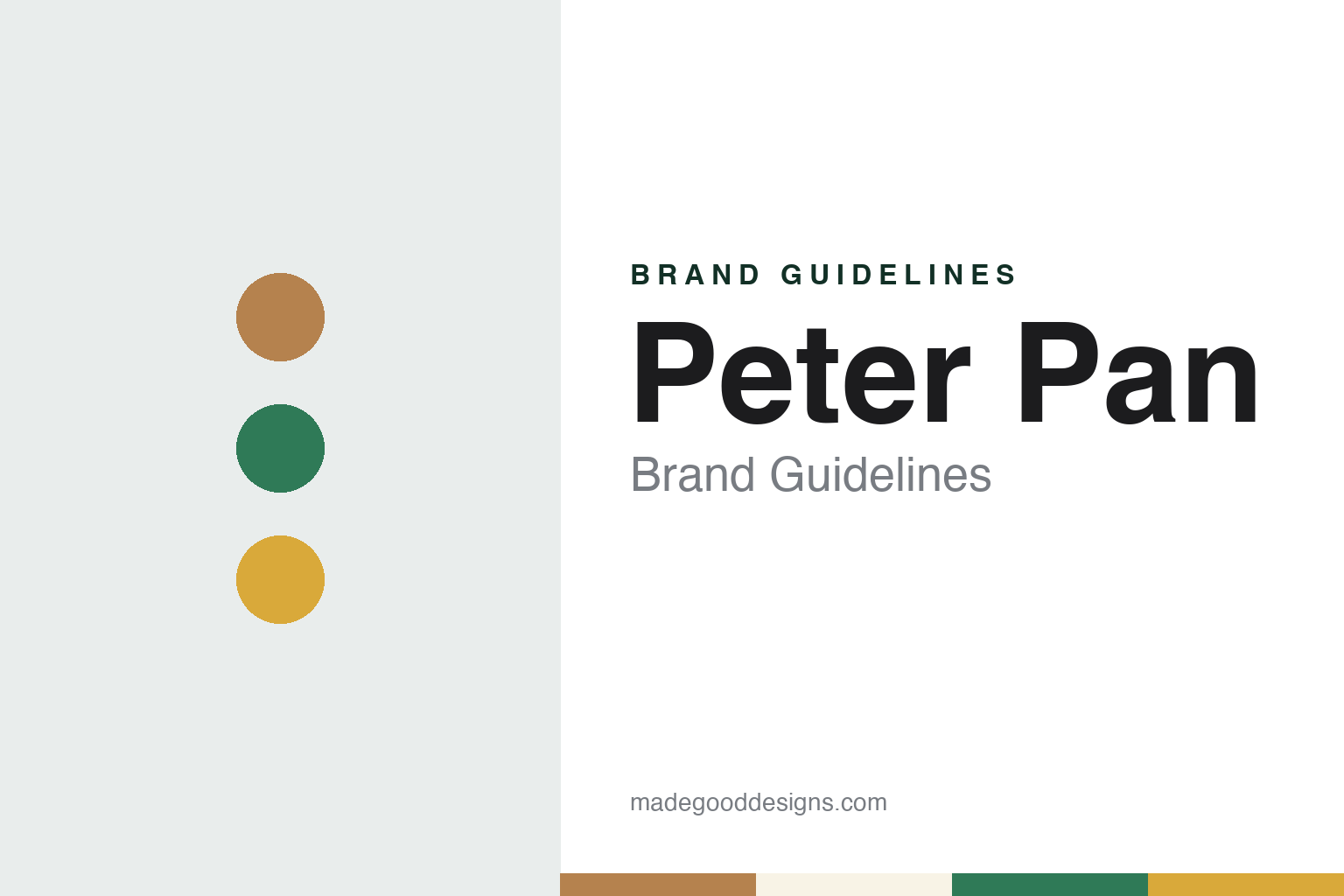
Peter Pan Brand Guidelines
The 1928 peanut butter named after the boy who never grew up.
Aa
Two constants: a peanut tan, Neverland green and pixie gold palette and a storybook serif register. Abstract homage — not a Peter Pan product or mark; no jar, label, character or logo is reproduced.
A play title
A patent, two failed names and a boy from a stage play.
Peter Pan is one of the oldest national peanut butter brands in the United States, and it took its name from the stage. English Wikipedia says the product was introduced by the meatpacker Swift & Company through its Derby Foods subsidiary, which had earlier made peanut butter under the name of the E.K. Pond Company. Pond’s peanut butters were also sold under brand names such as “Yankee” and “Toyland,” without much success.
The product that became Peter Pan rested on a technical change. In 1921 the chemist Joseph L. Rosefield patented a peanut butter made with partially hydrogenated peanut oil, which did not separate in the jar the way traditional peanut butter did. English Wikipedia says that in 1923 he licensed the patent to Derby Foods, which first sold the product as “Dainty” or “Delicia.” Neither name caught on.
The answer came from J. M. Barrie. In 1928, English Wikipedia says, Derby Foods took the title character of Barrie’s play, by then hugely popular, as its brand name, and Peter Pan peanut butter became a best seller. The New Yorker, in a 2012 history of peanut butter, is the source English Wikipedia cites for the 1928 date. Rosefield himself began making peanut butter under his own brand, Skippy, from 1932, according to English Wikipedia’s article on peanut butter. A third, Jif, followed in the 1950s, when Procter & Gamble reformulated the Kentucky-made Big Top peanut butter specifically to compete with Skippy and Peter Pan.
Colour
A turn-key tin, a woman in costume and voices from television.
The first Peter Pan packs were not jars. English Wikipedia says the peanut butter was originally sold in a tin can with a turn key and a reclosable lid, and that the packaging changed to glass jars because of metal shortages during the Second World War.
The character on the label has changed too. English Wikipedia, citing The New York Public Library Literature Companion (2001), says that in earlier versions of the product Peter Pan was clearly pictured as a woman in a Peter Pan costume rather than as a boy.
Peter Pan’s advertising leaned on familiar voices and faces. English Wikipedia lists past spokesmen including the actor Sterling Holloway, who voiced 1950s commercials; the comedian Alan Sues, who appeared in a 1972 commercial; the game show host Art James; and the actor Mark Linn-Baker.
The range today is broad but recognisable. Post Consumer Brands sells Peter Pan in creamy and crunchy styles and in Honey Roast versions, including a natural honey roast spread, and presents the brand with the lines “Spread a little more magic on your day” and “Feeding Your Imagination.” Under Conagra, the brand’s own website, archived in 2019, used the phrase “All Natural, Deliciously Magical.” English Wikipedia lists almond butters alongside the peanut butters among the varieties sold.
Typography
Design and documentation.
The seven brands in this group are all American pantry and convenience brands: Jif, Peter Pan, Kraft Mac & Cheese, Rice-A-Roni, Velveeta, Stouffer’s and Bisquick. American pantry brands in general sit at many different points in the food trade, from names that began with a single company or inventor to names that now belong to much larger food groups, and a single brand can be sold everywhere from a corner store to a national supermarket chain.
A pantry brand’s identity is usually carried less by a single recipe than by a pack, a name and the meal or shortcut it promises, because the company behind the name may have changed hands, moved its factories or grown far beyond the place where it started. That makes the questions behind each name worth asking plainly: who started it, who owns it now, and where its products are actually made and packed.
Each guide separates what independent sources record from what the company says about itself — its founding story, its owners over time, where its products are made and how its packaging has changed — and marks plainly what rests only on the company’s own word.
Aa
A storybook serif for a brand named after a character from the stage. (Specimen set in Playfair Display, a serif STAND-IN; NOT the Peter Pan logo.)
Peter Pan
Swift, Beatrice, Conagra and Post.
Peter Pan has changed hands several times as American food companies merged. English Wikipedia’s summary of its owners runs from Swift & Company (1928–1984) to Beatrice and its Hunt-Wesson business (1984–1988) and then to Conagra (1988–2021); its article on Beatrice Foods lists Peter Pan among that conglomerate’s well-known brands.
The most serious episode in the brand’s history came under Conagra. On 14 February 2007 a plant in Georgia operated by ConAgra Foods stopped production and recalled Peter Pan and some Great Value peanut butter, the store brand of Walmart, after illness in a salmonella outbreak was strongly associated with the two products, the US Centers for Disease Control and Prevention reported in its Morbidity and Mortality Weekly Report on 1 June 2007. Both were made at that single facility, and the recall covered jars with a product code beginning 2111. By 22 May 2007 the CDC counted 628 people in 47 states infected with the outbreak strain, Salmonella Tennessee, since August 2006; about one in five patients was hospitalised, and no deaths were attributed to the infection. The CDC said the source of the contamination at the plant was unknown and that peanut butter from the plant had been exported to 70 countries. Peter Pan returned to stores in late August 2007, English Wikipedia says, citing a CBS affiliate’s report at the time.
The brand’s current owner arrived more than a decade later. On 8 December 2020 Conagra announced that it would sell Peter Pan to Post Holdings, and the companies said the deal was completed on 25 January 2021, English Wikipedia says, citing their joint announcement. Peter Pan is now marketed by Post Consumer Brands, the Post division best known for breakfast cereals, and the brand’s old web address now leads to a Peter Pan page on the Post Consumer Brands site.
For a design guide, Peter Pan shows how a name borrowed from a 1920s stage hit can carry a pantry staple through tins, glass and plastic and four corporate owners. Compare Jif, the rival created to compete with it, and Justin’s, a much younger American nut butter. For this guide we use a peanut tan, a Neverland green and a pixie gold with a serif, an unofficial interpretation; no product or logo is reproduced.
Explore & save
Keep Peter Pan’s identity on hand — save it to a board in the Made Good inspiration library.
Peter Pan identity set
Pin the Peter Pan peanut tan, Neverland green and pixie gold palette and the storybook serif register to your own board.