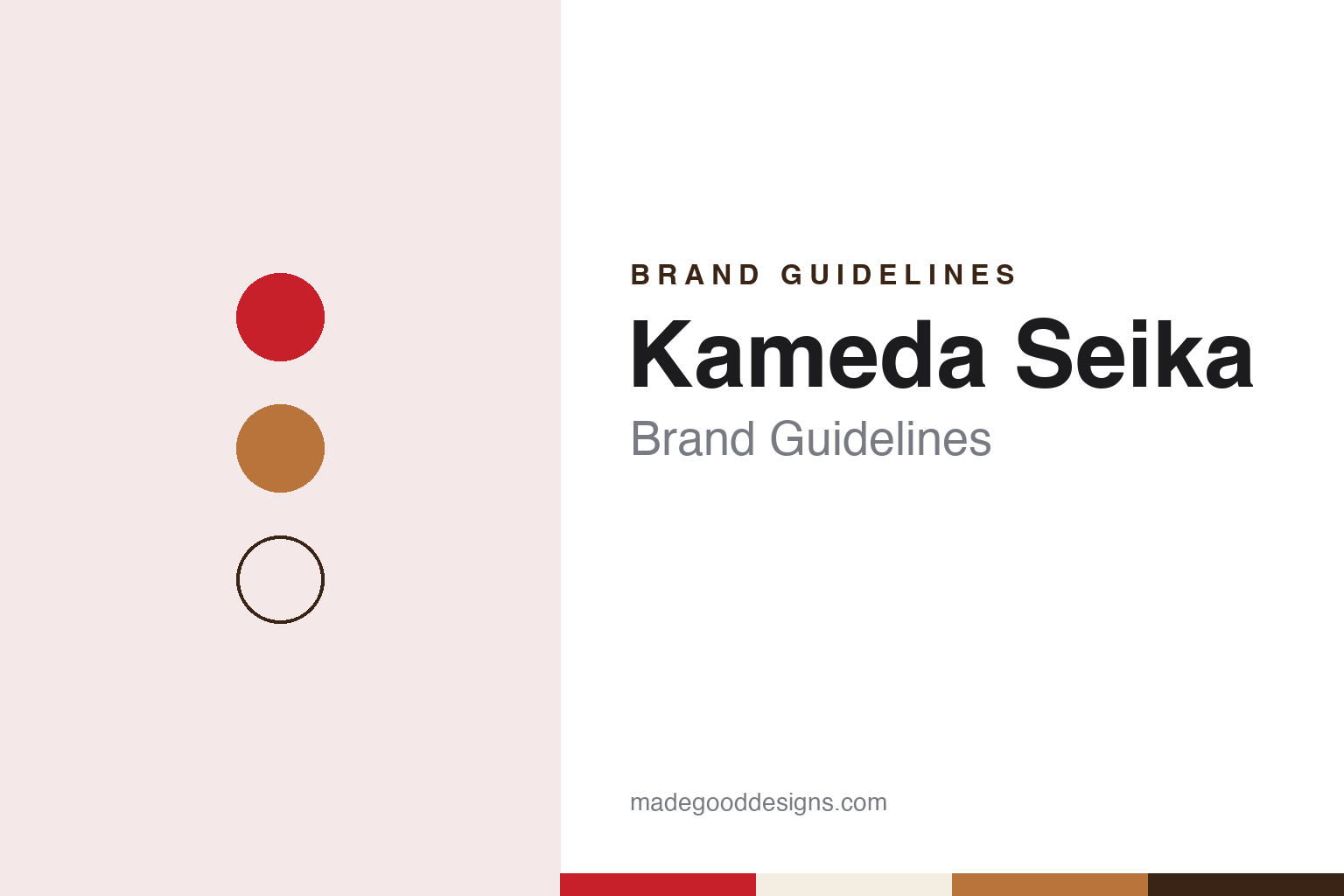
Kameda Seika Brand Guidelines
The Niigata farmers’ co-op that became a rice-cracker giant.
Aa
Two constants: a shell red, rice white and toasted amber palette and a Japanese Mincho serif register. Abstract homage — not a Kameda Seika product or mark; no pack, logo or emblem is reproduced.
The farmers’ works
Starch syrup, a cooperative and a company.
Kameda Seika began as a farmers’ venture. In September 1946, Japanese Wikipedia says, farmers in the town of Kameda, in Niigata prefecture’s Nakakanbara district, put up money together to form the Kamedagō Farmers’ Union and opened a contract-processing works in the Motomachi district, making mizuame, a starch syrup. The company’s history quotes its founder, Eiji Koizumi, looking back on that period as one of shared hardship with “only six employees.” Japanese Wikipedia, citing the 1991 Jinji Kōshinroku directory, says Koizumi, born in Niigata in 1915, founded the syrup business in 1946 and became president when it was turned into a company.
In 1950 the union became a legal body, the Kameda-machi Agricultural Products Processing Cooperative, and switched from syrup to rice crackers; the company says it made mainly baked crackers, along with mochi-rice crackers such as kaki no tane. Koizumi became head of the cooperative in 1956, and on 26 August 1957 Kameda Seika Co., Ltd. was established with the cooperative as its base. He served as president until 1983, when he became chairman and Hajime Koizumi took over as president.
Growth came quickly. The Salad Hope arare of 1961 sold in record amounts and laid the foundation for a major maker, Japanese Wikipedia says. In a 1963 statement the company still quotes, Koizumi set the aim of becoming Japan’s number one rice-cracker maker, arguing that rice crackers, unlike biscuits or chocolate, could not be made on imported plant. Sales passed ¥1 billion in 1965. With the Suibara factory in 1971 and the Shirone factory in 1976, Kameda says it became number one in domestic rice-cracker sales in 1975. It listed on the Niigata Stock Exchange in 1984, the first Niigata rice-cracker maker to do so, Japanese Wikipedia says, and moved to the Tokyo Stock Exchange when the two exchanges merged in 2000.
Colour
Kaki no tane, peanuts and a happy turn.
Kameda’s best-known product is one it did not invent. The kaki no tane, a small, slender rice cracker named for its resemblance to a persimmon seed, was created by Yosaburō Imai of Naniwaya Seika in Nagaoka, who launched it in 1925, Japanese Wikipedia says, citing Naniwaya’s own history; Shūkan Playboy News made the same point in a 2020 headline. Kameda’s contribution was the mix. In 1966 it launched peanut-filled kaki no tane, which Japanese Wikipedia calls the start of retail sales of the crackers-and-peanuts mix known as kaki-pī.
Packaging made it a best-seller. In 1977 Kameda launched Fresh Pack Kaki no Tane, with crackers and peanuts sealed in single-serving bags. Japanese Wikipedia says that until then the peanuts’ oil oxidised once a bag was opened, that portion packs kept the flavour and opened up individual and outdoor snacking, and that the product took off, with Kameda eventually accounting for more than half of kaki no tane sales. In 2017 the Japan Aerospace Exploration Agency certified Kameda’s kaki-pī as Japanese space food, the company announced. The ratio itself became a campaign: after a public vote in 2019, Kameda changed the mix in its six-bag packs from six parts crackers and four parts peanuts to seven and three in 2020, the Yomiuri Shimbun reported.
Happy Turn arrived in 1976. Japanese Wikipedia says the name came from the slump that followed the first oil shock: the hope was that happiness would “turn” back to customers. Its signature is a seasoning the company calls “Happy Powder.” Other long sellers include Obaachan no Potapota-yaki and Magari Senbei, both launched in 1986, and Nori-Pi Pack in 1989; Japanese Wikipedia calls Kameda the largest rice-cracker maker in Japan, citing the Kotobank encyclopedia.
Typography
Design and documentation.
The seven brands in this group all make snacks, sweets or food, and all of them come from Japan: Calbee, Lotte, Kracie, Bourbon, Tohato, Kameda Seika and House Foods. Japanese snack, confectionery and food brands in general sit at many different points in the trade, from firms that still carry a founder’s surname to names that now belong to much larger food groups, and a single brand can be sold everywhere from a convenience store to a supermarket shelf.
A food brand’s identity is usually carried less by a single product than by a pack, a name and the snack or meal it promises, because the company behind the name may have changed hands, moved its factory or grown far beyond the town where it started. That makes the questions behind each name worth asking plainly: who started it, who owns it now, and where its products are actually made and packed.
Each guide separates what independent sources record from what the company says about itself — its founding story, its owners over time, where its products are made and how its packaging has changed — and marks plainly what rests only on the company’s own word.
Aa
A Japanese Mincho serif for a maker that grew from a farmers’ cooperative. (Specimen set in Shippori Mincho, a serif STAND-IN; NOT the Kameda Seika logo.)
Kameda Seika
A tortoise-shell mark, an Eiffel Tower tin and Kameda Crisps.
Kameda’s design history begins with a mark. In 1965, Japanese Wikipedia says, citing the company’s history, Kameda adopted the kikkō mark, a tortoise-shell emblem in which the name “Kameda Seika” sits inside a red hexagon, to give its packaging a unified image. Advertising began in 1969 with the jingle “Kameda no arare, osenbei,” and in 1971 a television series depicting rice-growing Niigata, the “Furusato” series, won an ACC award, Japanese Wikipedia says.
Happy Turn shows how a pack can change a product’s fortunes. Japanese Wikipedia says it first went on sale in a metal tin painted with a blue silhouette of the Eiffel Tower on silver, priced slightly higher to suggest luxury, and that sales were slow until Kameda moved it into plastic bags at a lower price for ordinary shops. The brand later gained mascots — Happy-chan until 2004, Hapitan from 2004 to 2009 and Prince Turn from 2009 — and, in October 2012, a concept shop, HAPPY Turn’s, in the Hankyu Umeda department store in Osaka, followed in 2016 by TANEBITS, a kaki no tane shop in the same store.
Kameda is listed on the Prime market of the Tokyo Stock Exchange and has its head office in Kōnan ward, Niigata City, with Japanese factories at Kameda, at Suibara in Agano and at Shirone, according to the company outline cited by Japanese Wikipedia. Abroad it set up a subsidiary in Qingdao, China, in 2003, and Kameda USA in California in 2008, which test-sold kaki no tane as “Kakinotane” before renaming it Kameda Crisps to make it easier to say, Japanese Wikipedia says. According to the company history, Kameda bought the American cracker maker Mary’s Gone Crackers in 2012 and sold it in 2025, the year it also made TH Foods, formerly Sesmark Foods and a partner since 1989, a wholly owned subsidiary. In June 2022 Lekh Raj Juneja, who came to Japan from India in 1984, became chairman and CEO, the first India-born chief executive in the rice-cracker industry, Japanese Wikipedia says, citing Nikkei Business.
For a design guide, Kameda Seika shows how a farmers’ syrup works became a national brand through a red hexagonal mark, a portion pack and a well-named cracker. Compare Calbee, the Japanese snack maker, and Kikkoman, the Japanese soy-sauce maker. For this guide we use a shell red, rice white and toasted amber with a Mincho serif, an unofficial interpretation; no product or logo is reproduced.
Explore & save
Keep Kameda Seika’s identity on hand — save it to a board in the Made Good inspiration library.
Kameda Seika identity set
Pin the Kameda Seika shell red, rice white and toasted amber palette and the Japanese Mincho serif register to your own board.