MDH Brand Guidelines
The Sialkot spice shop that put its owner on every pack.
Aa
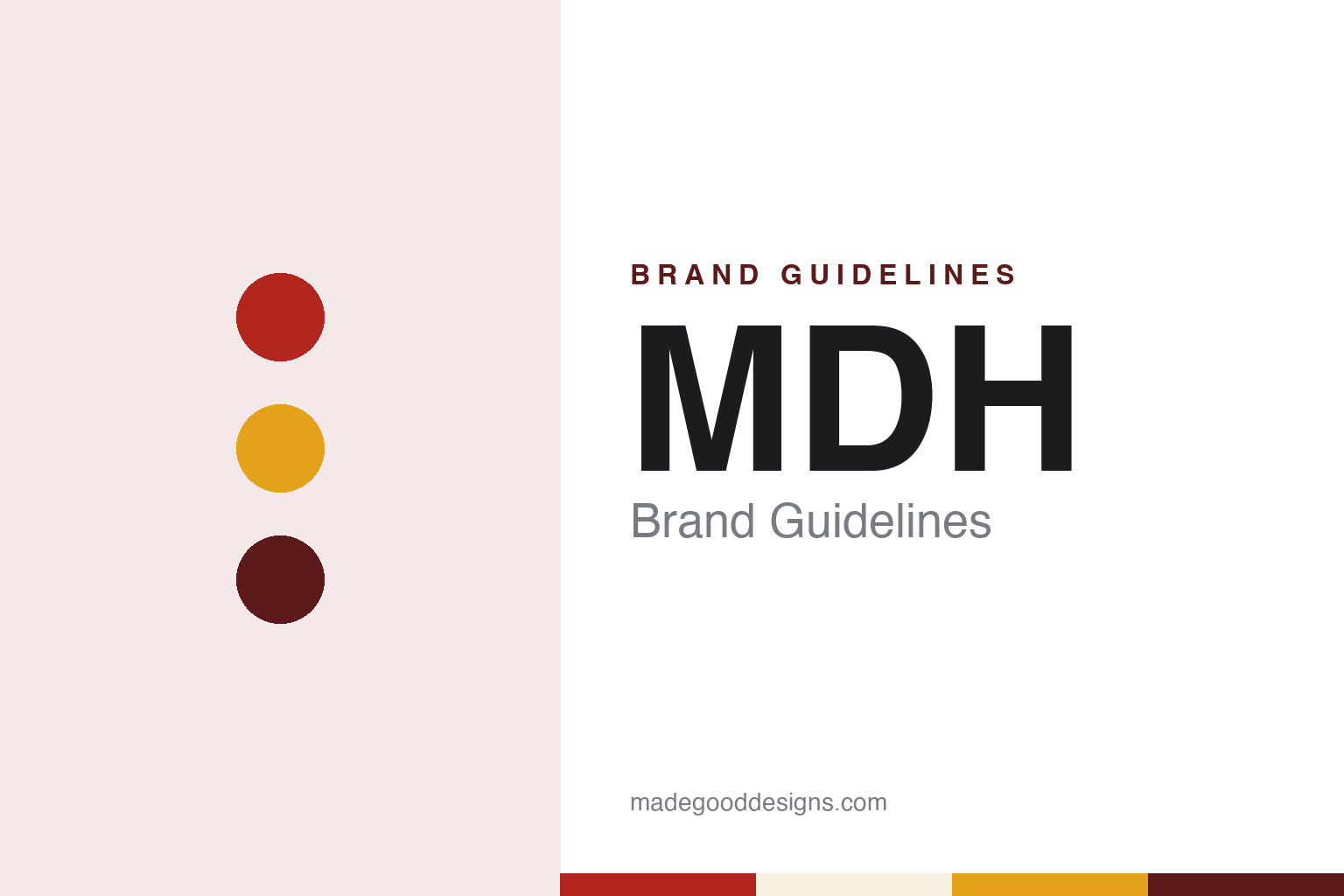
Two constants: a chilli red, turmeric and deep maroon palette and a bold display serif register. Abstract homage — not an MDH product or mark; no pack, logo or portrait is reproduced.
Mahashian Di Hatti
A shop in Sialkot, Partition and a new start in Karol Bagh.
MDH stands for Mahashian Di Hatti, a name that the Economic Times translated in 2009 as “the respected man’s shop.” Mahashay is an Indian honorific for a gentleman. The shop it names was a spice business that Mahashay Chunnilal Gulati set up in 1919 in Sialkot, then in British India’s Punjab province and since 1947 in Pakistan, the Economic Times reported. Forbes India wrote in 2020 that the shop was popularly known as “Deggi Mirch Wale.”
Chunnilal’s son Dharampal Gulati left school in 1933, at the age of ten, and tried a run of trades before joining his father in the spice shop, Forbes India reported. In a book of Partition memories by Mallika Ahluwalia, Divided by Partition: United by Resilience, he recalled expanding the business to Lahore, Sheikhupura, Nankana Sahib, Lyallpur and Multan.
Partition ended that. In 1947 the family left Sialkot, passed through a refugee camp in Amritsar and reached Delhi, where Gulati joined his sister. He bought a tonga, a horse-drawn carriage, and drove passengers between New Delhi railway station, Qutab Road and Karol Bagh, Forbes India said. In 1948 he used his savings to buy a small wooden shop in Karol Bagh and restarted the family business under the old name, as Mahashian Di Hatti of Sialkot; the Economic Times also dates that Karol Bagh hatti to 1948. By 1953 a second shop had opened in Chandni Chowk.
The move from shop to factory came in 1959, when Gulati bought land in Kirti Nagar, in west Delhi, and began making ground spices on a large scale, according to Forbes India and The Wall Street Journal’s India blog. Most households then ground their own spices; MDH, in a 2018 annual report quoted by Forbes India, said it had “visualized the concept of ready to use ground spices.” The business was incorporated in 1965, Forbes India reported, under the initials that became the brand: MDH.
Colour
A face on the pack, and an agency of its own.
MDH is best known for one design decision: putting its owner on the packet. Gulati told the Economic Times in 2009 that when he moved into packaged spices, which many shoppers then distrusted because they preferred spices freshly ground, he decided to stamp his own face on the packaging to vouch for the quality, “a practice that continues to date,” the paper wrote. Forbes India described the image used on the packs and in the advertising: a turban, a hooked moustache, glasses and a pearl necklace.
He was in the advertising too. The Economic Times noted in 2009 that the octogenarian Gulati appeared in every MDH television commercial, from blessing a married couple to posing regally on a horse carriage, and quoted him calling himself the brand’s “exclusive brand ambassador.” His earliest advertising was in print: Forbes India and the Economic Times both say his first notices ran in the Delhi newspaper Pratap in the shop’s early years. Before MDH became the umbrella name, he sold spices under names such as Pal di Mirch and Pal di Haldi, the Economic Times reported.
MDH told the Economic Times in 2009 that it had never hired an advertising agency. “All our advertising, promotional, packaging, designing work is done in house,” Gulati said, adding that this helped protect the brand names from misuse and kept the quality of the packing under watch. The company’s website today carries the line “Asli masale sach sach, MDH MDH,” roughly “real spices, truly, MDH MDH,” written in Devanagari script.
Brand consultants credited the approach. Jagdeep Kapoor of Samsika Marketing Consultants told Forbes India in 2020 that Gulati became “one of the most endearing and likeable brand ambassadors,” and argued that the grandfatherly figure set MDH apart from competing brands. In 2017 the Economic Times reported that Gulati, then 94, was the highest-paid chief executive in India’s fast-moving consumer goods sector. He received the Padma Bhushan, India’s third-highest civilian honour, in 2019.
Typography
Design and documentation.
The seven brands in this group all sell food, and all of them come from India: MDH, Everest, Haldiram’s, Amul, Parle, Britannia and MTR. Indian food brands in general sit at many different points in the trade, from family firms that still carry a founder’s name to names that now belong to much larger groups, and a single brand can be sold everywhere from a neighbourhood shop to a supermarket shelf abroad.
A food brand’s identity is usually carried less by a single product than by a pack, a name and the meal or snack it promises, because the company behind the name may have changed hands, moved its factories or grown far beyond the town where it started. That makes the questions behind each name worth asking plainly: who started it, who owns it now, and where its food is actually made and packed.
Each guide separates what independent sources record from what the company says about itself — its founding story, its owners over time, where its products are made and how its packaging has changed — and marks plainly what rests only on the company’s own word.
Aa
A bold display serif for a brand built on a founder’s portrait. (Specimen set in Rozha One, a serif STAND-IN; NOT the MDH logo.)
MDH
A family company after its famous face.
MDH remains a private company, Mahashian Di Hatti Pvt. Ltd., run by the Gulati family. Dharampal Gulati died in Delhi on 3 December 2020, The Hindu, the Economic Times and Forbes India reported; Forbes India wrote that his son and six daughters looked after the business. English Wikipedia says his son Rajeev Gulati took over the company and has since appeared as the face of the brand, and the company’s website names Rajeev Gulati as a director. In March 2022 MDH denied reports that it was selling the business to Hindustan Unilever, Business Standard reported. The company’s website now lists its head office in Gurugram, in Haryana, next to Delhi.
Production has grown well beyond Kirti Nagar. Forbes India said in 2020 that MDH had 18 manufacturing facilities; the company’s website today describes five advanced manufacturing plants, where raw spices sourced from growing regions are cleaned, dried, tested and ground on automatic machinery. It says it offers 90 products in more than 150 pack options and exports to the United States, Canada, the United Kingdom, Europe, Southeast Asia, Japan, the UAE and Saudi Arabia. Its range runs from ground single spices such as turmeric to blends for classic dishes, and in 2009 the Economic Times reported that it had also branched into incense sticks, hing and tooth powder.
In April 2024 Hong Kong suspended sales of three MDH spice mixes and one made by Everest over suspected elevated levels of ethylene oxide, a fumigant, and Singapore recalled the Everest mix, the BBC reported; the US Food and Drug Administration said it was gathering information, and India’s Spices Board began inspecting the companies’ plants. By May 2024 both brands insisted that their products were safe, the BBC reported.
For a design guide, MDH shows how a founder’s portrait, repeated on every pack and in every advertisement for decades, can become the brand itself. Compare Everest, its Mumbai rival, and Patak’s, another family spice business with Indian roots. For this guide we use chilli red, turmeric and a deep maroon with a bold display serif, an unofficial interpretation; no product or logo is reproduced.
Explore & save
Keep MDH’s identity on hand — save it to a board in the Made Good inspiration library.
MDH identity set
Pin the MDH chilli red, turmeric and deep maroon palette and the bold display serif register to your own board.