Dole Brand Guidelines
The pineapple name stamped on a can top in 1927.
Aa
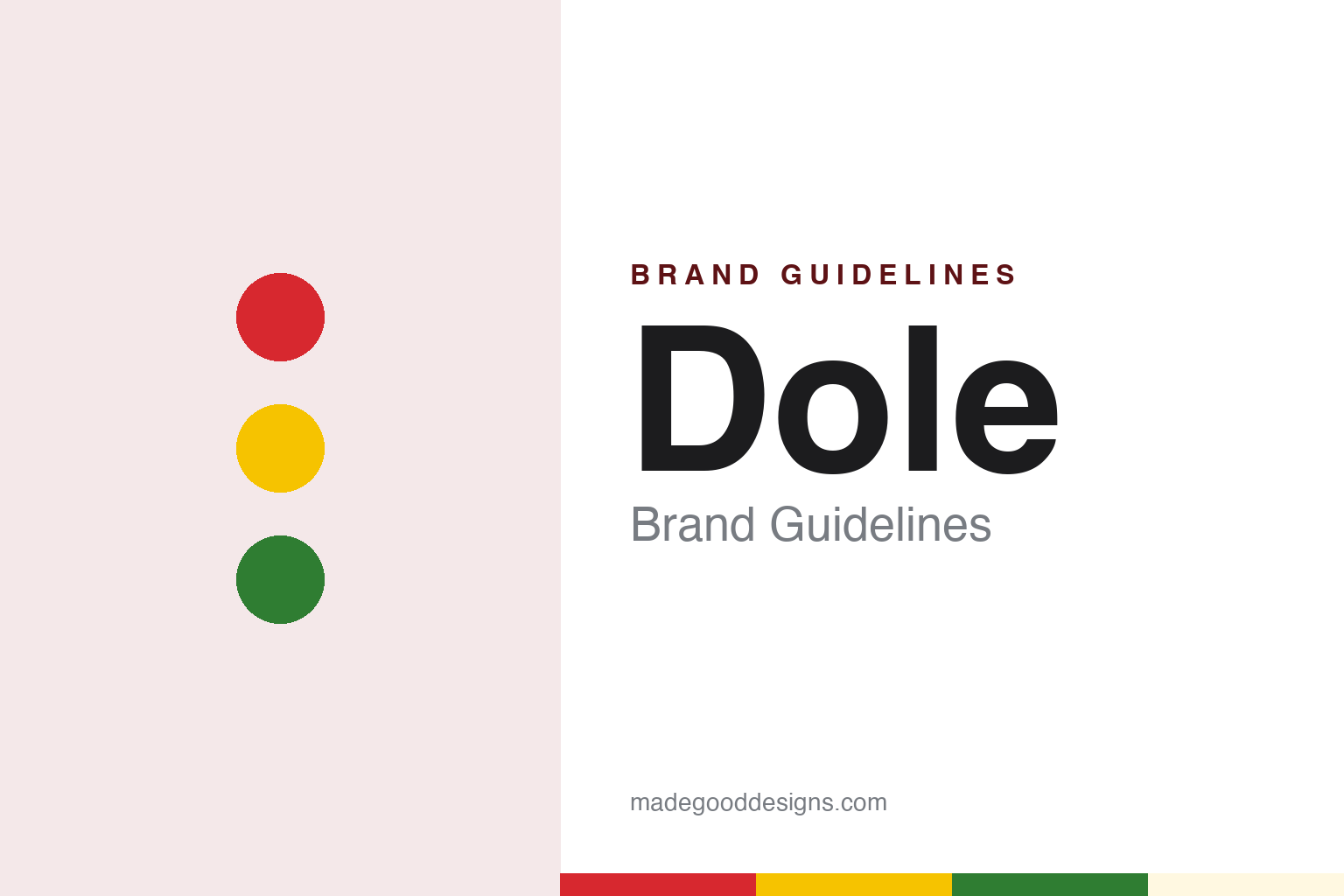
Two constants: a red, sunburst yellow and leaf green palette and a bold rounded sans register. Abstract homage — not a Dole product or mark; no pack, logo or label is reproduced.
The Hawaiian Pineapple Company
A Massachusetts graduate, a homestead and a tin can.
The name on the can is a person’s. James Drummond Dole came to the Hawaiian Islands from Massachusetts in late 1899, the historian Richard A. Hawkins wrote in The Hawaiian Journal of History in 2007, meaning to grow coffee on a homestead settlement. Coffee did not pay, so he turned to pineapples, and because fresh fruit spoiled on the voyage to the mainland he decided to process it first. Where a neighbour put his fruit up in glass, Dole chose tin cans. He founded the Hawaiian Pineapple Company in 1901; the company today dates his first plantings to that year at Wahiawa, on Oahu. Hawkins notes that Dole had to raise his capital outside Hawaii, from investors including the San Francisco firm Sussman & Wormser and men from Hunt Brothers Packing of Santa Rosa, because the islands’ sugar-rich business establishment was sceptical that pineapple canning would work.
For its first quarter-century the company sold almost nothing under its own name. When the Panic of 1907 hit demand, Dole led the growers into a cooperative advertising campaign on the mainland; the company now calls its 1907 magazine advertisements one of the first nationwide consumer campaigns in America. But the canners still had no brands of their own, Hawkins writes: most of their pineapple went out under wholesalers’ labels, “Sussman & Wormser” among them. The Hawaiian Pineapple Company used names such as Diamond Head, Outrigger, Hawaiian Club and Paradise Island, and in the 1920s it was the only one of the three big canners still packing for the private-label trade; its rivals, California Packing Corporation and Libby, McNeill & Libby, sold as Del Monte and Libby’s.
The factory side moved faster. The Ginaca machine, which peeled and cored pineapple, was in use from the 1910s, and in 1922 Dole bought the island of Lanai and planted it with pineapple. Output rose from 243,000 cases in 1909 to 1,775,000 in 1920, Hawkins records. The company adds that a recipe contest it held in 1925 helped popularise pineapple upside-down cake.
Colour
A name stamped in relief, three grades and a yellow sun.
The brand decision came in the 1920s. By then, Hawkins writes, the company judged it “commercially unsound” to keep selling under a scatter of labels, and in April 1927 it began its first national campaign independent of the growers’ association, with hundreds of thousands of dollars set aside over several years. The campaign rested on one device: the word “Dole,” stamped in bas-relief on the top of every can, with “Dole 1,” “Dole 2” and “Dole 3” marking the fancy, choice and standard grades. A grocer’s or wholesaler’s paper label could say anything; the lid still said Dole. Hawkins notes that California Packing Corporation had used stamped tops earlier, during the First World War boom.
The launch was loud. On 25 May 1927, four days after Charles Lindbergh reached Paris, Dole offered $25,000 to the first flyer to cross non-stop from the mainland to Honolulu; the race flew from Oakland that August. From 1929 the company ran a longer advertising programme built on the can-top idea, and on 1 November 1930 it bought newspaper space on the mainland for the first time. The company’s own timeline gives a different date for the stamp — 1933, “recognizing the popularity and quality associated with James Dole’s name” — so the two accounts differ by six years.
The modern mark is dated by the company too. It says the Dole logo was redesigned in 1986, when “the bright yellow sunburst” was chosen to signify freshness and quality. Other markers of the brand’s look and reach on the company’s timeline include the “5 A Day” programme for children in 1991 and Fruit Bowls in 1999, which it calls the first all-natural fruit snack in a plastic cup. Dole plc today also uses mascots such as Bobby Banana in comics and games for children, and by 2016 was putting Disney, Pixar, Marvel and Star Wars characters on its fruit through a licensing deal, The Washington Post reported that year.
Typography
Design and documentation.
The seven brands in this group are all pantry staples, and all of them come from the United States: Jell-O, Hidden Valley, Hunt’s, Del Monte, Dole, Libby’s and Skippy. American pantry brands in general sit at many different points in the trade, from names that still recall a founder or a hometown to names that now belong to much larger food groups, and a single brand can be sold everywhere from a corner store to a supermarket shelf.
A pantry brand’s identity is usually carried less by a single product than by a can, a jar, a name and the meal it promises, because the company behind the name may have changed hands, moved its factory or grown far beyond the town where it started. That makes the questions behind each name worth asking plainly: who started it, who owns it now, and where its products are actually made and packed.
Each guide separates what independent sources record from what the company says about itself — its founding story, its owners over time, where its products are made and how its packaging has changed — and marks plainly what rests only on the company’s own word.
Aa
A bold rounded sans for a name that was first a stamp on a lid. (Specimen set in Rubik, a sans STAND-IN; NOT the Dole logo.)
Dole
One name, two owners, dated.
James Dole lost his company. In the Depression the Hawaiian Pineapple Company lost money heavily, and in 1932 the sugar agent Castle & Cooke, a minority shareholder, forced a reorganisation: the assets, the “Dole” brand among them, passed to a new company in which Castle & Cooke held 56.25 percent, Hawkins writes, and Dole was removed as general manager that October. (The company’s timeline puts Castle & Cooke’s 1932 holding at 21 percent.) The pineapple business became a Castle & Cooke subsidiary in 1961, the company says, keeping the Dole brand; in 1968 Castle & Cooke merged with Standard Fruit, the banana shipper of the Vaccaro brothers. The businessman David H. Murdock bought Castle & Cooke in 1985 and in 1996 split off the food company as Dole Food Company, the Los Angeles Times reported. Pineapple farming on Lanai was phased out in 1992.
The name was divided in 2013. That April the Japanese trading house Itochu completed its purchase of Dole’s worldwide packaged-foods business and its Asian fresh-produce business for $1.685 billion, Food Business News reported, “including rights to the Dole brand on certain packaged food products worldwide and on certain fresh produce in Asia, Australia and New Zealand.” In the United States the packaged side trades as Dole Packaged Foods, LLC, which calls itself Dole Sunshine online and says it opened a frozen-food plant in Georgia in 2021. Murdock’s purchase of the rest of Dole Food Company, taking it private again, was completed in November 2013.
The fresh-produce company then went Irish. Total Produce, the Dublin fruit distributor descended from the McCann family’s 19th-century market, bought 45 percent of Dole Food Company in 2018, The Irish Times reported, and the two merged in 2021 as Dole plc, headquartered in Dublin and listed on the New York Stock Exchange that July; its US base is Charlotte, North Carolina. Dole’s bottled juices are made under licence by PepsiCo.
For a design guide, Dole shows how a founder’s surname, pressed into a can lid so it could survive any label, became one of the world’s produce brands. Compare Del Monte, the California Packing Corporation brand that sold Hawaiian pineapple beside it, and Libby’s, the third of the big 1920s canners. For this guide we use a Dole red, a sunburst yellow and a leaf green with a bold rounded sans, an unofficial interpretation; no product or logo is reproduced.
Explore & save
Keep Dole’s identity on hand — save it to a board in the Made Good inspiration library.
Dole identity set
Pin the Dole red, sunburst yellow and leaf green palette and the bold rounded sans register to your own board.