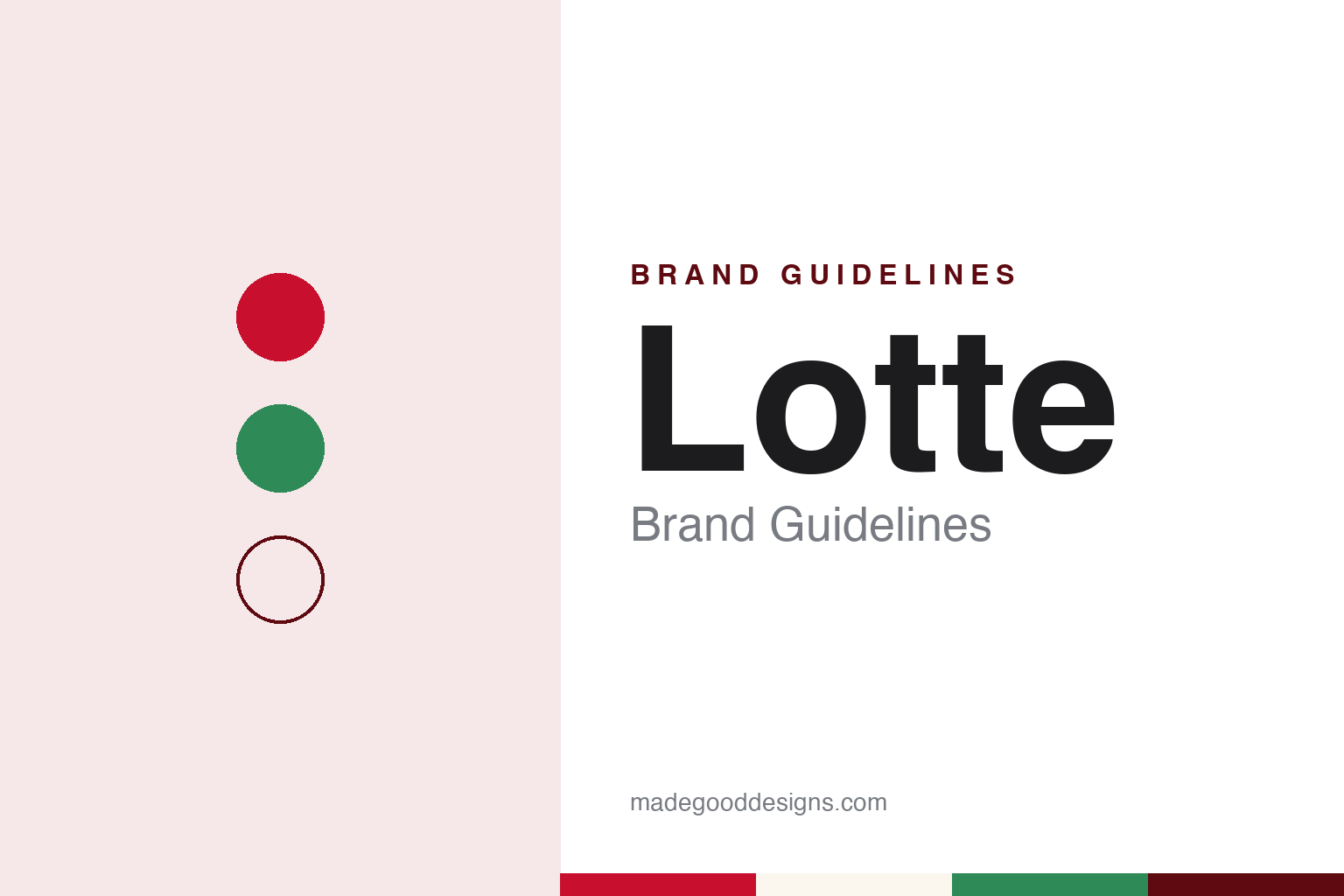
Lotte Brand Guidelines
The Tokyo gum maker named after Goethe’s Charlotte.
Aa
Two constants: a Ghana red, gum green and milk cream palette and a literary serif register. Abstract homage — not a Lotte product or mark; no pack, logo or sweet is reproduced.
Chewing gum and Charlotte
A Korean-born chemist, post-war Tokyo and a heroine from Goethe.
Lotte was born in Tokyo in June 1948 as a chewing-gum maker. Its founder was Shin Kyuk-ho, who was born in Ulsan, Korea, in 1921, went to Japan in 1941 and studied at Waseda University, and who was known in Japan as Takeo Shigemitsu, English Wikipedia says; Lotte’s own timeline names Shigemitsu as its first president. Japanese Wikipedia says that after the war he first ran a small chemical works in Tokyo’s Suginami Ward making soap and hair pomade, and moved into chewing gum before incorporating Lotte Co., Ltd. in 1948. English Wikipedia describes a company that grew from selling chewing gum to children in post-war Japan.
The name is literary. Shin admired Goethe’s 1774 novel The Sorrows of Young Werther and named the company after its heroine, Charlotte, English and Japanese Wikipedia both say; Japanese Wikipedia adds the wish that the company be loved forever, like Charlotte. The name later went back onto a chocolate: in 2018 Lotte’s “Charlotte” fresh chocolates were among four of its products to receive a Superior Taste Award from the International Taste Institute (iTQi), the company says.
Gum came first and stayed central. Lotte finished a gum factory in Shinjuku in March 1950, and its timeline credits a boxed Cowboy Gum as a hit in 1952 and a Spearmint Gum, made with natural chicle, in 1954. In 1956 it developed gum for Japan’s first Antarctic expedition, and the Antarctic and the penguin became the imagery of Cool Mint Gum, launched in June 1960. Before that, in April 1957, came Green Gum, a chlorophyll peppermint gum that the company still calls one of its longest sellers; in 2014 Lotte called its new version Green Gum’s biggest renewal in 57 years. From 1958 Lotte sponsored a long-running television song show, Lotte Uta no Album, which reached its 1,000th broadcast in 1977, the company says.
Colour
Ghana, Koala’s March and an award-winning gum pack.
Lotte moved into chocolate in February 1964. That month it completed a chocolate factory at Urawa, in Saitama, fitted with European and American machinery under the guidance of a chocolate engineer, Max Black, and launched its first chocolate, Ghana Milk Chocolate. American-style chocolate with a lighter taste was the norm in Japan then, the company says, and Ghana was conceived around the taste of Switzerland, home of milk chocolate. The bar is known for its bright red package; for Ghana’s 50th year in 2013 Lotte renewed both its recipe and its pack design. A “Mother’s Day Ghana” promotion began in May 2001 as an in-store event and became a fixture of the calendar, the company says.
Candy, ice cream and biscuits followed in the 1970s, and the 1980s brought the products that define Lotte for many Japanese children: Yukimi Daifuku, ice cream wrapped in rice cake, in October 1981; Choco Pie in 1983; and Koala’s March biscuits in March 1984. In 1988, the company says, a craze for finding the rare “eyebrow koala” spread among junior-high-school girls. In 2019 Lotte marked 35 years of both the snack and koalas in Japan by inviting the public to design 35 new koala pictures. The Bikkuriman sticker chocolate became a boom from 1985, selling up to 400 million units a year at its peak.
Packaging and advertising have won Lotte prizes. In 1993 it wrapped its head-office building in giant packs of its renewed Cool Mint and Green Gum for two weeks. A storage tin of Koala’s March biscuits received an encouragement prize at Nikkei BP’s first Smart Design Awards in 2012, and in 2017 Xylitol Gum, launched in 1997, and the Hokaron hand warmer received Good Design Long Life Design Awards. In 2018 a Xylitol Gum pack combined base designs by 20 young creators, among them the figure skater Yuzuru Hanyu, into more than two million unique designs; it won the Japan Packaging Institute’s Kinoshita Prize. A video for Kafuka candy won a bronze Cyber Lion at Cannes in 2013, the company says.
Typography
Design and documentation.
The seven brands in this group all make snacks, sweets or food, and all of them come from Japan: Calbee, Lotte, Kracie, Bourbon, Tohato, Kameda Seika and House Foods. Japanese snack, confectionery and food brands in general sit at many different points in the trade, from firms that still carry a founder’s surname to names that now belong to much larger food groups, and a single brand can be sold everywhere from a convenience store to a supermarket shelf.
A food brand’s identity is usually carried less by a single product than by a pack, a name and the snack or meal it promises, because the company behind the name may have changed hands, moved its factory or grown far beyond the town where it started. That makes the questions behind each name worth asking plainly: who started it, who owns it now, and where its products are actually made and packed.
Each guide separates what independent sources record from what the company says about itself — its founding story, its owners over time, where its products are made and how its packaging has changed — and marks plainly what rests only on the company’s own word.
Aa
A literary serif for a company named after a heroine of Goethe. (Specimen set in Noto Serif JP, a serif STAND-IN; NOT the Lotte logo.)
Lotte
One name, a Japanese company and a Korean one.
The Lotte name now covers two large business groups. In Japan, Lotte Co., Ltd. remains a Tokyo company, with its head office in Nishi-Shinjuku. In April 2007 a holding company, Lotte Holdings, was set up to oversee the Japanese group, and in April 2018 Lotte, the trading company Lotte Shoji and Lotte Ice merged to form today’s Lotte Co., Ltd., the company says. It gives its 2025 sales as ¥354.8 billion including overseas bases and group companies, and names Hideki Nakajima as president. Its main factories are at Urawa, for chocolate, and Sayama, both in Saitama; Japanese Wikipedia says gum production was concentrated at Sayama and the original Shinjuku factory closed in July 2013. Lotte has kept investing at Urawa, where a seventh factory, mainly for chocolate ingredients, was completed in 2019, and where the company says factory-tour visitors passed 250,000 that year.
The Korean side began in Seoul on 3 April 1967 as Lotte Confectionery, English Wikipedia says. It merged with Lotte Foods in 2022 and was renamed Lotte Wellfood in 2023, and it makes its own versions of Ghana chocolate, Koala’s March and Lotte gum alongside Korean lines such as Pepero. The wider group grew into hotels, retail, the Lotteria burger chain and two baseball clubs, the Chiba Lotte Marines in Japan and the Lotte Giants in Busan. English Wikipedia says a succession dispute between Shin’s two sons ended with the younger, Shin Dong-bin, leading the group.
The Japanese company has also bought confectioners. It acquired the Tokyo cake shop chain Ginza Cozy Corner and the gift-chocolate maker Mary Chocolate Company in 2008, and in September 2010 it bought all of Poland’s E. Wedel, which it calls Poland’s largest chocolate maker. Its timeline records companies set up abroad in the United States in 1978, with a factory at Battle Creek, Michigan, and later in Thailand, Indonesia, Vietnam and the Philippines. In April 2020 it set up a joint confectionery lab with the snack maker Calbee.
For a design guide, Lotte shows how a literary name, a red chocolate wrapper and a pack of koalas can carry a gum maker from post-war Tokyo across Asia. Compare Meiji, its Tokyo chocolate rival, and E. Wedel, its Polish subsidiary. For this guide we use a Ghana red, a gum green and a milk cream with a serif, an unofficial interpretation; no product or logo is reproduced.
Explore & save
Keep Lotte’s identity on hand — save it to a board in the Made Good inspiration library.
Lotte identity set
Pin the Lotte Ghana red, gum green and milk cream palette and the literary serif register to your own board.