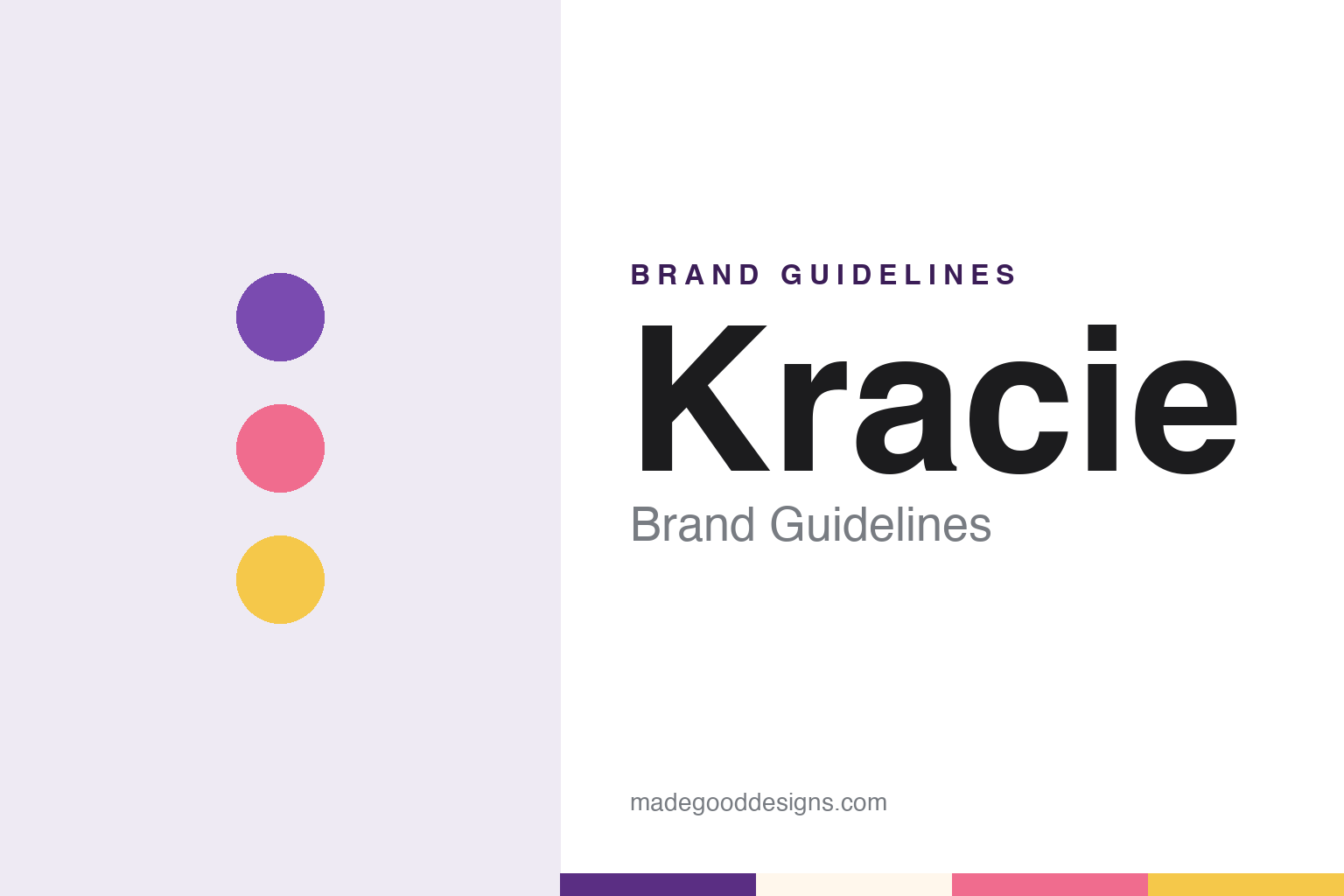
Kracie Brand Guidelines
The Kanebo food arm behind Popin’ Cookin’.
Aa
Two constants: a kit purple, rose candy and soda yellow palette and a rounded playful sans register. Abstract homage — not a Kracie product or mark; no pack, logo or sweet is reproduced.
From a spinning mill to a sweet shop
A textile giant’s food arm, a new name and a hair-colour owner.
Kracie is a young name on an old business. Its roots lie in Kanebo, which Japanese Wikipedia, drawing on the company’s own history, says began on 6 May 1887 as a cotton trading company at Kanegafuchi, in what is now Sumida in Tokyo, and grew into the spinning firm Kanegafuchi Boseki, one of the largest companies in pre-war Japan. Over the following century Kanebo spread from textiles into cosmetics, soap, medicines and food.
The food side began in 1964, when Kanebo took over Harris, an Osaka chewing-gum maker best remembered as the sponsor of the television series Harris no Kaze. Japanese Wikipedia lists the mergers that followed: Tachibana Seika in 1965, which brought ice confectionery; Izumi Seika in 1971; and in 1972 the Nagoya firm Watanabe Seika, known for its powdered juice drink. The business was called Kanebo Shokuhin from 1973, and in 1976 it launched Nonfry Tanmen, which Japanese Wikipedia describes as Japan’s first non-fried instant noodle. After years as a Kanebo division and as part of a company called Bell Foods, it was set up again as Kanebo Foods in July 1993.
The name Kracie came out of Kanebo’s collapse. Japanese Wikipedia says that the old Kanebo, by then deep in debt, transferred its household products, medicines and food businesses on 1 May 2006 to a new holding company, Kanebo Trinity Holdings, backed by three investment funds, while its cosmetics business and the Kanebo trademark went to the Kao subsidiary Kanebo Cosmetics. In 2007 the holding company and its subsidiaries took the name Kracie, and Kanebo Foods became Kracie Foods. The company says the name expresses the wish to bring brightness to people’s lives through the seasons — “towards everyday living,” or kurashi e in Japanese. For a time its advertising carried the line “Kanebo wa Kracie e,” and Japanese Wikipedia says the Kanebo name was dropped from commercials altogether when the right to use it ran out in February 2008.
Colour
Sweets you build, and a candy that smells of roses.
Kracie’s best-known foods are sweets that children make themselves, which the company groups as chiiku-gashi, or “educational confectionery” — a term Japanese Wikipedia says Kracie has registered as a trademark. The oldest is Neruneru Nerune, launched in 1986, a powder that changes colour and texture when water is stirred in. In January 2021 Kracie rebranded the whole chiiku-gashi line, saying in a press release that the sweets would now aim to build children’s confidence as well as their creativity.
The Popin’ Cookin’ range applies the same idea to miniature meals. Its kits shape and colour candy into tiny sushi, burgers, takoyaki, bento boxes or festival-stall snacks. Japanese Wikipedia dates the sushi kit to 2008 and the takoyaki kit to March 2014, and says burger and taiyaki kits first sold under a separate “Happy Kitchen” name moved into Popin’ Cookin’ in September 2017; by February 2023 the range had eight kits.
For adults, the company launched Fuwarinka in 2005, Japanese Wikipedia says. It is now a soft candy made with geraniol, an aroma compound found in roses; earlier versions included a gum and an ice. Gum itself has gone from the portfolio of a company that began with a gum maker: by the end of March 2022 Kracie had stopped selling all its gum products and left the category, the news site J-CAST reported in January 2023, citing shrinking demand. Kracie also sells other companies’ brands in Japan, taking over domestic sales of Mentos from Mondelez Japan in 2015 and of Chupa Chups from Morinaga in 2016, according to the company’s announcements. Its food factories, Japanese Wikipedia says, are at Shinmachi in Takasaki, Gunma; at Takatsuki in Osaka, where the food research laboratory shares the site; and at Fukuchiyama in Kyoto.
Typography
Design and documentation.
The seven brands in this group all make snacks, sweets or food, and all of them come from Japan: Calbee, Lotte, Kracie, Bourbon, Tohato, Kameda Seika and House Foods. Japanese snack, confectionery and food brands in general sit at many different points in the trade, from firms that still carry a founder’s surname to names that now belong to much larger food groups, and a single brand can be sold everywhere from a convenience store to a supermarket shelf.
A food brand’s identity is usually carried less by a single product than by a pack, a name and the snack or meal it promises, because the company behind the name may have changed hands, moved its factory or grown far beyond the town where it started. That makes the questions behind each name worth asking plainly: who started it, who owns it now, and where its products are actually made and packed.
Each guide separates what independent sources record from what the company says about itself — its founding story, its owners over time, where its products are made and how its packaging has changed — and marks plainly what rests only on the company’s own word.
Aa
A rounded playful sans for a maker of build-it-yourself sweets. (Specimen set in M PLUS Rounded 1c, a sans STAND-IN; NOT the Kracie logo.)
Kracie
Owned by a hair-colour maker, run as three companies in one.
Kracie did not stay with its investment funds for long. On 24 September 2009, Japanese Wikipedia says, Hoyu — an unlisted Nagoya company and Japan’s largest maker of hair colourants — announced that it would buy 60% of Kracie Holdings from the three funds, completing the deal on 30 September; it bought the remaining 40% on 30 March 2012. On 31 August 2018 the shares passed to Hoyu Holdings, a holding company set up in 2014, which made Kracie and Hoyu sister companies under one parent.
The group was then reorganised. On 1 October 2023 Kracie Holdings absorbed its three operating subsidiaries — home products, pharmaceuticals and foods — and renamed itself Kracie Co., Ltd., with a Home Products Company, a Pharmaceutical Company and a Foods Company inside one business. Japanese Wikipedia, citing the company’s March 2023 announcement, notes that the merger brought the 59-year history of the food company to an end, while a separate Kracie Foods Sales company continued. Kracie’s head office is in Minato, Tokyo, and outside food it is known for shampoos and skincare and for kampo, the Japanese adaptation of traditional Chinese herbal medicine, in which English Wikipedia names it alongside Tsumura as one of the two leading makers.
The name has taken time to reach the shelf. Japanese Wikipedia says Kracie Foods did not at first print the Kracie corporate logo on its packs after the 2007 rename, and that it began adding the logo to products launched or renewed from September 2010. The group’s corporate slogan, which accompanies the logo in advertising, has changed twice: “Taisetsu na koto. Kracie” from 2008 to 2019, and “Muchu ni nareru ashita Kracie,” roughly “a tomorrow you can lose yourself in,” from January 2020.
For a design guide, Kracie shows how a brand born from a corporate break-up can earn a public face through its products — a powder that changes colour, a candy sushi kit and a rose-scented sweet — rather than through the company name. Compare Morinaga, the Tokyo confectioner from which Kracie took over Japanese sales of Chupa Chups, and Meiji, another Tokyo maker of sweets. For this guide we use a kit purple, a rose candy pink and a soda yellow with a rounded sans, an unofficial interpretation; no product or logo is reproduced.
Explore & save
Keep Kracie’s identity on hand — save it to a board in the Made Good inspiration library.
Kracie identity set
Pin the Kracie kit purple, rose candy and soda yellow palette and the rounded playful sans register to your own board.