Pocky Brand Guidelines
Glico’s chocolate stick with a handle, sold in Europe as Mikado.
Aa
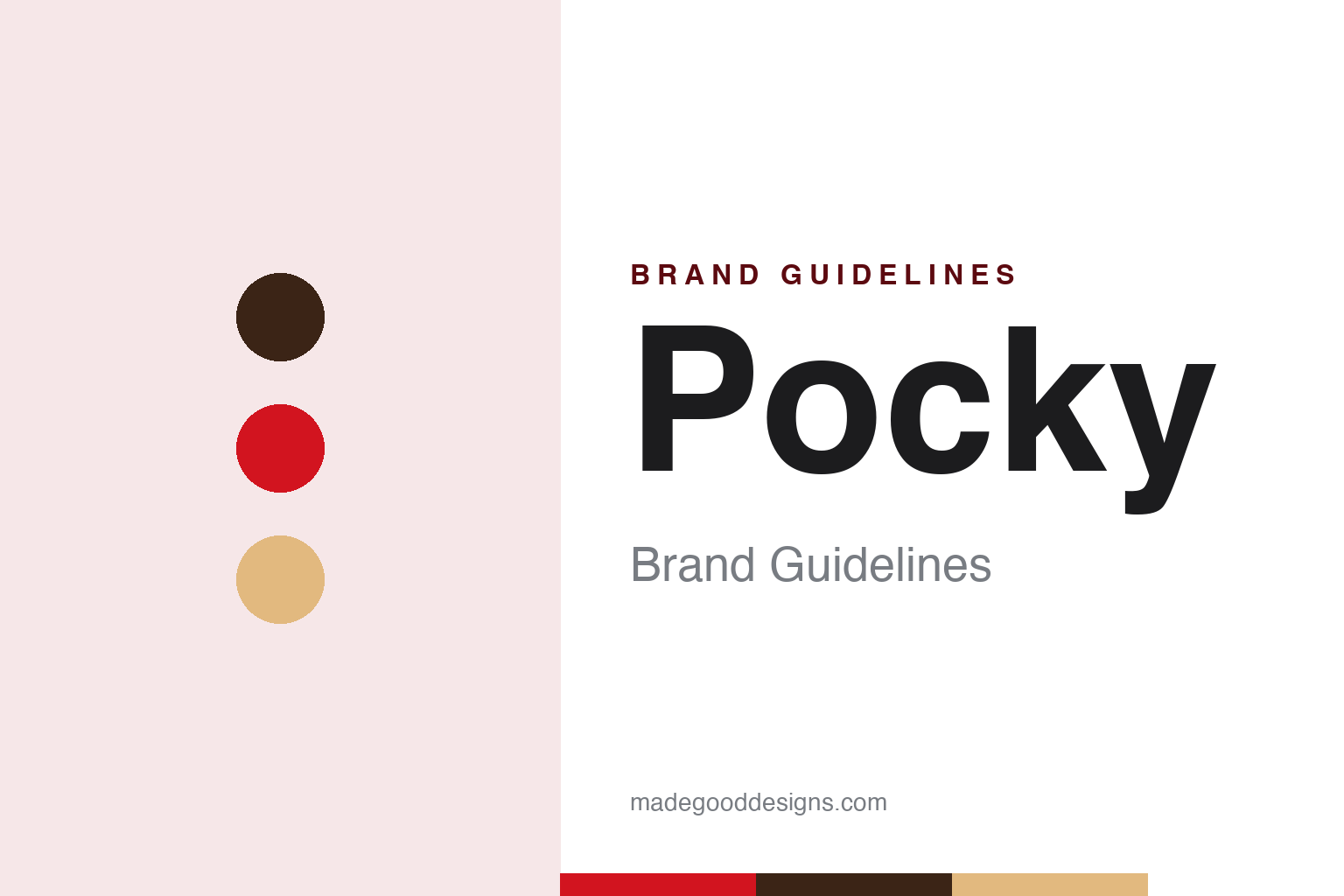
Two constants: a pack red, chocolate and biscuit palette and a bold geometric sans register. Abstract homage — not a Pocky product or mark; no pack, stick or logo is reproduced.
A stick with a handle
A coated pretzel stick, a bare end and a snapping sound.
Pocky is a product brand rather than a company. It belongs to Ezaki Glico, the Osaka confectioner that began in 1922 with Glico Caramel (see our Glico guide for the company’s own story). Glico launched Pocky Chocolate in Japan in 1966, and the company calls it “the world’s first stick-shaped chocolate confection.” It came after PRETZ, Glico’s uncoated pretzel stick, and the company’s global product page describes Pocky as a chocolate-covered biscuit stick that balances creamy chocolate with a crunch of biscuit.
The idea that made it work was simple. After many meetings and much trial and error, the company says, its developers decided to leave one part of each stick without chocolate. That bare end became a handle, so the sticks could be eaten without chocolate getting on the fingers — a “snack with a handle,” as the Japanese Pocky site puts it.
The name came late. Japanese Wikipedia says the sticks were first called “Choco Teck,” for a chocolate snack to eat while walking along, and were test-sold in dozens of sweet shops in Neyagawa, in Osaka Prefecture, where they sold well; but another company had already registered “Choco Teck” as a trademark, so the name could not be used. The replacement came from sound. Glico says the name Pocky was inspired by the onomatopoeic “pokin, pokin” that Japanese listeners hear when the sticks snap, and English Wikipedia links it to the word pokkiri, the sound of something breaking cleanly. “Pocky” is a registered trademark of Ezaki Glico.
Flavours followed. English Wikipedia dates an almond-coated Pocky to 1971 and a strawberry version to 1977, and the range in Japan today runs from the original Pocky Chocolate to extra-thin, crushed-almond and strawberry-pieces versions.
Colour
Mikado, Rocky and a Guinness record.
Pocky does not travel under one name. In Europe it is sold as Mikado. Glico’s own Pocky history says that in 1982 it set up General Biscuit Glico France, and that the sticks went on sale there under the name Mikado, after a popular game — the pick-up-sticks game of the same name. French Wikipedia says the French launch came that year through the joint venture, with the biscuit maker LU marketing it after Glico granted it the rights to make and sell the biscuit in France. French Wikipedia, citing the trade magazine LSA, says that by 2006, with Mikado then part of the Danone group, LU had reinvested in its factory at Cestas, in the Gironde. In 2007 Kraft Foods bought Danone’s biscuit business, Mikado included, French Wikipedia says, and English Wikipedia says Mikado is now produced under licence by Mondelēz International, the company formed from Kraft’s snacks business, in markets including France, Germany, Italy, Spain, the Netherlands and the United Kingdom.
In Asia, Glico has its own companies. Its Pocky history lists the founding of Thai Glico in 1970 and Shanghai Glico in 1995, and the company dates Pocky’s sales in Indonesia and Vietnam to 2012, Korea to 2013 and Malaysia to 2014. English Wikipedia says the sticks had been sold in Malaysia as “Rocky” for decades before that 2014 change to Pocky. In Indonesia, Glico says, a new factory of PT Glico Manufacturing Indonesia began shipping Pocky to the local market in 2023, and in Japan production was brought together in 2020 under Glico Manufacturing Japan, which took over the businesses of 14 manufacturing subsidiaries. In North America, English Wikipedia says, Pocky is sold both by Ezaki Glico USA and by LU.
Scale brought a record. Glico says that in 2020 Guinness World Records certified Pocky as the largest chocolate-coated biscuit brand, on estimated global sales of about US$589.9 million in 2019 drawn from international market research data; Japanese Wikipedia dates the certification to 13 October 2020.
Typography
Design and documentation.
The seven brands in this group are pantry, sauce, snack and cultured-drink names from Japan, China, South Korea and the United States: Yakult, Calpis, Kewpie, Lao Gan Ma, Huy Fong Foods, Ottogi and Pocky. Asian pantry and drink brands in general sit at many different points in the trade, from family firms that still carry a founder’s name to product names that belong to much larger food groups, and a single brand can be sold everywhere from a neighbourhood grocer to a supermarket shelf on another continent.
A pantry or drink brand’s identity is usually carried less by a single recipe than by a bottle, a jar, a box and the name printed on it, because the company behind the name may have changed hands, licensed its product abroad or grown far beyond the city where it started. That makes the questions behind each name worth asking plainly: who started it, who owns it now, and where its products are actually made and packed.
Each guide separates what independent sources record from what the company says about itself — its founding story, its owners over time, where its products are made and how its packaging has changed — and marks plainly what rests only on the company’s own word.
Aa
A bold geometric sans for a snack named after the sound of a snap. (Specimen set in Poppins, a sans STAND-IN; NOT the Pocky logo.)
Pocky
A red box, a date made of ones and “Share happiness!”
Pocky’s brand is built on its shape. The company’s Japanese site sets out its points plainly: a crisp pretzel stick with a coat of creamy chocolate; an uncoated end that is easy to hold; a “stylish” snack for parties and time with friends; a light snapping sound; and a compact pack that is easy to carry. The site also shows how the Pocky pack in Japan has changed since its debut in 1966. Japanese Wikipedia says that in the 2000s the pack was substantially redesigned, with a larger area of red and the lettering changed from white to gold.
The shape also gave the brand its day. Because a Pocky or PRETZ stick looks like the number one, Glico says, it chose 11 November as “Pocky & Pretz Day,” starting on 11 November 1999 — the eleventh year of the Heisei era, a date written with six ones. The company says the day was recognised as an anniversary more than 20 years ago, and that it runs a campaign every year to thank its customers. English Wikipedia notes that the Malaysian change of name in 2014 came with a new pack.
Its message today is about sharing. Under the slogan “Share happiness! Pocky,” the company says it wants a box of Pocky passed between people to start a conversation, connect feelings and leave both sides happier. The current Pocky Chocolate commercial on the Japanese site is a spot titled “Getting to know Pocky.”
For a design guide, Pocky shows how a single practical detail — a stick left bare at one end — can become a product, a name, a calendar date and a brand that changes its name from one market to the next. Compare Glico, the Osaka company that makes it, and Meiji, the Tokyo confectioner whose milk chocolate turned 100 in 2026. For this guide we use pack red, chocolate and biscuit with a bold geometric sans, an unofficial interpretation; no product or logo is reproduced.
Explore & save
Keep Pocky’s identity on hand — save it to a board in the Made Good inspiration library.
Pocky identity set
Pin the Pocky pack red, chocolate and biscuit palette and the bold geometric sans register to your own board.