Jell-O Brand Guidelines
The Le Roy gelatin dessert that advertising made famous.
Aa
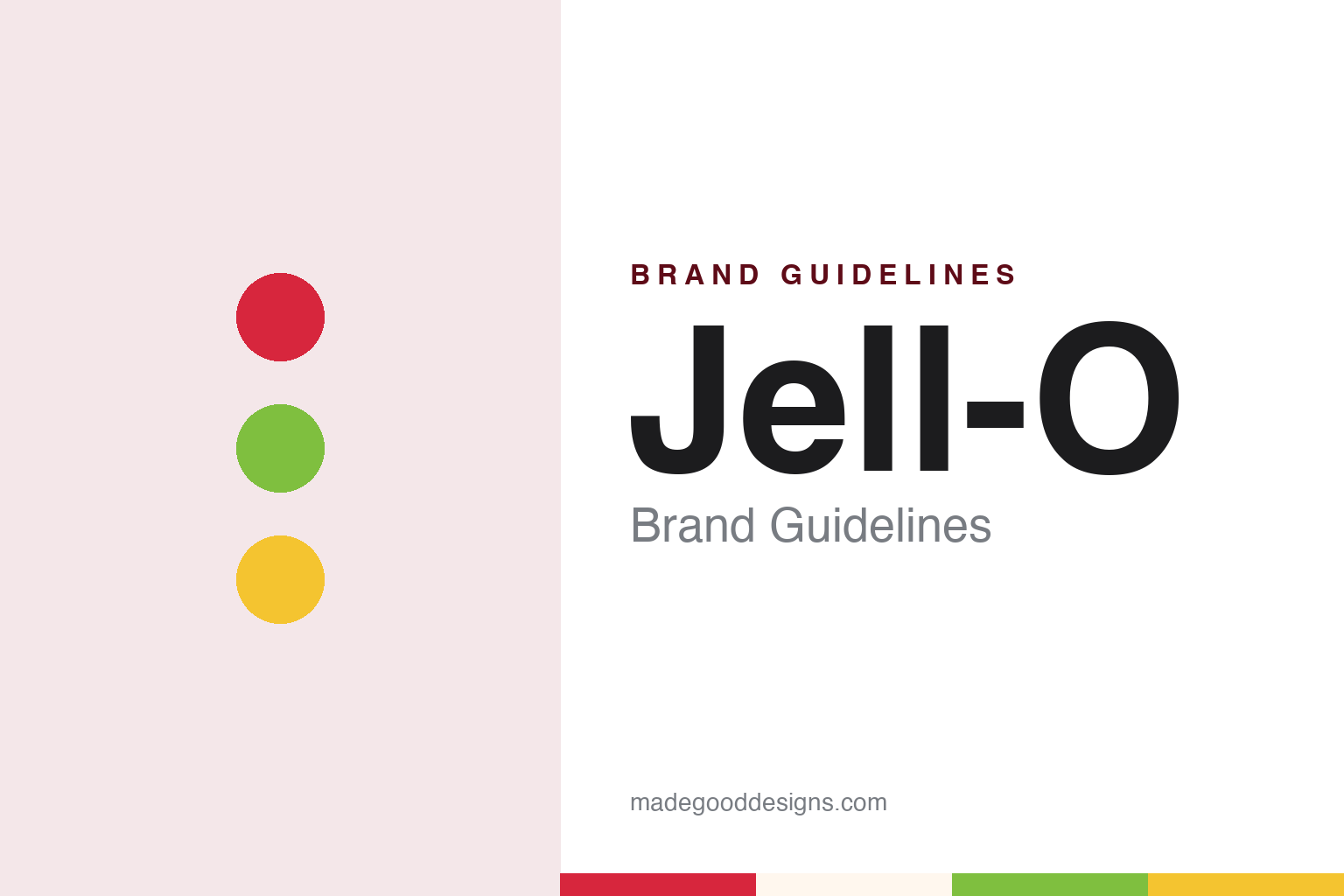
Two constants: a cherry red, lime and lemon palette and a bold blocky sans register. Abstract homage — not a Jell-O product or mark; no pack, logo or dessert is reproduced.
A carpenter’s dessert
A small town in western New York, a name and a sale.
Jell-O began in Le Roy, New York, in 1897. According to the history published by the Jell-O Gallery, the museum run by the Le Roy Historical Society, Pearle B. Wait was a carpenter who was also putting up a cough remedy and a laxative tea in his home. He experimented with gelatin and came up with a fruit-flavoured dessert, and his wife, May, named it Jell-O. English Wikipedia, citing the museum, says Wait trademarked the name that year and that the couple flavoured granulated gelatin and sugar with strawberry, raspberry, orange and lemon. The idea had a precedent: the industrialist Peter Cooper had patented a powdered gelatin in 1845, but, the museum says, it never caught on with the public.
Wait lacked the capital and experience to sell his dessert, the museum says, and in 1899 he sold it to a fellow townsman, Orator F. Woodward. Woodward was already one of the best-known makers of proprietary medicines in the area; his Genesee Pure Food Company made Grain-O, a cereal drink. The museum dates the purchase of the name and the business to 9 September 1899 and says the Jell-O name was first used by Genesee Pure Food in 1900. Sales were slow at first. Carolyn Wyman’s 2001 book Jell-O: A Biography, cited by English Wikipedia, covers the deal between the two men, part of which dealt with the similarity of the two “-O” names.
What changed Jell-O’s fortunes was selling. From 1902, English Wikipedia says, Genesee Pure Food advertised in the Ladies’ Home Journal, calling Jell-O “America’s Most Famous Dessert,” and from 1904 it sent salesmen into the field to hand out free recipe books. The museum describes salesmen in horse-drawn rigs, later cars, working fairs, church socials and country gatherings, and says that in some years as many as 15 million booklets were distributed. Within a decade, English Wikipedia says, the company had added chocolate, cherry and peach and had launched Jell-O in Canada.
Colour
The Jell-O Girl, illustrators and a radio jingle.
Jell-O’s look was made in print. The Jell-O Gallery says the advertising was directed first by William E. Humelbaugh and then by Frank LaBounty, and that illustrators including Rose O’Neill, Maxfield Parrish, Coles Phillips and Norman Rockwell painted colour pictures for the campaign. In 1904 it introduced the Jell-O Girl: four-year-old Elizabeth King, daughter of Franklin King, an artist at the Dauchy Company, Jell-O’s advertising agency. The museum says she held a teakettle in one hand and a packet of Jell-O in the other.
On 5 November 1923, the museum says, the Jell-O Company, Inc. was organised and took over the assets of Genesee Pure Food, so that the name would be closely tied to the business and kept from becoming a common noun. The same year, English Wikipedia says, the company launched D-Zerta, an artificially sweetened version. Lime arrived in 1930, as moulded “congealed salads” grew popular.
Radio gave Jell-O its sound. In 1934 the brand began sponsoring Jack Benny’s radio programme, and, English Wikipedia says, the first show originated the five-note “J-E-L-L-O” jingle that the brand kept for decades; Variety credited the tune in 1940 to Don Bestor, the show’s bandleader. Lucille Ball’s radio comedy My Favorite Husband was another Jell-O-sponsored programme from 1949. Chocolate came back in 1936 as a pudding, the start of a long pudding line. The slogan “There’s always room for Jell-O” dates from 1964, English Wikipedia says, and in 1966 a No-Bake dessert line followed.
The identity has been refreshed since. In August 2023 Dezeen reported that Jell-O had updated its brand design for the first time in a decade, in work by the agency Brandopus, with a bolder, blockier logo and hyper-realistic images of pudding and jelly. In September 2024, Dezeen reported, the brand released the Jelly Collection, a series of inflatable chairs based on its classic moulds.
Typography
Design and documentation.
The seven brands in this group are all pantry staples, and all of them come from the United States: Jell-O, Hidden Valley, Hunt’s, Del Monte, Dole, Libby’s and Skippy. American pantry brands in general sit at many different points in the trade, from names that still recall a founder or a hometown to names that now belong to much larger food groups, and a single brand can be sold everywhere from a corner store to a supermarket shelf.
A pantry brand’s identity is usually carried less by a single product than by a can, a jar, a name and the meal it promises, because the company behind the name may have changed hands, moved its factory or grown far beyond the town where it started. That makes the questions behind each name worth asking plainly: who started it, who owns it now, and where its products are actually made and packed.
Each guide separates what independent sources record from what the company says about itself — its founding story, its owners over time, where its products are made and how its packaging has changed — and marks plainly what rests only on the company’s own word.
Aa
A bold, blocky sans for a brand whose logo went bolder in 2023. (Specimen set in Rubik, a sans STAND-IN; NOT the Jell-O logo.)
Jell-O
From Postum and General Foods to Kraft Heinz.
Jell-O left local ownership in the 1920s. On 31 December 1925, the Jell-O Gallery says, the Jell-O Company was sold to the Postum Cereal Company through an exchange of stock, becoming the first subsidiary of the merger that grew into General Foods. English Wikipedia says Postum bought Clarence Birdseye’s frozen-food company in 1927 on the way to forming General Foods. In 1990, English Wikipedia says, General Foods was merged into Kraft by their parent company, Philip Morris, and it lists Jell-O today as a brand of Kraft Heinz.
Production moved with the owners. General Foods closed the Le Roy plant in 1964 and moved Jell-O manufacturing to Dover, Delaware, the museum and English Wikipedia say. Ready-to-eat cups have their own home: English Wikipedia says the Kraft Heinz plant in Mason City, Iowa, supplies America’s ready-to-eat Jell-O gelatin and pudding cups, and the Des Moines Register reported in May 2019 that Kraft Heinz would spend $63 million expanding and retooling it. English Wikipedia says that by 2016 more than 110 products were sold under the Jell-O name.
Le Roy kept the story. The Jell-O Gallery is run by the Le Roy Historical Society at the Le Roy House and Union Free School, listed on the National Register of Historic Places in 1997, and English Wikipedia describes a walkway of bricks inscribed with the names of former factory workers. The dessert has also become a regional emblem: in 2001, the BBC reported, Utah’s Senate recognised Jell-O as a favourite snack food of the state.
For a design guide, Jell-O shows how illustration, recipe books and a sung spelling of the name could make a powdered dessert a household word. Compare Birds Eye, Clarence Birdseye’s frozen-food name that joined Jell-O at General Foods, and Philadelphia, its Kraft Heinz stablemate. For this guide we use a cherry red, a lime green and a lemon yellow with a bold, blocky sans, an unofficial interpretation; no product or logo is reproduced.
Explore & save
Keep Jell-O’s identity on hand — save it to a board in the Made Good inspiration library.
Jell-O identity set
Pin the Jell-O cherry red, lime and lemon palette and the bold blocky sans register to your own board.