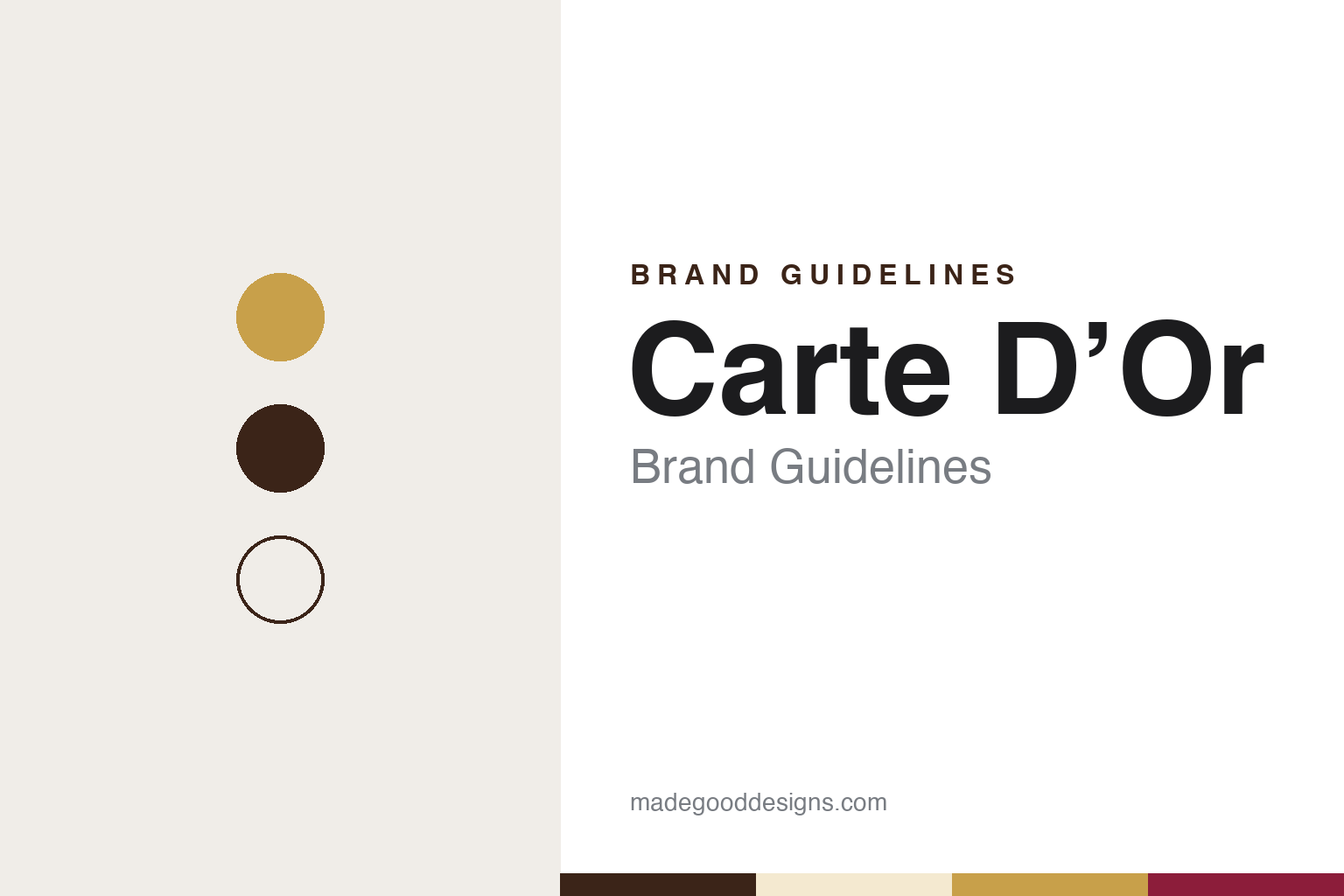
Carte D’Or Brand Guidelines
The French dessert ice cream that left the restaurant kitchen.
Aa
Two constants: a gold, cocoa and vanilla palette and a classic dessert serif register. Abstract homage — not a Carte D’Or product or mark; no tub, logo or heart is reproduced.
From the restaurant
A catering brand, a borrowed name and a French takeover.
Carte D’Or is a French brand that reached British freezers through Wall’s. French Wikipedia dates it to 1978 and says it was created in France, originally for professional catering — the restaurant and foodservice trade — before it was sold in supermarkets. The company tells the story in similar terms: Carte D’Or, it says, “began over 40 years ago as a restaurant desserts brand in Paris, proudly served by chefs in the home of gastronomie.” Its distributors in other markets repeat the 1978 date. The name joins the French words carte, a card or a restaurant menu, and or, gold; in France it is usually written Carte d’Or, while the brand’s British website uses a capital D.
For its first years the brand did not stand alone. French Wikipedia says Carte D’Or was a range under the Motta name until 1994, and that its slogan in the 1980s, under Motta, was “la qualité qui fait la différence” — the quality that makes the difference.
The change came with a takeover. In 1994 Unilever moved to buy the French ice cream group Ortiz-Miko, as the business daily Les Echos reported in March that year. Miko had its own long history: English Wikipedia says Luis Ortiz, a Spanish immigrant, started selling ice cream in Saint-Dizier, in north-eastern France, in 1921, and that the family renamed its ice cream Miko in 1951. After the purchase, French Wikipedia says, Carte D’Or became a range of Miko, and its manufacture was moved from a factory at Argentan, in Normandy, to Miko’s new factory at Saint-Dizier – Trois Fontaines, where it became the main activity.
Colour
Madagascar vanilla, Ecuadorian cocoa and a dessert promise.
In Britain and Ireland Carte D’Or is sold under the Wall’s heart. Its UK pages sit on the Wall’s ice cream website, which carries a copyright line for The Magnum Ice Cream Company and says it is not directed at consumers outside the UK and Ireland. The range is built around large tubs of ice cream and sorbet meant to be served as a dessert at home.
Its own descriptions lean on ingredients. The company says its vanilla ice cream uses vanilla beans from Madagascar that are hand-pollinated, hand-picked and traditionally cured, and that the dark chocolate pieces in its chocolate ice cream use cocoa from Ecuador that is Rainforest Alliance Certified. Other flavours it describes include a strawberry ice cream with candied strawberry pieces, a mint chocolate ice cream with pieces of 70 per cent cocoa dark chocolate, and a salted caramel with caramel chunks and flakes of fleur de sel. Its British sign-off is a pun on the name: “you always get M’Or with Carte D’Or.”
Vanilla also carries the brand’s social programme. The company says its Vanilla for Change programme works with vanilla-farming communities in the SAVA region of Madagascar, which it calls the island’s “vanilla belt,” and that it has supported 56,609 people, including 23,599 young people; those figures are the company’s own. In France, French Wikipedia says, the best-selling Carte d’Or flavour is vanilla made with Madagascar vanilla extract.
The French brand speaks to the same idea of dessert. Its current slogan there, according to French Wikipedia, is “Si vous avez Carte d’Or, vous avez un dessert” — if you have Carte d’Or, you have a dessert. French Wikipedia also lists sorbets, richer “gourmand” tubs and frozen yule logs for the end-of-year holidays among its products.
Typography
Design and documentation.
The seven brands in this group all make ice cream, and all of them are sold in Britain: Wall’s, Carte d’Or, Mackie’s, Kelly’s of Cornwall, Little Moons, Viennetta and Solero. Ice cream brands sold in Britain in general sit at many different points in the trade, from family firms that still carry a founder’s surname to names that now belong to much larger food groups, and a single brand can be sold everywhere from a seaside kiosk to a supermarket freezer.
An ice cream brand’s identity is usually carried less by a single product than by a pack, a name and the treat it promises, because the company behind the name may have changed hands, moved its factory or grown far beyond the place where it started. That makes the questions behind each name worth asking plainly: who started it, who owns it now, and where its ice cream is actually made and packed.
Each guide separates what independent sources record from what the company says about itself — its founding story, its owners over time, where its ice cream is made and how its packaging has changed — and marks plainly what rests only on the company’s own word.
Aa
A classic dessert serif for a brand that began on restaurant menus. (Specimen set in Playfair Display, a serif STAND-IN; NOT the Carte D’Or logo.)
Carte D’Or
A paper tub and a new owner.
The most visible recent change is the pack. In 2022, the company says, Carte D’Or launched responsibly sourced, recyclable paper tubs made with 93 per cent less plastic than its previous packaging, together with new-look packs; it says the ice cream itself is unchanged.
In Britain the brand sits inside a family of marks. Wall’s heart, the shared Heartbrand symbol, was designed by the London agency Carter Wong & Partners and announced in 1998, The Independent reported at the time; it is used by local names such as Algida in Italy, Langnese in Germany and Ola in the Netherlands. Carte D’Or appears among the brands on the Wall’s UK website.
The owner has changed as well. Unilever announced in March 2024 that it would separate its ice cream business. The Magnum Ice Cream Company began operating as a Unilever subsidiary on 1 July 2025, with headquarters in Amsterdam, and on 8 December 2025 it was listed in Amsterdam, London and New York, Reuters reported. Carte D’Or passed to it with the rest of the ice cream brands, as French Wikipedia also records.
For a design guide, Carte D’Or shows how an ice cream can borrow the language of the restaurant — a menu, gold and a promise of dessert. Compare Wall’s, the heart it is sold under in Britain, and Viennetta, another of the company’s dessert brands. For this guide we use gold, deep cocoa and vanilla with a serif, an unofficial interpretation; no product or logo is reproduced.
Explore & save
Keep Carte D’Or’s identity on hand — save it to a board in the Made Good inspiration library.
Carte D’Or identity set
Pin the Carte D’Or gold, cocoa and vanilla palette and the classic dessert serif register to your own board.