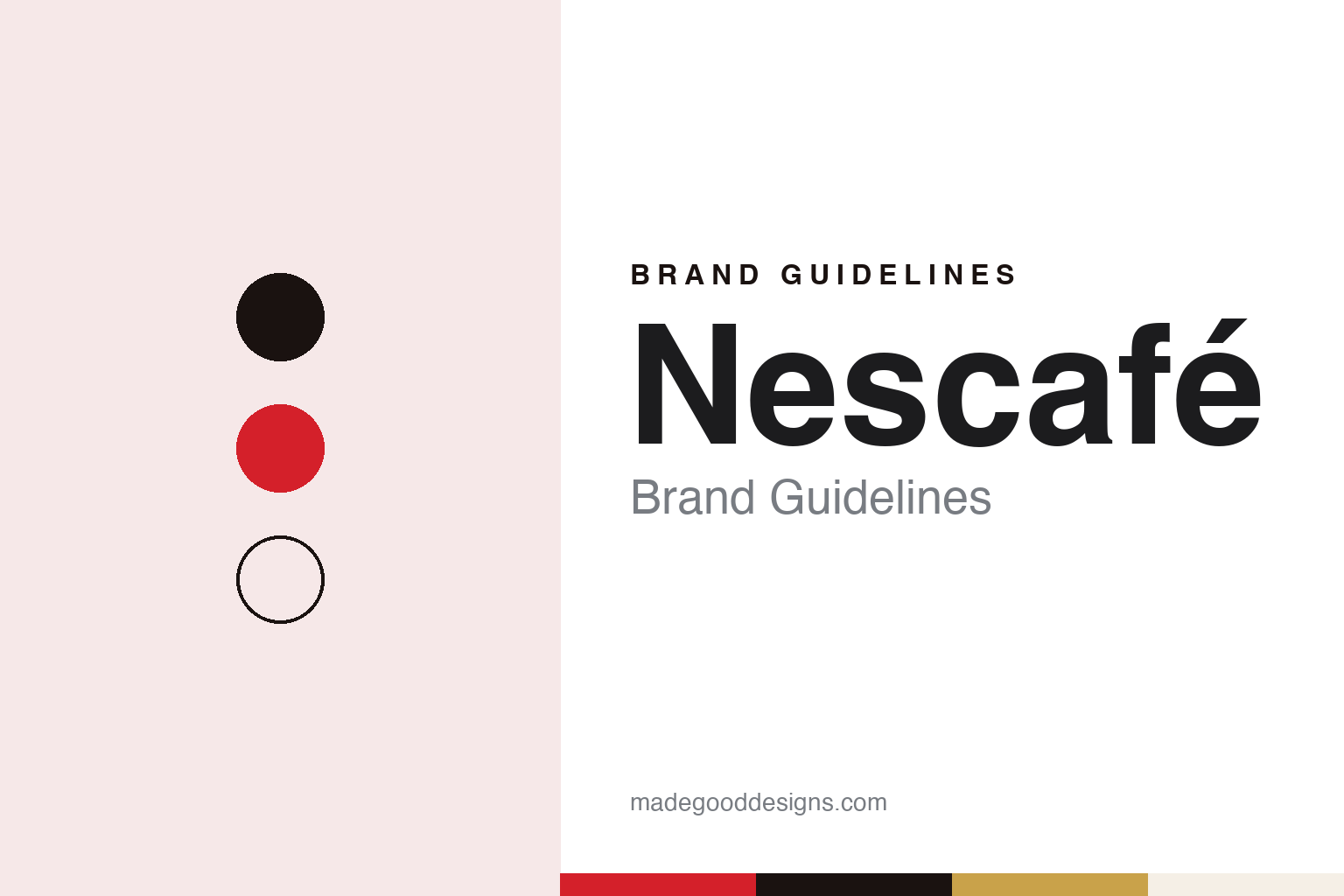
Nescafé Brand Guidelines
Nestlé’s 1938 instant coffee, from Max Morgenthaler to the Gold Blend couple.
Aa
Two constants: a red, espresso and gold palette and a bold grotesque register. Abstract homage — not a Nescafé product or mark; no jar, mug, logo or label is reproduced.
A powdered extract
A coffee surplus and a chemist’s answer.
Nescafé is Nestlé’s instant coffee, and its name joins the company’s name to the word café. It was launched in Switzerland on 1 April 1938. Nestlé’s own history describes it as a “powdered extract of pure coffee” that gives coffee’s flavour just by adding hot water, and calls it “the brainchild of Max Morgenthaler.”
The problem it solved was a glut of coffee. Prices had collapsed after the Wall Street Crash of 1929, leaving Brazil with huge unsold stocks. Nestlé says the Brazilian government asked the company, then called Nestlé & Anglo-Swiss, to find an outlet for its surplus; English Wikipedia says the approach came from Sudameris, a French-Italian bank serving South American markets that held surplus coffee in its warehouses. Both accounts agree that Nestlé began work in 1932, with Morgenthaler leading the project, and that the first product was made by spray drying liquid coffee into a powder.
The timing made the brand. English Wikipedia says Nescafé became an American staple during the Second World War, when the output of Nestlé’s American plant was reserved for the military. Nestlé used the same method to launch a soluble tea, Nestea, in the United States in 1948, the company says.
Britain came early. English Wikipedia’s article on Nestlé’s Tutbury factory says Nestlé introduced instant coffee to the UK in 1939, and that until the late 1980s most British instant coffee was made from robusta beans by spray drying. In the 1970s Nestlé had around half of UK coffee production, the same article says, and in 2000 it held a 56 per cent share of a coffee market worth £650 million.
Colour
Gold Blend, Taster’s Choice and the couple.
Nescafé grew into an umbrella name. In the UK it covers the original instant coffee as well as the freeze-dried Gold Blend and Blend 37; in Australia and New Zealand the original is sold as Blend 43, a name first used to tell locally made coffee from the imported version, English Wikipedia says. In India Nestlé sells Nescafé Classic and Sunrise, a mix of 70 per cent instant coffee and 30 per cent chicory.
America took a different path. Nestlé used the Nescafé name there until the late 1960s, then introduced Taster’s Choice in the United States and Canada, which replaced Nescafé for many years; in 2003 the company brought the Nescafé name back, and the product became Nescafé Taster’s Choice.
In Britain the brand is remembered for its advertising. Before 1987 a series of commercials starred the actor Gareth Hunt, shaking his closed hand and opening it to show coffee beans; by 1986 Sarah Greene and Mike Smith also appeared in that campaign. In the 1986 Smash Hits readers’ poll Nescafé came fifth for “Best TV Ad” and first for “Worst TV Ad” in the same year.
Then came the Gold Blend couple. Developed by the agency McCann Erickson, the campaign ran in 12 instalments from 1987 to 1993, with Anthony Head and Sharon Maughan as neighbours whose slow romance unfolded over cups of coffee. The first 11 episodes were released in 1993 on a video called Love Over Gold, alongside a novel of the same name written by Susan Moody under the name Susannah James. From 1990 new versions were made for the American market as the “Taster’s Choice saga.”
Later British campaigns used the boxer Chris Eubank and the footballer Ian Wright, and in August 2009 Nestlé launched a £43 million UK campaign with the line “Coffee at its brightest.” Not every use went smoothly: in 2003 the band Muse sued over the use of its recording of “Feeling Good” in a Nescafé advertisement without permission, and gave the £500,000 compensation to Oxfam.
Typography
Design and documentation.
The seven brands in this group all sell coffee, and they come from Britain, France, Switzerland, the United States and Italy: Kenco, Carte Noire, Percol, Nescafé, Caribou Coffee, Gloria Jean’s and Caffè Mauro. Coffee brands in general sit at many different points in the trade, from family roasters that still carry a founder’s surname to names that now belong to much larger food and drink groups, and a single brand can be sold everywhere from a café counter to a supermarket shelf.
A coffee brand’s identity is usually carried less by a single product than by a pack, a name and the cup it promises, because the company behind the name may have changed hands, moved its roastery or grown far beyond the town where it started. That makes the questions behind each name worth asking plainly: who started it, who owns it now, and where its coffee is actually roasted and packed.
Each guide separates what independent sources record from what the company says about itself — its founding story, its owners over time, where its coffee is made and how its packaging has changed — and marks plainly what rests only on the company’s own word.
Aa
A bold grotesque for a coffee sold in a jar since 1938. (Specimen set in Archivo, a sans STAND-IN; NOT the Nescafé logo.)
Nescafé
From Hayes to Tutbury, and from powder to pods.
Nescafé has remained a Nestlé brand since its launch, and Nestlé is still based in Vevey, Switzerland. In Britain the brand’s story runs through two factories. Nestlé located a major chocolate and instant coffee works beside the canal at Hayes, in west London, after buying Peter, Cailler, Kohler in 1929, English Wikipedia says; the site was for many years its UK headquarters, and the road to it was renamed Nestlé’s Avenue. The Hayes factory closed in 2014 with the loss of 230 jobs.
The other is Tutbury. Despite its name, the factory stands in Hatton, Derbyshire, across the railway line from Tutbury in Staffordshire. Built in 1901 and carrying the Nestlé name from 1905, it is described by English Wikipedia as Nestlé’s longest-running factory outside Switzerland. New coffee buildings opened there on 9 June 1959, with roasters made by Probat of Emmerich am Rhein in Germany. In 2014 Nestlé moved all of its UK and Ireland coffee production to Tutbury, and a new Dolce Gusto plant opened there in late 2014. English Wikipedia says the site makes around 175,000 jars of coffee a day and about 35,000 tonnes of coffee a year for the UK and Ireland.
The brand has moved beyond powder. In 2006 Nestlé launched Nescafé Dolce Gusto, a capsule machine for espresso, lungo, cappuccino and latte macchiato as well as hot chocolate and cold drinks; unlike most Nescafé products, most of its drinks use roasted and ground coffee rather than instant. English Wikipedia says the machines are sold in more than 60 countries. Nestlé keeps a separate coffee brand, Nespresso, whose story it dates to 1986.
Elsewhere Nescafé has become a sponsor as much as a jar. In Chile, since 2009, it has supported a theatre renamed the Nescafé Theatre of the Arts; in Pakistan it runs an annual music show, Nescafé Basement; and in Ecuador an AeroGal Boeing 737-200 was painted red to promote it.
For a design guide, Nescafé shows how one name can stretch across a powder, a premium freeze-dried blend, a capsule system and decades of serial advertising. Compare Maggi, another Nestlé brand born in Switzerland, and Kenco, its British instant-coffee rival. For this guide we use red, espresso and gold with a sans, an unofficial interpretation; no product or logo is reproduced.
Explore & save
Keep Nescafé’s identity on hand — save it to a board in the Made Good inspiration library.
Nescafé identity set
Pin the Nescafé red, espresso and gold palette and the bold grotesque register to your own board.