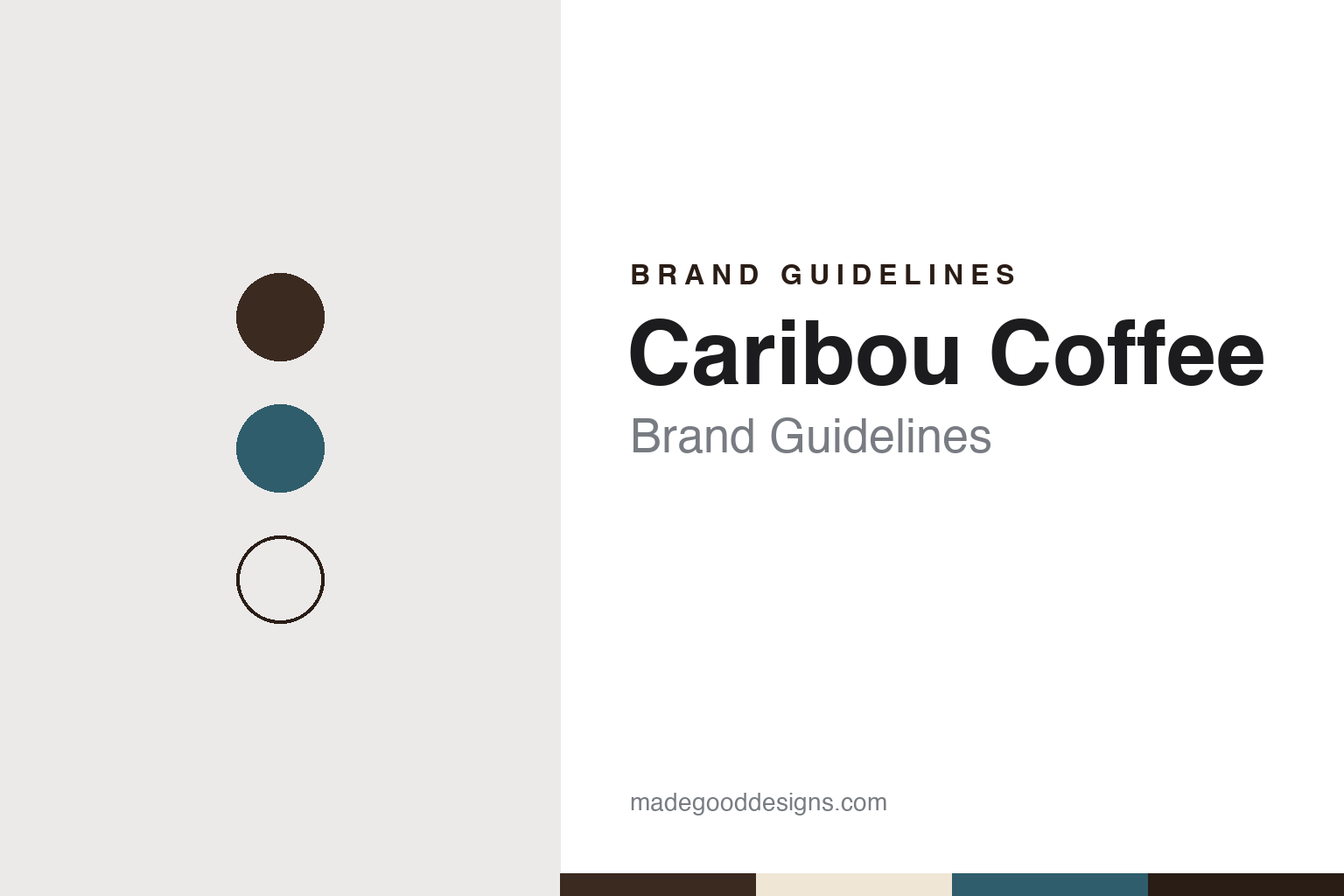
Caribou Coffee Brand Guidelines
The Minnesota coffeehouse that grew from Edina to more than 800 locations.
Aa
Two constants: a roast brown, lake blue and birch cream palette and a Northwoods slab serif register. Abstract homage — not a Caribou Coffee product or mark; no cup, logo or caribou is reproduced.
From Bain to Edina
A consultant, a trip to Alaska and a lease that fell through.
Caribou Coffee was started by John Puckett, a management consultant at Bain & Company in Boston, and his wife Kim. After a trip to Denali National Park in Alaska, the couple decided to raise money and open a coffee company, Puckett told the Minneapolis/St. Paul Business Journal in 2013. Kim kept her job at General Motors while John moved to Minnesota to find a first site and put the financing together. The company itself says its founders opened the first Caribou Coffee “with a vision to build personal connection into the coffeehouse experience.”
The plan was a five-day-a-week coffee bar for office workers in downtown Minneapolis, modelled on what worked in Boston. Puckett signed for a site in the Pillsbury Center, but the landlord backed out after another tenant with exclusive rights to sell coffee in the building threatened to sue, and the financing tied to that site collapsed. He looked to the suburbs instead, and the first Caribou Coffee opened in Edina, a suburb of Minneapolis. English Wikipedia, citing the Business Journal, dates the opening to December 1992, and the company says it was “founded in Minnesota in 1992”; a timeline on the company’s website in 2023 gave the date of the Edina opening as 14 December 1993.
In 1994 Puckett recruited Kent Parker, his roommate at Dartmouth’s Tuck business school, to help grow the company. The same company timeline says Amy’s Blend launched in 1995 to honour Caribou’s original roastmaster, Amy Erickson; that in 2003 Caribou built its own roasting operation and distribution center; and that in 2004 it opened in the Middle East, its first market outside the United States.
Colour
NASDAQ, JAB and Panera Brands.
In 2003 Michael J. Coles was named chief executive, the Atlanta Business Chronicle reported. On 29 September 2005 Caribou listed on NASDAQ under the ticker CBOU; in 2006 the investment bank Arcapita was its majority shareholder, according to Arcapita’s own website at the time.
The public years ended in December 2012, when JAB Holding, the investment company of Germany’s Reimann family, took Caribou private in a deal worth about $340 million. JAB already owned Peet’s Coffee, and the Minneapolis/St. Paul Business Journal reported that Caribou would be run as an independent company with its own brand and management team, based in Minneapolis. In April 2013 CNN reported that Caribou would close 80 stores and convert 88 others to Peet’s Coffee & Tea.
JAB’s restaurant holdings grew around Caribou. In 2014 JAB agreed to buy Einstein Noah Restaurant Group, the parent of Einstein Bros. Bagels, the Chicago Tribune reported, and in July 2017 it completed its purchase of Panera Bread for $7.5 billion, according to English Wikipedia. Caribou then became a buyer itself: in August 2017 it acquired Bruegger’s Bagels, the Business Journal reported. In January 2019 John Butcher succeeded Sarah Spiegel as chief executive. On 5 August 2021 Panera Bread, Caribou Coffee and Einstein Bros. Bagels announced that they had come together as Panera Brands, a group controlled by JAB; Panera Brands filed paperwork for a public listing that November, the Associated Press reported, and in December 2023 CNBC reported that Panera had confidentially filed to go public again.
The company has also changed how it grows. Its timeline lists the Caribou Cabin, a small drive-thru and walk-up format with no indoor seating, in 2020, and the launch of franchising in the United States in 2021; World Coffee Portal reported the first US franchised store in November 2022. Outside the United States, Caribou works through franchise partners, in markets that English Wikipedia lists as including the Gulf states, Turkey, Egypt and Morocco.
Typography
The coffee category.
The seven brands in this group all sell coffee, and they come from Britain, France, Switzerland, the United States and Italy: Kenco, Carte Noire, Percol, Nescafé, Caribou Coffee, Gloria Jean’s and Caffè Mauro. Coffee brands in general sit at many different points in the trade, from family roasters that still carry a founder’s surname to names that now belong to much larger food and drink groups, and a single brand can be sold everywhere from a café counter to a supermarket shelf.
A coffee brand’s identity is usually carried less by a single product than by a pack, a name and the cup it promises, because the company behind the name may have changed hands, moved its roastery or grown far beyond the town where it started. That makes the questions behind each name worth asking plainly: who started it, who owns it now, and where its coffee is actually roasted and packed.
Each guide separates what independent sources record from what the company says about itself — its founding story, its owners over time, where its coffee is made and how its packaging has changed — and marks plainly what rests only on the company’s own word.
Aa
A Northwoods slab serif. (Specimen set in Bitter, a slab-serif STAND-IN; NOT the Caribou Coffee logo.)
Caribou Coffee
A Minnesota roastery and a caribou mark.
Caribou has kept its Minnesota base through each change of owner. Its headquarters are in Brooklyn Center, north of Minneapolis, and the company says that its “headquarters and roastery are still located” in Minnesota, where it was founded. It also says its packaged coffee is sold in all 50 states, through grocery stores, mass retailers, club stores, foodservice and online, alongside the coffeehouses. In 2024 it described itself as a global brand with more than 800 locations in 11 countries, and gave its purpose as creating “day-making experiences that spark chain reactions of good.”
On sourcing, the company says that in 2012 it became the first US coffeehouse to commit to, and reach, 100 percent Rainforest Alliance certification, and that in 2018 it became the first US coffeehouse to serve only “clean label” beverages; both are its own claims. Its website’s legal line names Caribou Coffee Operating Company, Inc. and adds that Caribou Coffee “is a part of Panera Brands.”
The chain’s name is carried by a caribou mark; English Wikipedia dates the current version of the logo to 2010.
For a design guide, Caribou Coffee shows how a regional coffeehouse can keep its local identity inside a large international group. Compare Peet’s Coffee, the JAB-owned chain that took over 88 of its stores, and Tim Hortons, another North American coffee chain. For this guide we use roast brown, lake blue and birch cream with a slab serif, an unofficial interpretation; no product or logo is reproduced.
Explore & save
Keep Caribou Coffee’s identity on hand — save it to a board in the Made Good inspiration library.
Caribou Coffee identity set
Pin the Caribou Coffee roast brown, lake blue and birch cream palette and the Northwoods slab serif register to your own board.