OLDTOWN White Coffee Brand Guidelines
The Ipoh white coffee maker that became a kopitiam chain.
Aa
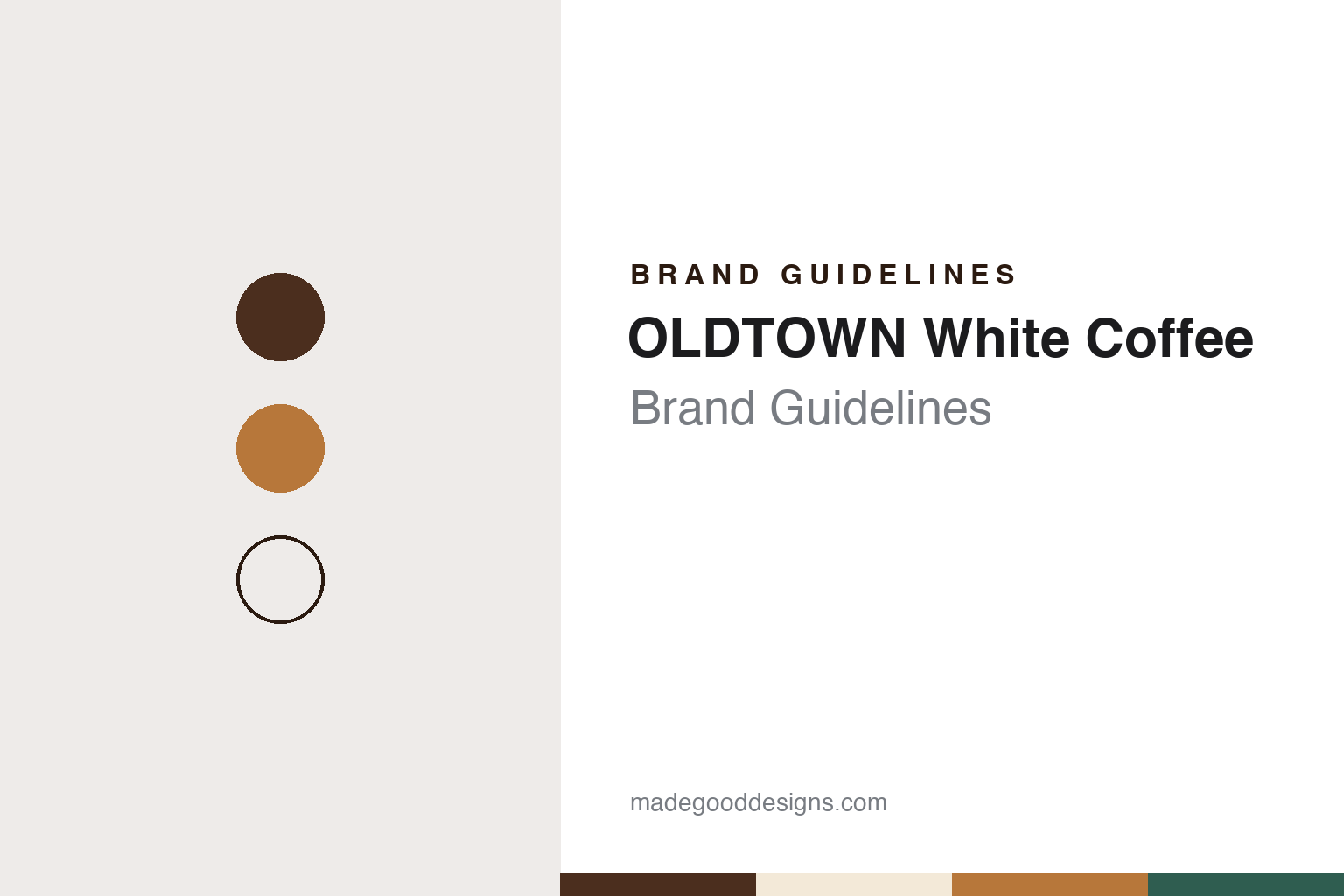
Two constants: an OLDTOWN roast brown, cream and caramel palette and a heritage serif register. Abstract homage — not an OLDTOWN product or mark; no pack, logo or café sign is reproduced.
White Café, Ipoh
A town drink in a sachet.
OLDTOWN White Coffee comes from Ipoh, the capital of the Malaysian state of Perak. English Wikipedia, citing a Bloomberg company profile, names its founders as Goh Ching Mun and Tan Say Yap. The company’s own timeline, as archived in 2017, begins in 1999 with the incorporation of a company called White Café in Ipoh and the creation of a three-in-one instant coffee blend.
White coffee is an Ipoh speciality, and the brand builds its story on that. Its website says the drink was first made in the town by the Hainanese in the 1930s, and that its own blend uses three kinds of bean — Arabica, Robusta and Liberica — moderately roasted at high temperature and blended with caramel.
Exports came early. According to the archived timeline, the three-in-one mix went to Singapore in 2000 and to Hong Kong in 2001, the year a separate marketing company, White Café Marketing, was set up. In 2002 the products reached hypermarkets and supermarkets across East and West Malaysia and received halal certification from the Islamic religious department of Perak. In 2003 the company added a three-in-one instant milk tea under the OLDTOWN name.
The same timeline records two further steps from those years: roasted coffee powder made with the company’s own roasting process, sold to traditional coffee shops in Ipoh and other states and to retailers under a second brand, NANYANG, and distribution of its products to the United States, Canada and the United Kingdom.
Colour
From sachet to kopitiam.
In 2005 the business opened its first café. English Wikipedia describes a chain of outlets “based on the traditional Ipoh coffee shop setting and ambience,” and the company’s 2017 profile said its cafés carried “the charm of a traditional Ipoh coffee shop,” serving white coffee with toast, rice and noodle dishes. The same year, the timeline says, Kopitiam Asia Pacific began licensing the café brand and supplying food, drinks and management services to outlets that were fully owned, partly owned or franchised.
Behind the cafés the company built its own kitchens. Its timeline lists central food-processing centres — Emperor’s Kitchen from 2005, Esquire Chef and Dynasty Confectionery from 2007 — and a distribution company, Dynasty Kitchen, incorporated in 2006. The first OLDTOWN café in Singapore opened in 2008, according to the same timeline, a year after a Singapore company was set up to supply the outlets there.
The chain grew quickly. By 2017 the company said it had more than 200 café outlets across Asia and exported its white coffee to more than 13 countries; its present-day website says the products reach 21 countries. English Wikipedia counts 232 outlets in 2018 and lists cafés in Malaysia, China, Indonesia and the Philippines.
The packaged coffee remains tied to its town. “OLDTOWN is manufactured in Ipoh,” the brand’s website says, and English Wikipedia places the company’s headquarters on the Tasek Industrial Estate in Ipoh. The website also describes a central bakery that makes the bread served in the cafés, and a coffee range that now runs from the classic white coffee to hazelnut and salted-caramel versions.
Typography
Southeast Asia’s pantry brands.
The seven brands in this group make coffee, tea, noodles and sauces, and they come from Singapore, Indonesia, Japan, Vietnam and Malaysia: Prima Taste, Indocafe, Kopiko, Acecook, Chin-su, OLDTOWN White Coffee and BOH. Drink and food brands of this kind in general sit at many different points in the trade, from family firms that still carry a founder’s name to names that now belong to much larger food groups, and a single brand can be sold everywhere from a coffee shop counter to a supermarket shelf.
A drink or food brand’s identity is usually carried less by a single product than by a pack, a name and the cup or bowl it promises, because the company behind the name may have changed hands, moved its factory or grown far beyond the town where it started. That makes the questions behind each name worth asking plainly: who started it, who owns it now, and where its products are actually made and packed.
Each guide separates what independent sources record from what the company says about itself — its founding story, its owners over time, where its products are made and how its packaging has changed — and marks plainly what rests only on the company’s own word.
Aa
A heritage serif for an old-town coffee shop. (Specimen set in Playfair Display, a serif STAND-IN; NOT the OLDTOWN White Coffee logo.)
OLDTOWN White Coffee
From Bursa Malaysia to JDE Peet’s.
The group went public as OldTown Berhad, incorporated in 2006 as an investment holding company for a stock-market listing, according to its timeline. The Edge Malaysia reported that it was listed on the Main Market of Bursa Malaysia on 13 July 2011.
The takeover came six years later. On 11 December 2017 Jacobs Douwe Egberts Holdings Asia NL BV, a subsidiary of the Dutch coffee and tea company Jacobs Douwe Egberts, made a pre-conditional voluntary offer for all of OldTown’s shares, The Star and The Edge Malaysia reported. Shareholders holding about 51.45% of the company, among them Old Town International Sdn Bhd and the director Lee Siew Heng, undertook to accept. The Edge called it the first takeover offer in Malaysia to carry pre-conditions, which included clearance from Singapore’s competition authority.
The formal offer followed on 30 January 2018. When it closed on 20 March, Jacobs Douwe Egberts held 98.6% of the company, and OldTown was delisted on 4 April 2018, The Edge Malaysia reported, naming the deal its privatisation of the year.
Jacobs Douwe Egberts merged with Peet’s Coffee in December 2019 to form JDE Peet’s, listed in Amsterdam since May 2020, according to English Wikipedia, and JDE Peet’s lists OLDTOWN among its “local icons.” In August 2025 Keurig Dr Pepper announced an agreement to acquire JDE Peet’s, English Wikipedia says. The OLDTOWN website is now operated by Kopitiam Asia Pacific and a Malaysian JDE retail company.
For a design guide, OLDTOWN White Coffee shows how one town’s coffee-shop tradition can carry both a packaged product and a café format under a single name. Compare Kapal Api, the Indonesian coffee brand, and Trung Nguyên, the Vietnamese coffee house that also runs cafés. For this guide we use roast brown, milk cream and caramel with a serif, an unofficial interpretation; no product or logo is reproduced.
Explore & save
Keep OLDTOWN White Coffee’s identity on hand — save it to a board in the Made Good inspiration library.
OLDTOWN White Coffee identity set
Pin the OLDTOWN White Coffee roast brown, cream and caramel palette and the heritage serif register to your own board.