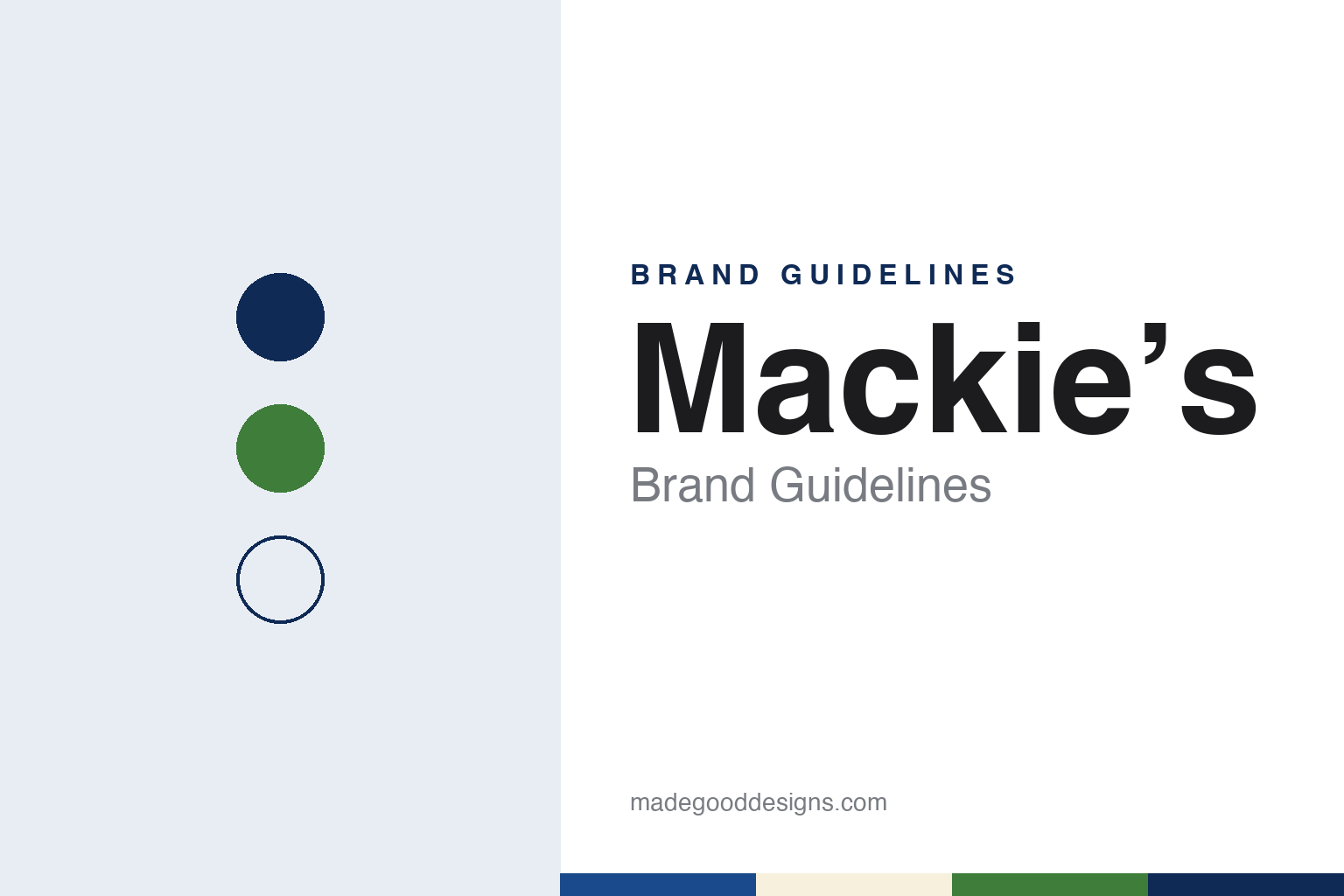
Mackie’s Brand Guidelines
The Aberdeenshire dairy farm that turned surplus cream into ice cream.
Aa
Two constants: a dairy blue, pasture green and cream palette and a rounded farm sans register. Abstract homage — not a Mackie’s product or mark; no tub, logo or cow illustration is reproduced.
Westertown farm
A dairy farm, a milk round and a surplus of cream.
Mackie’s ice cream is made on a working dairy farm. The company says the Mackie family began farming at Westertown, near Rothienorman in Aberdeenshire, in 1912, and that Sir Maitland (Mike) Mackie, who lived from 1912 to 1996 and whom today’s family calls “our grandpa,” had one of the first tractors in the area and started a milk retail business. English Wikipedia also dates the business to 1912, as a dairy farm that later diversified. Doorstep delivery of Mackie’s Milk, sold as “fresh from the farm,” grew through the 1930s, the company says, in returnable bottles printed with the Mackie’s name.
Milk carried the business for most of the century. The company says it sold its milk round to Kennerty Farm Dairy in 1964, restarted local rounds in the late 1960s and by 1994 ran a substantial milk-processing dairy with a turnover of £12 million and 250 staff, its milk moving from returnable bottles to sachets, cartons and plastic bottles. Companies House lists the company’s earlier name as Mackies Aberdeen Dairy Company Limited, used from 1954 to 1995. In 1997 the milk retail business was sold to Robert Wiseman, the dairy group, Wikipedia says, citing a 2013 blog post by Maitland Mackie for the University of Strathclyde’s business school and a 2017 report in The Times.
Ice cream began as a way to use up cream. As shoppers switched to semi-skimmed milk, the farm was left with surplus cream, and in 1986 it began making what it calls “real dairy ice cream,” made in the morning and sold locally in the afternoon, the company says. The first supermarket to stock it was Fine Fare in Aberdeen, and early growth came through Safeway. In 1993 old byres and a mill on the farm were turned into a modern dairy able to make six million tubs a year, keeping the historic water wheel. The company names Maitland Mackie CBE, the second generation, as the founder of Mackie’s of Scotland, and says that in 1998 Mac Mackie, of the fourth generation, became managing director.
Colour
Traditional, Honeycomb and a blue tub.
Mackie’s built its range on plain flavours. Its best-known ice cream is Traditional, which Wikipedia describes as plain rather than vanilla and, citing the Grampian Online news site in 2021, as Scotland’s best-selling ice cream. The company says Honeycomb joined the range in 1995 and became its second most popular flavour, and that a Highland range of 500ml tubs with Scottish-themed flavours followed in 1996; it also worked with other Scottish food makers on flavours such as an orange marmalade with Baxters and a ginger shortbread with Walker’s. In 2001 it launched Cream of Scottish, a soft-scoop vanilla in two-litre tubs, in response to the Cream of Cornish ice cream then reaching supermarket shelves. Not every idea lasted: the company’s own history lists a chocolate-covered lolly called Mackice, iced fruit smoothies and an “Extra Posh” range with portraits of tiara-wearing Jersey cows on the tubs that did not sell well enough to stay.
The tub is the brand’s main design asset, and the company has documented how it changed. In 2008 Mackie’s moved its tubs to a “green, wind turbine” design that celebrated the renewable energy made on the farm and put more weight on farming, with a dairymaid incorporated into the logo; that design stayed until 2021. Since 2010 the farm has made its own tubs, on what the company says are now four injection-moulding machines. The 2021 refresh brought the line “Mackie’s. Making Simple Delicious.” while keeping what the company calls its three “sacred cows”: the blue colour, the one-litre tub shape and the cow itself. The same year, the company says, the BBC series Inside the Factory filmed at the farm to show how its Honeycomb ice cream is made.
The farm has also branched out beyond ice cream. In 2009 Mackie’s went into potato crisps with a Perthshire potato-farming family, the Taylors, as Mackie’s at Taypack; in 2022 the Taylors bought out Mackie’s shares in the joint venture, BBC News reported, and the company says Taylors-branded crisps followed in 2023. Chocolate arrived in 2014, made on the farm, with bars whose flavours — Traditional, Honeycomb, Dark and Mint among them, with Orange added in 2020 — nod to the ice creams. The company says it commissioned a chocolate factory in a former tractor shed in 2015.
Typography
Design and documentation.
The seven brands in this group all make ice cream, and all of them are sold in Britain: Wall’s, Carte d’Or, Mackie’s, Kelly’s of Cornwall, Little Moons, Viennetta and Solero. Ice cream brands sold in Britain in general sit at many different points in the trade, from family firms that still carry a founder’s surname to names that now belong to much larger food groups, and a single brand can be sold everywhere from a seaside kiosk to a supermarket freezer.
An ice cream brand’s identity is usually carried less by a single product than by a pack, a name and the treat it promises, because the company behind the name may have changed hands, moved its factory or grown far beyond the place where it started. That makes the questions behind each name worth asking plainly: who started it, who owns it now, and where its ice cream is actually made and packed.
Each guide separates what independent sources record from what the company says about itself — its founding story, its owners over time, where its ice cream is made and how its packaging has changed — and marks plainly what rests only on the company’s own word.
Aa
A rounded farm sans for an ice cream made beside the milking shed. (Specimen set in Fredoka, a sans STAND-IN; NOT the Mackie’s logo.)
Mackie’s
Wind, sun and a family firm on the farm.
Energy has become part of the Mackie’s story. The company says it trialled a small grid-connected wind turbine as early as 1983 and installed its first 850kW turbine in 2005. It now runs four turbines with a total capacity of 3MW, a 10-acre solar farm of 1.8MW installed in 2016 and a 400kW biomass plant, and says it produces more than twice as much energy as it uses, exporting the rest to the grid. Between 2021 and 2022 it installed a low-carbon refrigeration system that uses ammonia, a natural refrigerant, together with heat from the biomass boiler. The herd stayed at the centre: the company says it installed robotic milking in 2001, and the Evening Express reported in 2017 that the farm kept 330 cows and made more than 10 million litres of ice cream a year.
Mackie’s Limited is a private company based at Rothienorman, and by the company’s account the Mackie family has run the farm for four generations. Its annual report for the year to May 2025, cited by Wikipedia, records turnover of £24.8 million; Food Manufacture reported in April 2026 that this was its highest yet, up 11%, with profits up 3%. The same report named Stuart Common as managing director and Maitland Mackie as executive chairman, and said Mackie’s had bought a 50,000 sq ft distribution centre at Kintore, Aberdeenshire, to bring deliveries to Scottish customers in-house. Its ice cream is sold through Tesco, Sainsbury’s, Morrisons and Asda, the magazine said, and the company says it was first listed in Marks & Spencer stores in 2018. In December 2017 it opened its first parlour, Mackie’s 19.2, in Aberdeen’s Marischal Square, named for its distance of 19.2 miles from the farm, BBC News reported.
For a design guide, Mackie’s shows how a farm brand can hold a few fixed signals — a blue tub, a one-litre shape and a cow — while the words and illustrations around them change. Compare Kelly’s of Cornwall, another regional dairy ice cream, and Tunnock’s, the Scottish family bakery. For this guide we use a dairy blue, a pasture green and a cream with a rounded sans, an unofficial interpretation; no product or logo is reproduced.
Explore & save
Keep Mackie’s’s identity on hand — save it to a board in the Made Good inspiration library.
Mackie’s identity set
Pin the Mackie’s dairy blue, pasture green and cream palette and the rounded farm sans register to your own board.