Solero Brand Guidelines
The Wall’s fruit-coated lolly named for the sun.
Aa
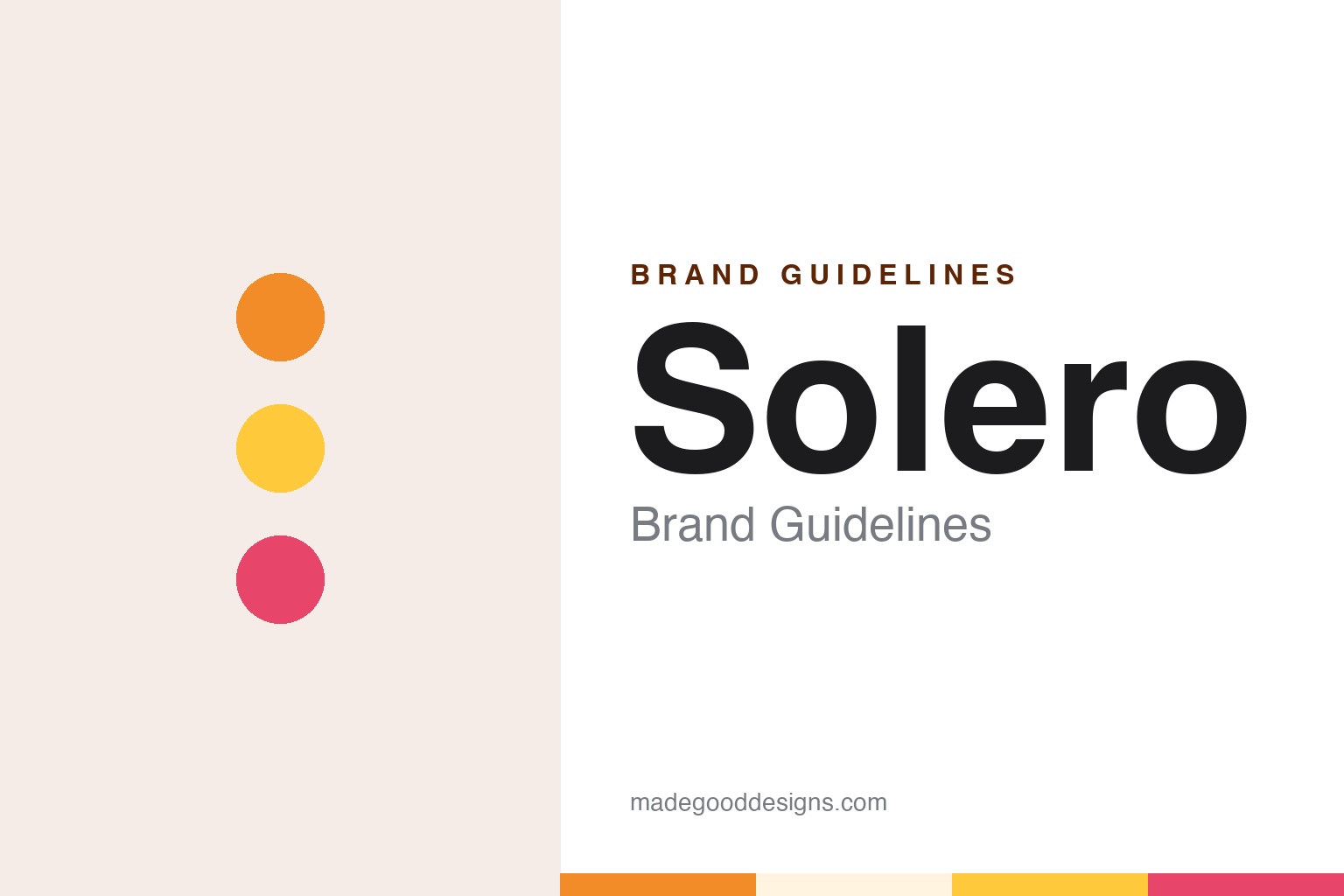
Two constants: an exotic orange, mango yellow and passion pink palette and a sunny rounded sans register. Abstract homage — not a Solero product or mark; no pack, logo or lolly is reproduced.
A name with the sun in it
Birds Eye Wall’s, 1994, and a coat of soft fruit.
Solero is an ice lolly on a stick: ice cream inside a coating of fruit sorbet. In Britain it is sold under the Wall’s name, and since 2025 it has belonged to The Magnum Ice Cream Company, the Amsterdam-based business that Unilever separated from the rest of the group. Its best-known flavour is Solero Exotic, which the trade site FoodBev called the range’s top-selling flavour in 2025.
The brand began in Britain. According to Advertising Age International, which profiled the launch in December 1996, Solero was developed by Birds Eye Wall’s, then Unilever’s British ice cream subsidiary, and introduced in the UK in mid-1994, backed by advertising and a sampling campaign. The magazine described the outer coating as a fruit purée that stays soft even at very low temperatures, worked out with Unilever’s UK ice cream development department, and said the lolly was aimed at people aged 24 to 35. English Wikipedia likewise gives 1994 as the year Unilever first launched the brand.
The name was chosen with export in mind. Advertising Age International quoted the senior brand manager Giles Pearman as saying the team wanted a name that would work across the world, was not tied to any one language and carried a reference to the sun. That suited what came next. After strong demand in Britain, the magazine reported, a pan-European launch in 13 markets began in March 1995, and the first television campaign, called “Fruits”, went national in the UK in May 1995 before running in other European markets. By the end of 1995 more than 130 million Soleros had been sold in the UK and Europe, about 10% above Wall’s target, and the next aim was to be on sale in more than 20 European countries by the end of 1996. The magazine called it the fastest international roll-out of an ice cream brand in Unilever’s history.
Colour
Spin-offs, a “sleeping beauty” and a new range.
Over the following decades the name was stretched to new formats in different markets. In Thailand, the trade site Just Food reported in January 2002, Wall’s put 50 million baht behind two new Solero products in what it called an “ice refreshment” category: lime-flavoured ice balls in a flip-lid cup, and Solero Crush, an icicle with pineapple pieces. In Britain, Just Food reported in March 2007 that Wall’s was adding Solero Smoothies in two flavours, Strawberry & Banana and Blackberry & Banana, and relaunching Solero Exotic with real fruit pieces in its coating.
For much of its life, though, the brand was essentially British. In a November 2025 company article, Leyal Eskin Yilmaz, The Magnum Ice Cream Company’s chief marketing officer for Europe, Australia and New Zealand, called Solero “a sleeping beauty”: five years earlier, the company says, its only significant market was the UK. Sales among 25- to 45-year-olds began to take off in 2020, Yilmaz said, and the company says Solero has since doubled in size by both volume and value and expanded from the UK into Spain, France, Italy and Portugal. The company describes the lolly as dipped in real fruit juice that is rapidly frozen to form its coating, and says the range has grown from one variant to four, with two mini multipacks added and more formats beyond the stick planned for 2026.
In March 2025 FoodBev reported that Wall’s was launching Solero Orange Burst, a multipack of Solero Exotic and a relaunch of the red berries flavour as Solero Berry Bliss. The same announcement paired two brands from the same stable: a Carte d’Or Solero Exotic dessert, combining Carte d’Or vanilla ice cream with Solero fruit sorbet and peach, passion fruit, mango and pineapple flavours. On the marketing side, the company says its UK team trialled a partnership with the television show Love Island in 2025, with Solero-branded bikinis and pool floats, and works with TikTok and Meta on social content.
Typography
Design and documentation.
The seven brands in this group all make ice cream, and all of them are sold in Britain: Wall’s, Carte d’Or, Mackie’s, Kelly’s of Cornwall, Little Moons, Viennetta and Solero. Ice cream brands sold in Britain in general sit at many different points in the trade, from family firms that still carry a founder’s surname to names that now belong to much larger food groups, and a single brand can be sold everywhere from a seaside kiosk to a supermarket freezer.
An ice cream brand’s identity is usually carried less by a single product than by a pack, a name and the treat it promises, because the company behind the name may have changed hands, moved its factory or grown far beyond the place where it started. That makes the questions behind each name worth asking plainly: who started it, who owns it now, and where its ice cream is actually made and packed.
Each guide separates what independent sources record from what the company says about itself — its founding story, its owners over time, where its ice cream is made and how its packaging has changed — and marks plainly what rests only on the company’s own word.
Aa
A sunny rounded sans for a lolly whose name points to the sun. (Specimen set in Fredoka, a sans STAND-IN; NOT the Solero logo.)
Solero
A Gloucester-made lolly in a new ice cream company.
Solero has always been one part of a much larger ice cream business. For most of its life that business was Unilever’s ice cream division, which sold many of its products under local names grouped behind a shared heart logo: Wall’s in Britain, Langnese in Germany, Algida in Italy and Ola in the Netherlands, among others. The heart itself dates from 1998. Designed by the London consultancy Carter Wong, it was first shown as a pair of red and yellow intertwining hearts, Design Week and The Independent reported that spring, and in Britain the change reached about 100,000 outlets selling Wall’s ice cream. Unilever relaunched the logo in 2003.
The ownership changed in 2025. Unilever announced in March 2024 that it would separate its ice cream business; on 1 July 2025 the division became a subsidiary called The Magnum Ice Cream Company, with its head office in Amsterdam, and on 8 December 2025 the company began trading on Euronext Amsterdam, its primary listing, as well as in London and New York, Euronext announced. Euronext described it as the world’s largest ice cream company, active in 80 countries, with €7.9 billion of revenue in 2024. Solero sits there alongside Magnum, Cornetto and Viennetta, and the company groups Solero with Twister and Calippo as its Wall’s refreshment brands, which it says together grew sales by double digits across Europe in the summer of 2025.
For the British market, Solero is made in Gloucester. In November 2025, Food Manufacture and the regional business site TheBusinessDesk.com reported a £50 million upgrade of the company’s Gloucester factory, which they described as the home of UK production for Solero, Viennetta and Magnum, among others. Opened in 1959, the site is the largest ice cream factory in the UK and the second-largest in Europe, employing almost 500 people and producing more than 600 million ice creams a year, over 80% of them for the UK market, Food Manufacture reported. The investment covers a rebuilt mix plant and new high-speed production lines, with the company aiming to raise output by 50% by 2027 compared with 2023.
For a design guide, Solero shows how a single product idea — ice cream in a coat of soft fruit — and a name chosen to travel can carry a British lolly across Europe and back to growth three decades later. Compare Magnum, the same company’s chocolate-coated stick, and Cornetto, its cone. For this guide we use an exotic orange, a mango yellow and a passion pink with a rounded sans, an unofficial interpretation; no product or logo is reproduced.
Explore & save
Keep Solero’s identity on hand — save it to a board in the Made Good inspiration library.
Solero identity set
Pin the Solero exotic orange, mango yellow and passion pink palette and the sunny rounded sans register to your own board.