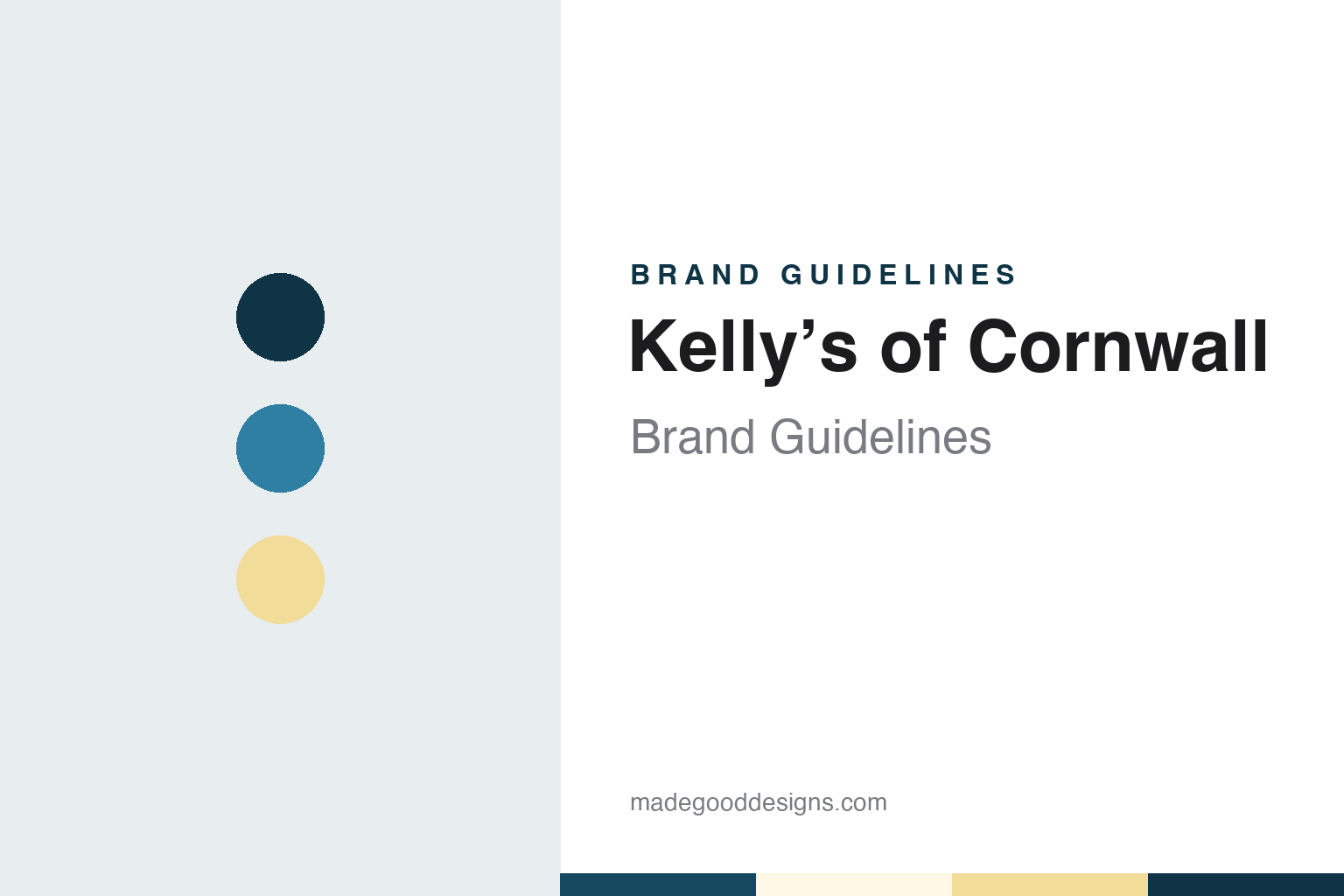
Kelly’s of Cornwall Brand Guidelines
The St Austell ice cream family business that became a Froneri brand.
Aa
Two constants: an Atlantic blue and clotted cream palette and a soft seaside serif register. Abstract homage — not a Kelly’s of Cornwall product or mark; no tub, logo or advert is reproduced.
From St Austell to Bodmin
An Italian migrant, a pony and cart and a new name.
Kelly’s of Cornwall began not in Bodmin but in St Austell. In the 1890s, Cornwall Life reported in 2016, Joseph Staffieri moved to Britain from Italy and settled in the town; English Wikipedia, citing the West Briton, says he set up an ice cream and fish-and-chips business there. His daughter Florrie married Lazero Calicchia, who took over the family business — in 1918, according to Wikipedia, citing the Cornish Guardian — and built up the ice cream side, launching the first Kelly’s mobile unit with a pony and cart. That, the magazine said, was the origin of a fleet of around 30 vans seen each summer on Cornish beaches and landmarks from Polzeath to Land’s End.
The name came later. In the early 1930s, Cornwall Life said, Lazero Calicchia changed the family and business name to the easier-to-pronounce Kelly. After his death in 1948 his sons took over, and in the 1970s, when the parents of the later managing director Philip Kelly were running it, the business moved to a new ice cream factory in Bodmin. The brand today dates itself from the renaming: the Kelly’s website says the company has been taking its ice cream “very seriously since 1930,” and Froneri’s UK head of marketing called it a brand that had “stood the test of time since 1930,” Retail Times reported in 2021. In 2016 the company told The Guardian it had been in business in Cornwall for more than 100 years.
The ice cream has been a fixture at the Royal Cornwall Show since 1947, Wikipedia says, citing the Cornish Guardian. Its distinguishing ingredient is Cornish clotted cream, and Cornwall Life called Kelly’s a pioneer of Cornish clotted cream ice cream. Philip Kelly told the magazine in 2016 that all the company’s milk and clotted cream came from Trewithen Dairy, which pasteurised the milk, heated the cream slowly to 75°C and delivered it chilled; Food Manufacture put the dairy about five miles from the factory in 2012.
Colour
R&R, Froneri and the national tub.
Kelly’s left family ownership in two steps. R&R Ice Cream — formed in 2006, according to Froneri’s own history, when the investment firm Oaktree Capital Management bought Richmond Foods and merged it with Roncadin — took a 75% stake in 2008 and the rest of the business in January 2010, Food Manufacture reported in 2012. Froneri’s history describes the 2008 deal as the acquisition of “the UK’s leading producer of premium Cornish ice cream.” The aim was to take the brand national, Wikipedia says, citing the Western Morning News, and Kelly’s went on to be stocked by supermarkets such as Tesco.
The owner changed twice more. PAI Partners bought R&R from Oaktree in 2013, and in 2016 R&R combined with Nestlé’s ice cream business to form Froneri, the company says. Kelly’s is still made in Bodmin. Food Manufacture found the factory producing about 12 million litres a year in 2012. Wikipedia, citing the Western Morning News, says it made about 14.5 million litres of clotted cream ice cream between June 2013 and June 2014, when the company described itself as Britain’s sixth-largest ice cream maker, and that in 2016 it announced a £2 million investment at the factory to raise output. The Kelly’s website says its whole milk and clotted cream come from local herds within 25 miles of the factory.
Alongside the supermarket tubs, Kelly’s kept a local trade of vans and scooping parlours. Wikipedia says the company ran its van fleet independently of R&R and invested in parlours around Cornwall after the takeover, with at least 49 listed on its parlour map in 2016; Cornwall Life mentioned a Kelly’s shop in St Ives. Philip Kelly told the magazine that some of the best-selling flavours, including Strawberries & Cream and Honeycomb Caramel, were his father’s creations, and the company says its parlours now offer more than 20 flavours.
Typography
Design and documentation.
The seven brands in this group all make ice cream, and all of them are sold in Britain: Wall’s, Carte d’Or, Mackie’s, Kelly’s of Cornwall, Little Moons, Viennetta and Solero. Ice cream brands sold in Britain in general sit at many different points in the trade, from family firms that still carry a founder’s surname to names that now belong to much larger food groups, and a single brand can be sold everywhere from a seaside kiosk to a supermarket freezer.
An ice cream brand’s identity is usually carried less by a single product than by a pack, a name and the treat it promises, because the company behind the name may have changed hands, moved its factory or grown far beyond the place where it started. That makes the questions behind each name worth asking plainly: who started it, who owns it now, and where its ice cream is actually made and packed.
Each guide separates what independent sources record from what the company says about itself — its founding story, its owners over time, where its ice cream is made and how its packaging has changed — and marks plainly what rests only on the company’s own word.
Aa
A soft seaside serif for a clotted cream ice cream sold from beach vans. (Specimen set in Fraunces, a serif STAND-IN; NOT the Kelly’s of Cornwall logo.)
Kelly’s is Cornish for ice cream
A language advert and two pack refreshes.
Kelly’s design and advertising have leaned on Cornwall itself. In 2016 the range was relaunched in new packaging featuring a Cornish beach scene and a dairy cow, Cornwall Life reported. The same year the agency Isobel, which won the account in January 2016 according to Campaign, made what The Guardian called the first Cornish-language television advert. In the 30-second spot a Cornish ice cream seller speaks Kernewek as he sells his ice cream; it ran for six weeks from May 2016 in prime-time breaks on ITV and Channel 4, including Britain’s Got Talent. Shot at Millbrook, it carried the tagline “Kelly’s is Cornish for ice cream” and was made with support from the Cornish Language Partnership, with a downloadable Cornish phrasebook alongside. It aired weeks after the government cut its £150,000 annual funding for the language, the newspaper noted.
The next refresh came in March 2021, the brand’s first in five years, Retail Times reported. It brought a new cream-coloured tub that the brand said looked more contemporary, kept the transparent lid, added a picture of the ice cream to the front of the tub and updated the flavour banners so the range was easier to tell apart on the shelf. Two new flavours, chocolate and raspberry ripple, came with it, along with support for the Bumblebee Conservation Trust. Kelly’s of Cornwall remains one of Froneri’s brands in Britain, with its base and factory in Bodmin.
For a design guide, Kelly’s shows how a regional ice cream can sell its place — a beach, a cow, a language — once it reaches national shelves. Compare Mackie’s, the Aberdeenshire farm ice cream, and Tillamook, the farmer-owned Oregon dairy. For this guide we use an Atlantic blue, a surf blue and a clotted cream yellow with a soft serif, an unofficial interpretation; no product or logo is reproduced.
Explore & save
Keep Kelly’s of Cornwall’s identity on hand — save it to a board in the Made Good inspiration library.
Kelly’s of Cornwall identity set
Pin the Kelly’s of Cornwall Atlantic blue and clotted cream palette and the soft seaside serif register to your own board.