Percol Brand Guidelines
Brian Chapman’s 1987 Fairtrade and organic coffee brand.
Aa
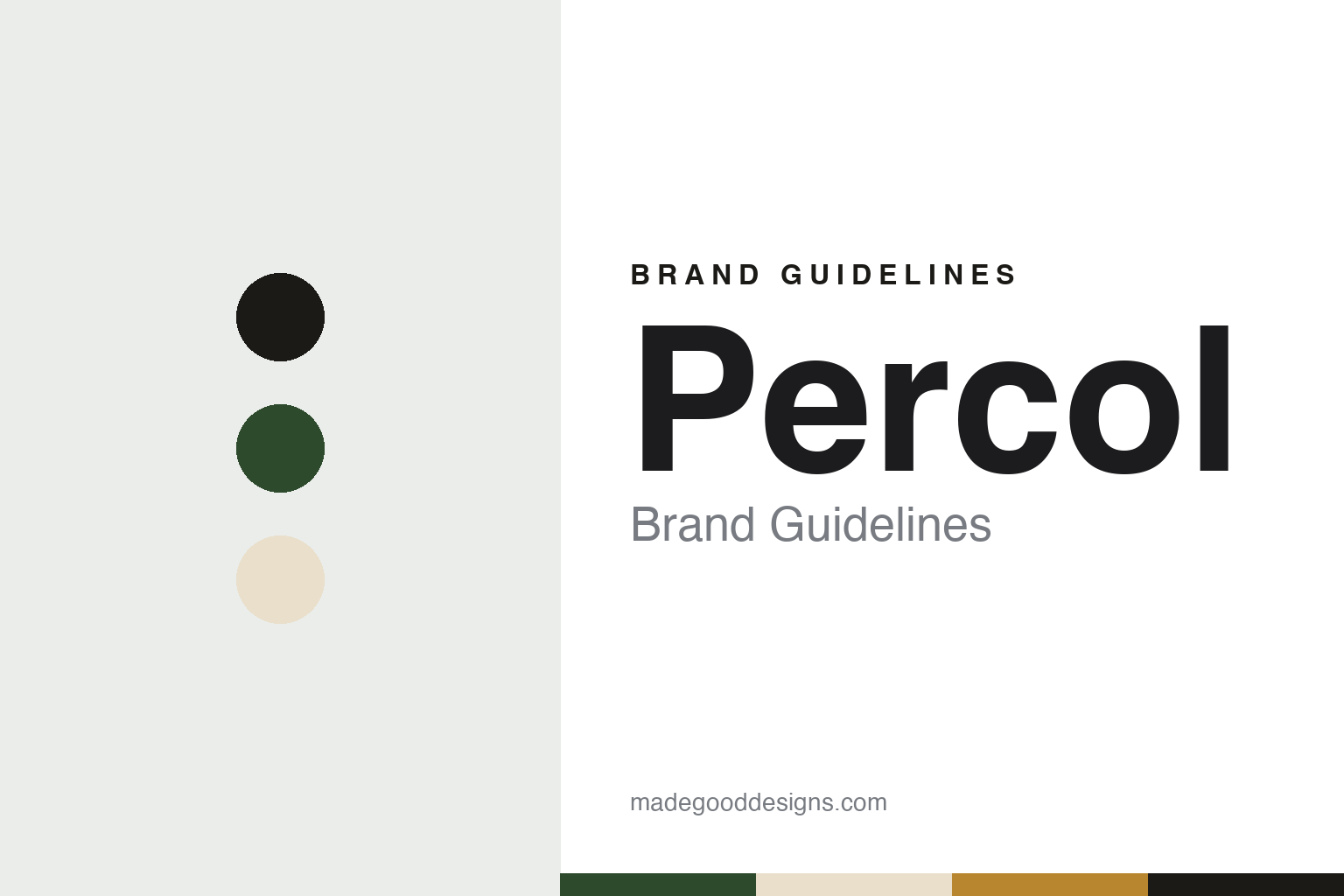
Two constants: a leaf green, roast black and kraft palette and a display serif register. Abstract homage — not a Percol product or mark; no jar, bag, logo or label is reproduced.
Food Brands Group
An advertising man who went into coffee.
Percol is a British coffee brand created in 1987 by Brian Chapman, and the company still gives 1987 as its founding year. English Wikipedia, citing an Evening Standard profile of 3 January 2007, says Chapman began his career in advertising before founding a coffee distributor called Copack in 1970. In 1978, working with another company, he launched a coffee brand called Verdona through Sainsbury’s, which sold a million jars in its first week, the same article says.
In 1987 Chapman went out on his own, and Percol was the brand he built at Food Brands Group, the London coffee wholesaler he ran as director. Companies House records Food Brands Group Limited as a private company incorporated in July 1983, classed under the wholesale of coffee, tea, cocoa and spices, and it remained the company behind the brand for more than 25 years: archived copies of the Percol website from 2017 name Food Brands Group Ltd, of south-west London, as the promoter of its competitions and offers.
From the start Percol placed itself at the ethical end of the supermarket coffee aisle. It sold organic and single-origin coffees alongside its blends, and by the mid-2000s its website described it as a maker of “Fairtrade and Organic Coffees,” with ground coffees named after origins such as Honduras and Nicaragua and a Fairtrade Colombia decaf instant coffee sold through Waitrose. The 2008 version of the site also said the brand supported coffee-growing communities through the charities Grounds for Hope and Coffee Kids.
When Percol came to Fairtrade is told two ways. The company says that in 1994 it “pioneered Fairtrade in the UK, the first to supply certified coffee,” and earlier versions of its website said Percol “was the first ground coffee to be Fairtrade certified.” English Wikipedia, citing a 2007 newspaper profile, says Percol became “one of the first coffee brands” to achieve Fairtrade certification in 2003. Both are given here as their sources state them.
Colour
Awards, organics and the end of plastic.
Percol built its reputation on taste awards and certification marks rather than on a single famous advertisement. Its website says it won more gold medals than any other coffee at the 2007 Great Taste Awards, a British fine-food competition, and four golds in 2010, bringing its total to 36 industry awards since 2002; later it put the total at more than 40, including three Great Taste Awards in 2012. The archived 2008 homepage led with “5 Golds at the 2007 Great Taste Awards.” By 2007, English Wikipedia says, citing the same profile, the brand was worth £10 million.
Certification has always sat on the front of the pack. The company lists three schemes: Fairtrade, the Rainforest Alliance and the Soil Association, the British organic certifier. Its current range marks each product with one of them — the Rich Americano ground coffee, for example, is sold as Fairtrade and organic, while its freeze-dried instant coffees carry the Rainforest Alliance seal.
Packaging became the brand’s second story. In 2017 Percol ran a scheme it called the “Percol Pod Revolution,” offering compostable coffee capsules in exchange for used ones. The company says that in 2018 it was the first coffee brand to receive the “Plastic Free Trust Mark” from the campaign group A Plastic Planet, and that in 2019 it became the first brand to move much of its plastic packaging, including its ground-coffee bags and capsules, to other materials. Its website from 2019 to 2023 opened with the line “Coffee on a mission” and promised “Plastic-free. Carbon-neutral. Fairtrade-certified.” Its coffee bags — ground coffee in a bag with a string and tag, brewed like a tea bag — are described as plastic-free, with the instruction that used bags can go into a local authority food-waste bin. The company says that in 2024 it replaced the plastic lids on its instant-coffee jars with metal ones.
The range today is small: instant, ground and coffee bags. Each product carries a roast number on a strength scale, from Roast 3 for the light Smooth Colombian to Roast 6 for the Intense Espresso Noir, a robusta instant powder.
Typography
Design and documentation.
The seven brands in this group all sell coffee, and they come from Britain, France, Switzerland, the United States and Italy: Kenco, Carte Noire, Percol, Nescafé, Caribou Coffee, Gloria Jean’s and Caffè Mauro. Coffee brands in general sit at many different points in the trade, from family roasters that still carry a founder’s surname to names that now belong to much larger food and drink groups, and a single brand can be sold everywhere from a café counter to a supermarket shelf.
A coffee brand’s identity is usually carried less by a single product than by a pack, a name and the cup it promises, because the company behind the name may have changed hands, moved its roastery or grown far beyond the town where it started. That makes the questions behind each name worth asking plainly: who started it, who owns it now, and where its coffee is actually roasted and packed.
Each guide separates what independent sources record from what the company says about itself — its founding story, its owners over time, where its coffee is made and how its packaging has changed — and marks plainly what rests only on the company’s own word.
Aa
A display serif for a brand that says it is “Carefully Crafted Coffee.” (Specimen set in Playfair Display, a serif STAND-IN; NOT the Percol logo.)
Percol
From a London wholesaler to Karlstad and India.
Percol has changed hands. In 2013 Food Brands Group was bought by Löfbergs, the family coffee roaster of Karlstad in Sweden, English Wikipedia says, citing the Western Mail of 5 July 2013, which put the company’s turnover at about £9 million a year. Companies House still lists the Löfberg family holding company in Karlstad as the person with significant control of Food Brands Group, holding 75 per cent or more of its shares.
The brand itself is now presented differently. Since at least July 2024, archived copies of the Percol website show a copyright line in the name of CCL Products (India) Limited, the listed instant-coffee maker based in Andhra Pradesh, India, which also makes coffee in Vietnam and Switzerland, according to its 2023–24 annual report, and they direct UK consumer enquiries to Sucafina UK. The current website opens by asking visitors to choose between a UK store and an India store, and says the brand is now bringing its “legacy to India,” with a separate Indian range of instant coffees that blend Indian beans with coffee from Colombia or Vietnam.
Where Percol is made is stated only in general terms. The company says its ground coffee is “roasted in the UK,” and in 2023 its website said its beans were “freshly roasted in the UK”; it does not name a roastery, and it says its roasting uses “energy-efficient” processes. It remains on sale in British supermarkets, and its website lists Tesco, Morrisons, Ocado and Costco among its stockists.
The brand’s voice has stayed consistent across owners. It calls itself “Carefully Crafted Coffee,” says coffee is “for life’s doers,” and has asked for years, in the same words, “Can coffee change the world? Well, we won’t know until we try.”
For a design guide, Percol shows how a supermarket brand can make its certification marks and its packaging choices the centre of its identity. Compare Löfbergs, the Swedish roaster that bought its parent company, and Kenco, another British supermarket coffee. For this guide we use leaf green, roast black and kraft with a serif, an unofficial interpretation; no product or logo is reproduced.
Explore & save
Keep Percol’s identity on hand — save it to a board in the Made Good inspiration library.
Percol identity set
Pin the Percol leaf green, roast black and kraft palette and the display serif register to your own board.