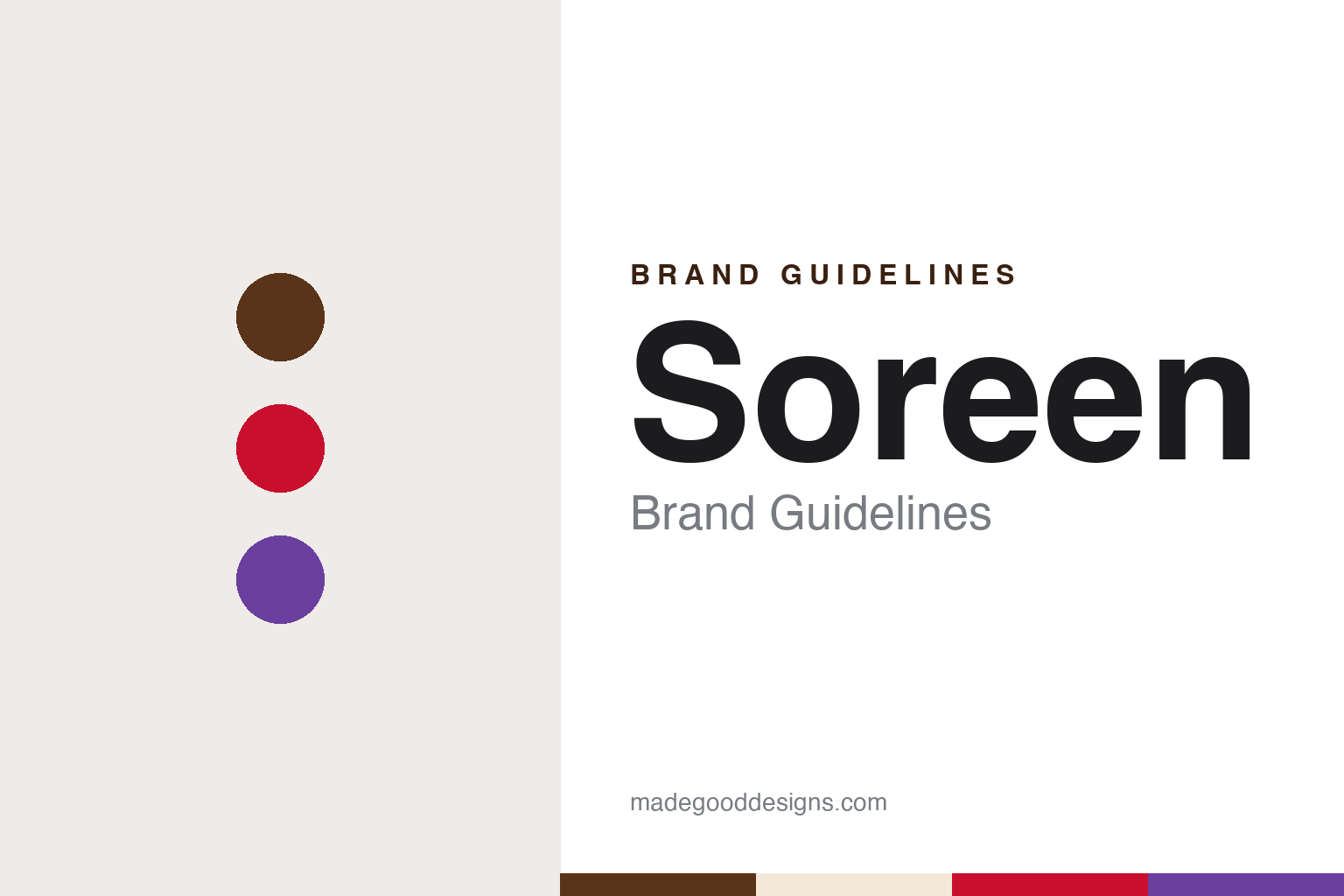
Soreen Brand Guidelines
The Manchester malt loaf with a Danish founder.
Aa
Two constants: a malt brown, wrapper red and grape purple palette and a rounded friendly sans register. Abstract homage — not a Soreen product or mark; no pack, logo or loaf is reproduced.
A Dane in Manchester
A bakery-equipment trader, a malt cake and a £300 sale.
Soreen is a Manchester loaf with a Danish name behind it. The company’s own history says its creator, John Rahbek Sorensen, was born in Denmark in 1893 and reached Britain in 1920 after a long journey from Melbourne. In 1932, the company says, he bought a property on Drake Street in Hulme, Manchester, and two years later he set up John Sorensen Bakery Equipment & Co, selling bakery machinery such as pastry brakes and bun dividers.
Baking followed the equipment. Over the next few years, Soreen says, Sorensen bought more property, including a small shop in Beswick, in east Manchester, where he began selling his own cakes. The one customers queued for was what he called the Sorensen Malt Cake, which the company today describes as a “squidgy” loaf. Soreen says its malt loaf is still made from Sorensen’s original 1938 recipe, which it keeps under lock and key and shares with only a handful of its bakers.
In 1938, by the company’s account, Sorensen sold the bakery business for £300 to William Mason, a local maker of bakery ovens. Mason and his wife, Peggy, became the directors of a new company, Imperial Bakeries Limited (Manchester), and Sorensen’s name lived on in a shortened trading name: Soreen. When the business changed hands in 2014, its new owner said the malt loaf range had earned the trust of British shoppers since 1939, Food Manufacture reported.
The early business was small. Soreen says that in the early 1940s, despite wartime rationing, Imperial Bakeries ran one oven with four bakery staff and two shop assistants; apart from the mixing, everything was made by hand and delivered by a small van to shops within a five-mile radius. In 1942, the company says, a bomb destroyed the bakery; nobody was hurt, because the staff were on holiday while the oven was being serviced. Production resumed in larger premises on Buckley Street in Higher Openshaw.
Colour
Waxed paper, grapes and a squidgy loaf.
The look of the loaf goes back to those wartime years. According to Soreen, each loaf leaving Buckley Street was wrapped by hand in a single sheet of waxed paper printed with a red Soreen logo and a bunch of purple grapes, there to show that the loaf contained fruit. The company presents the grapes as a motif its customers will still recognise today, and says its loaves are now wrapped by machine while still warm.
For much of its life Soreen sold itself on energy. The company says that in the 1980s its marketing promoted its loaves as a source of long-lasting energy and that it ran joint adverts and competitions with Adidas. Sport sponsorship followed. Soreen says it backed the football club Bolton Wanderers in 1999 and the rugby league side Leigh Centurions in 2000, and in 2006 signed a four-year deal with the track cyclist Chris Hoy, who went on to become an Olympic champion and appeared at events as a Soreen ambassador. In October 2010, the company says, a Soreen team pedalled for 24 hours at the Manchester Velodrome and set a world record for the most power generated by cyclists in that time.
Its advertising later leaned into texture. In 2017 Soreen took an animated campaign, “Are you a squidgy bit Soreen?”, to UK cinemas, the trade title British Baker reported. In October 2019 the Manchester agency Cheetham Bell launched a national campaign called “Deliciously Squidgy Adventures”, which the website About Manchester reported ran on YouTube and video on demand, on digital screens at London Euston and the Manchester Arndale shopping centre, on London Underground platforms and on the sides of buses. It featured the Original Malt Loaf alongside Lunchbox Loaves, Loaf Bars and Buttered Slices. In February 2026 Food Manufacture reported that Soreen was relaunching its Lunchbox Loaves with an updated pack design and an improved recipe, backed by £2 million of marketing.
Typography
Design and documentation.
The seven brands in this group all sell bread, cake or other bakery goods, and all of them come from Britain: Warburtons, Hovis, Kingsmill, Allinson, Soreen, Mr Kipling and Genius. British bakery brands in general sit at many different points in the trade, from family firms that still carry a founder’s surname to names that now belong to much larger food groups, and a single brand can be sold everywhere from a corner shop to a supermarket shelf.
A bakery brand’s identity is usually carried less by a single product than by a pack, a name and the loaf or cake it promises, because the company behind the name may have changed hands, moved its bakeries or grown far beyond the town where it started. That makes the questions behind each name worth asking plainly: who started it, who owns it now, and where its products are actually baked and packed.
Each guide separates what independent sources record from what the company says about itself — its founding story, its owners over time, where its products are made and how its packaging has changed — and marks plainly what rests only on the company’s own word.
Aa
A rounded friendly sans for a soft, squidgy loaf. (Specimen set in Fredoka, a sans STAND-IN; NOT the Soreen logo.)
Soreen
Warburtons, Inter Link, McCambridge and Samworth.
By the early 2000s Soreen belonged to Warburtons, the Bolton bakers. In February 2003 the food group Inter Link Foods completed its purchase of the Soreen malt loaf business from Warburtons, which the trade site Bakery and Snacks described that July as Inter Link’s largest acquisition to date; English Wikipedia’s article on malt loaf, citing the Manchester Evening News, dates the sale to 2004. In 2007 Inter Link itself was bought by the McCambridge group, Just Food reported.
In February 2014 Samworth Brothers, the Leicestershire food maker that also owns the Ginsters pasty brand, bought Soreen from McCambridge for an undisclosed sum. Food Manufacture reported that the buyer was Gibbs Croft, part of Samworth Brothers, and that the deal included the Soreen bakery at Trafford Park, Manchester, its assets and its 125 staff, with the managing director Paul Tripp’s team staying on to run Soreen as an autonomous business. Just Food quoted an Ernst & Young adviser who credited the management with bringing the brand “out of the dark ages.” Later that month the Manchester Evening News reported that Soreen’s sales had risen 20% in 2013, to £30 million.
Soreen is still a Manchester product. The company says every Soreen loaf is made in Manchester and that it sends out about 1.5 million loaves a week. In November 2024 Grocery Gazette reported that Samworth Brothers had put Soreen up for sale, working with the corporate finance adviser Spayne Lindsay, as it focused on its core products; the report put Soreen’s 2023 sales at £41 million, up 13%. In February 2026 Food Manufacture still described the brand as Samworth Brothers-owned.
For a design guide, Soreen shows how a wartime wrapper — a red name and a bunch of grapes — can carry a single loaf through more than eight decades and several owners. Compare Warburtons, the Bolton baker that owned Soreen until 2003, and Tunnock’s, the family bakery in Uddingston. For this guide we use a malt brown, a wrapper red and a grape purple with a rounded sans, an unofficial interpretation; no product or logo is reproduced.
Explore & save
Keep Soreen’s identity on hand — save it to a board in the Made Good inspiration library.
Soreen identity set
Pin the Soreen malt brown, wrapper red and grape purple palette and the rounded friendly sans register to your own board.