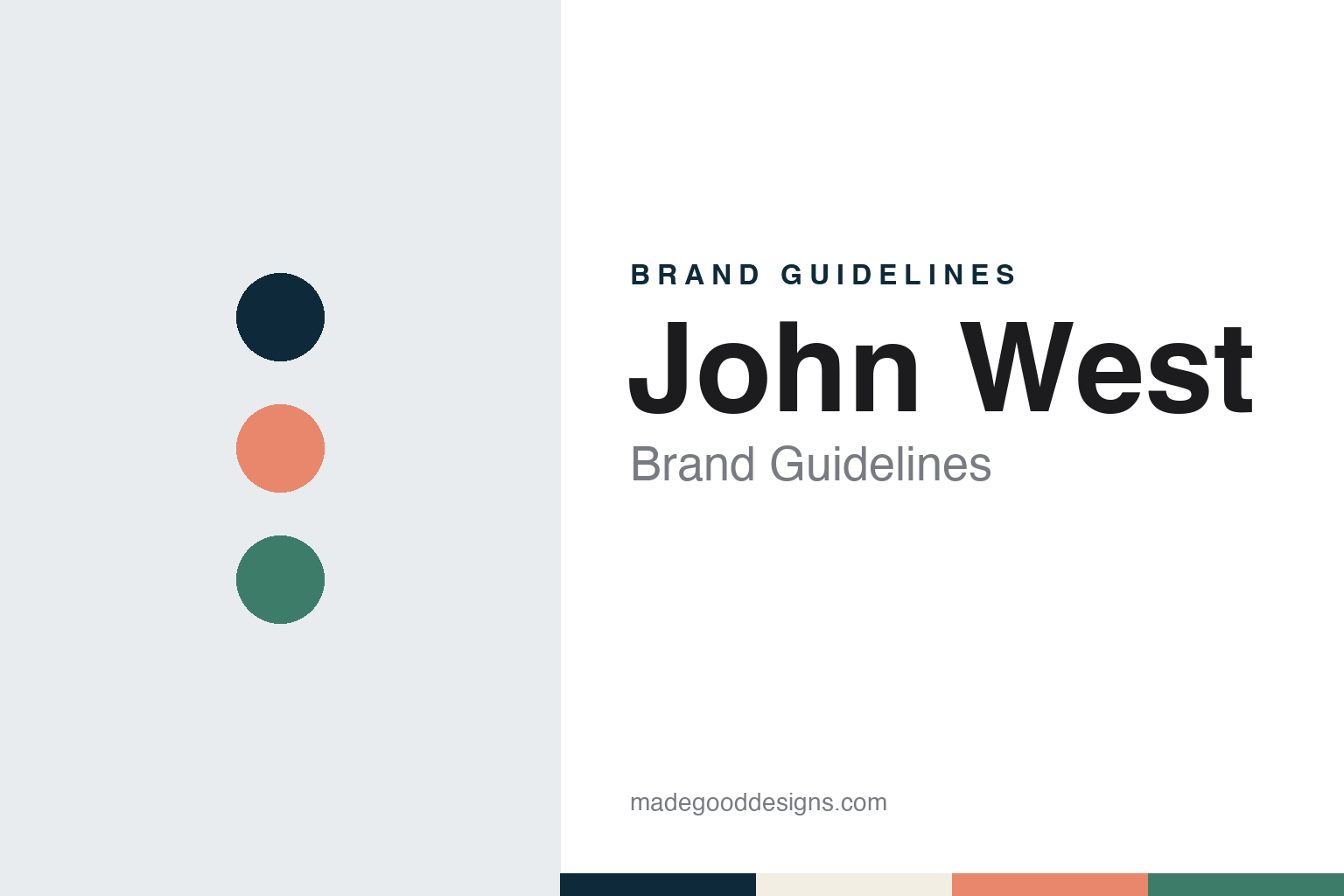
John West Brand Guidelines
The Oregon salmon canner’s name that Liverpool bought.
Aa
Two constants: a deep water, salmon pink and river green palette and a sturdy slab serif register. Abstract homage — not a John West product or mark; no can, label or logo is reproduced.
Pelling Stanley
A Liverpool importer and a Scottish canner in Oregon.
The brand is named after a real man, but the business behind it was founded in Liverpool. English Wikipedia, citing Grace’s Guide to British Industrial History, says T. L. Pelling and C. H. Stanley set up Pelling Stanley & Co. in Liverpool in 1857, and that the firm soon specialised in importing canned food, then a new kind of product. By 1879 it was importing canned salmon packed by the John West company in Oregon; it bought the rights to the John West name in 1888, and the first shipments of John West Salmon appeared in 1892, the article says, citing a company history.
John West himself was a Scot. English Wikipedia says he was born in Linlithgow in 1809, trained as a millwright in Quebec, joined the California gold rush in 1849 and reached Astoria, Oregon, in 1850. In 1853 he took up a 640-acre land claim on the lower Columbia River, where the settlement of Westport grew up around his sawmill. Wikipedia says he was shipping salted salmon in barrels as early as 1857, and that in 1868, with partners, he founded the Westport Cannery, the first on the Oregon shore of the Columbia. Citing a 1953 article in the Oregon Historical Quarterly, it says the cannery won a gold medal from the Oregon Agricultural Society in October 1873; the brand’s own timeline dates that medal to 1874. West died at Westport in 1888, the year Pelling Stanley bought the rights to his name.
Today’s brand tells his story as its own. The John West website calls him the company’s founder and opens its timeline with his voyage from Scotland in 1832, his sawmills on the Columbia and, in 1857, the salmon salterie that it says first made the John West name known in Great Britain. It also credits him with inventing an automated can-filling machine in the 1860s, a claim English Wikipedia repeats. A state historical marker near Westport has commemorated him and the town he founded since July 2009, Wikipedia says.
Colour
Unilever, Heinz, a French holding and Thai Union.
In the twentieth century the brand passed into the Unilever group. English Wikipedia says that by 1924 Pelling Stanley and two other fish importers, Angus Watson & Co. and R. B. Green & Co., were all associated with Unilever, and that by 1964 Unilever had merged the three into a single company, John West Foods. The brand’s own timeline dates its first canned tuna to 1952 and its first television advertising to the 1960s.
Unilever sold most of the business in the late 1990s. On 30 June 1997 the American food company H.J. Heinz announced that its British affiliate had acquired John West Foods Limited from Unilever, describing it as the leading brand of canned tuna and fish in the UK, according to the PR Newswire release. The John West operations in Australia, New Zealand and South Africa stayed with Unilever, and in June 2003 Simplot Australia bought the Australian canned-fish business, The Age reported. Heinz kept the European business for less than a decade. In March 2006 it completed the sale of its European seafood business, John West included, to MW Brands, a French-based company owned by Lehman Brothers, for €425m, The Manufacturer reported at the time.
The current owner arrived in 2010. In July that year Thai Union Frozen Products, now Thai Union Group, agreed to buy MW Brands, owner of John West and the French brand Petit Navire, for €680m from the private-equity firm Trilantic Capital Partners, FinanceAsia reported. MW Brands brought processing plants in France, Portugal, the Seychelles and Ghana, and FinanceAsia said the deal would make the Thai company one of the world’s largest seafood groups. John West was MW Brands’ flagship, with more than €300m of annual sales across Europe, led by the UK and France, the same report said. The brand’s UK website lists John West Food Ltd at an office in Liverpool, the city where Pelling Stanley began.
Typography
Design and documentation.
The seven brands in this group all sit in the British store cupboard: Princes, John West, Batchelors, Ambrosia, Bird’s, Paxo and Saxa. British store-cupboard brands in general sit at many different points in the trade, from names that still carry a founder’s surname to names that now belong to much larger food groups, and a single brand can be sold everywhere from a corner shop to a supermarket shelf.
A store-cupboard brand’s identity is usually carried less by a single product than by a pack, a name and the meal or kitchen job it promises, because the company behind the name may have changed hands, moved its factory or grown far beyond the town where it started. That makes the questions behind each name worth asking plainly: who started it, who owns it now, and where its products are actually made and packed.
Each guide separates what independent sources record from what the company says about itself — its founding story, its owners over time, where its products are made and how its packaging has changed — and marks plainly what rests only on the company’s own word.
Aa
A sturdy slab serif for a name first printed on Oregon salmon tins. (Specimen set in Bitter, a slab-serif STAND-IN; NOT the John West logo.)
John West
The fish it rejects, a bear and a promise.
John West advertising has leaned on one idea for decades. In the 1960s, as television advertising took off in Britain, the brand used the line “It’s the fish that John West rejects that makes John West the best,” The Drum recalled in 2022, and the company’s website still quotes it in its timeline.
Its best-known commercial came in 2000. Made by the agency Leo Burnett, “Bear” showed a fisherman fighting a bear for a salmon on a riverbank, ending on the line “John West endure the worst to bring you the best.” The Drum says the bear was a suit from the Jim Henson Company. In November 2006 BBC News reported a study by the marketing firm The Viral Factory that ranked the “John West Salmon Bear Fight” joint sixth among the most-watched viral videos online, with an estimated 300 million views, five years after the spot first aired.
The brand’s sourcing has been argued over in public. In August 2008 Greenpeace ranked John West last in its UK tinned-tuna league, The Grocer reported. In 2011 the company pledged to source all its tuna by pole and line, or by purse seine without fish aggregating devices, by the end of 2016, and that October it launched an online tool for tracing a can back to the boat. In October 2015 BBC News reported Greenpeace’s accusation that John West was breaking the pledge, and The Guardian reported a Greenpeace challenge to the tracing tool over tuna canned in Thailand; John West told The Independent that there was no longer enough pole-and-line tuna to meet global demand. In July 2016 The Times reported that Tesco had dropped some John West tuna over fishing methods. The company points to Thai Union’s SeaChange sustainability programme and says that in 2024 it introduced its ECOTWIST can, which it describes as fully recyclable.
For a design guide, John West shows how a Liverpool importer could borrow a person’s name and story — a Scottish millwright canning salmon on the Columbia River — and keep telling it more than a century later through a chain of owners. Compare Princes, the other Liverpool tinned-fish importer that grew into a brand, and Batchelors, another British store-cupboard name in tins. For this guide we use a deep water blue, a salmon pink and a river green with a slab serif, an unofficial interpretation; no product or logo is reproduced.
Explore & save
Keep John West’s identity on hand — save it to a board in the Made Good inspiration library.
John West identity set
Pin the John West deep water, salmon pink and river green palette and the sturdy slab serif register to your own board.