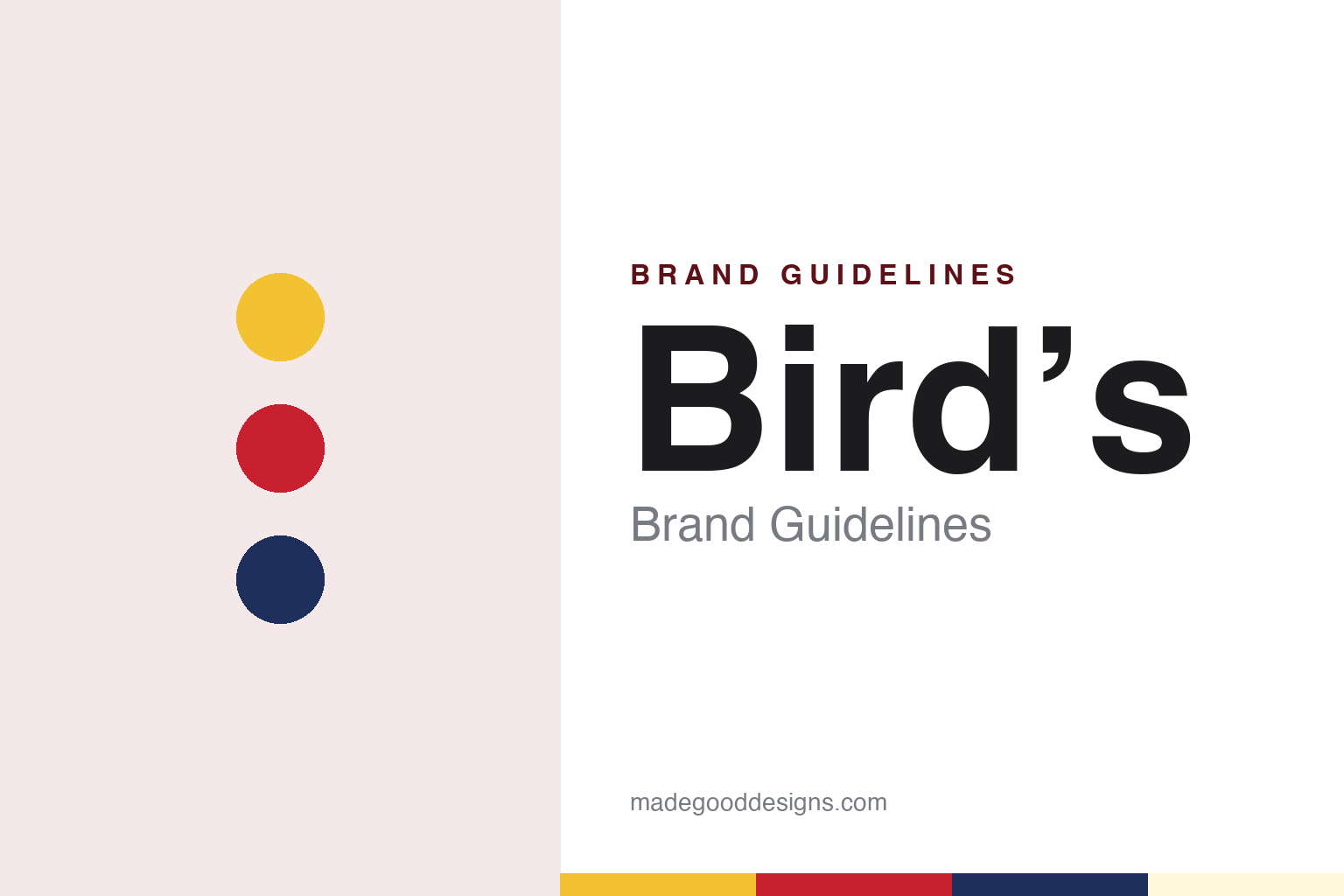
Bird’s Brand Guidelines
The Birmingham chemist’s egg-free custard that became a store-cupboard staple.
Aa
Two constants: a custard yellow, red and navy palette and a Victorian serif register. Abstract homage — not a Bird’s product or mark; no pack, logo or trademark is reproduced.
A chemist’s shop
An egg-free custard on Bull Street, Birmingham.
Bird’s began in a chemist’s shop. Alfred Bird (1811–1878), born in Nympsfield in Gloucestershire, served a pharmacist’s apprenticeship with Philip Harris in Birmingham and in 1837 opened a shop on Bull Street, trading as “Alfred Bird, experimental chemist,” according to English Wikipedia. That year, Wikipedia says, he made an imitation custard thickened with cornflour instead of egg for his wife, Elizabeth, who was allergic to eggs and yeast.
The story that follows is the brand’s founding legend. The Birds are said to have served real egg custard to their dinner guests until one evening the egg-free version reached the table, by accident or design; it was well received, and Bird saw that it had a wider market. Premier Foods, which owns the brand today, calls Bird’s Custard powder its oldest brand, “invented by Alfred Bird in his chemist shop in Birmingham” in 1837.
Custard was not his only product. In 1843, Wikipedia says, he devised Bird’s Fermenting Powder, an early baking powder, so that his wife could eat bread made without yeast, and by 1844 the business was promoting custard powder nationally. The firm became Alfred Bird and Sons. After Bird’s death in 1878 his son, Alfred Frederick Bird, later a baronet, carried the business on, adding egg substitute powder in 1890 and blancmange and jelly powders, according to Wikipedia. During the First World War, Bird’s Custard was supplied to the British armed forces.
The company outgrew Bull Street. A large works in Digbeth, off the High Street at Deritend, was built for Alfred Frederick Bird to designs by the architects Hamblins, Wikipedia says. Those buildings on Gibb Street survive as the Custard Factory, an arts and creative quarter whose redevelopment, by Glenn Howells Architects, began in January 1992.
Colour
General Foods, Banbury and Kraft.
The Bird’s trademark of three birds dates from between the wars. Grace’s Guide, the British industrial-history reference, says the Three Birds trademark originated in 1929, after the success of an advertising campaign, and Wikipedia describes Alfred Bird and Sons as an early user of promotional items and colourful advertising.
After the Second World War, Bird’s became American-owned. Grace’s Guide says that in 1946, with post-war restrictions on imports of packaged goods, General Foods of the United States came to an agreement with Bird’s for it to make and sell General Foods’ Grape-Nuts and Maxwell House ground coffee in Britain, and that in 1947, the arrangement having gone so well, Bird’s became part of General Foods.
The move out of Birmingham followed. Grace’s Guide says work started in 1963 on a new factory at Banbury in Oxfordshire, to provide capacity the Birmingham sites could not, and that production moved there, with many of the staff, in 1966. Wikipedia gives 1964 for the move, and a Midlands News film on the move held by the Media Archive for Central England is dated October 1965, so the dates differ by source.
Bird’s then followed its parent through American mergers. Grace’s Guide says General Foods came together with the tobacco group Philip Morris in 1985 and that in 1988 Bird’s became part of Kraft General Foods.
Under Kraft the pack was redrawn. The D&AD awards archive lists a 1999 Wood Pencil in packaging design for Bird’s Custard, with Kraft Jacobs Suchard as client, and Campaign credited the design to the consultancy Wickens Tutt Southgate. Campaign described the idea as turning the pack’s familiar yellow stripe into a dribbling blob of custard, under the brand proposition “Glorious Satisfaction.”
Typography
Store-cupboard brands and their owners.
The seven brands in this group all sit in the British store cupboard: Princes, John West, Batchelors, Ambrosia, Bird’s, Paxo and Saxa. British store-cupboard brands in general sit at many different points in the trade, from names that still carry a founder’s surname to names that now belong to much larger food groups, and a single brand can be sold everywhere from a corner shop to a supermarket shelf.
A store-cupboard brand’s identity is usually carried less by a single product than by a pack, a name and the meal or kitchen job it promises, because the company behind the name may have changed hands, moved its factory or grown far beyond the town where it started. That makes the questions behind each name worth asking plainly: who started it, who owns it now, and where its products are actually made and packed.
Each guide separates what independent sources record from what the company says about itself — its founding story, its owners over time, where its products are made and how its packaging has changed — and marks plainly what rests only on the company’s own word.
Aa
A Victorian serif — for a brand founded in 1837. (Specimen set in Fraunces, a serif STAND-IN; NOT the Bird’s logo.)
Bird’s
From Kraft to Premier Foods.
Kraft sold the brand in Britain in 2004. On 9 December that year Just Food reported that Premier Foods had agreed to buy Bird’s Custard, Angel Delight and associated brands from Kraft Foods, taking the brand rights, intellectual property, stock and packaging machinery, and that production would be integrated into Premier’s factory at Knighton, in Staffordshire, during 2005. Robert Schofield, Premier’s chief executive, called the business “a perfect fit with our Ambrosia and other desserts brands.” Wikipedia dates completion to February 2005.
Knighton then changed hands in stages. In June 2014 Premier put the site into a joint venture with Specialty Powders, trading as Knighton Foods, Food Manufacture reported, naming Bird’s, Angel Delight and Marvel as brands made there. In January 2023 Premier proposed closing Knighton, with about 300 jobs at risk; FoodBev reported that some branded products made there would be transferred to other group sites from the middle of the year. The same week Kent Online listed Birds among the brands produced at Premier’s factory at Ashford, in Kent, alongside Bisto, Paxo, Angel Delight, Batchelors and McDougalls.
Today the Bird’s website, run by Premier Foods, dates the brand to 1837 and sells Original Custard Powder, trifle kits, Dream Topping and semolina. Premier Foods is headquartered in St Albans, Hertfordshire.
For a design guide, Bird’s shows how a founder’s surname, a dated origin story and a long-lived trademark can carry a brand through almost two centuries and several owners. Compare Ambrosia, the custard brand Premier already owned when it bought Bird’s, and Bisto, another Premier Foods store-cupboard name. For this guide we use custard yellow, red and navy with a serif, an unofficial interpretation; no product or logo is reproduced.
Explore & save
Keep Bird’s’s identity on hand — save it to a board in the Made Good inspiration library.
Bird’s identity set
Pin the Bird’s custard yellow, red and navy palette and the Victorian serif register to your own board.