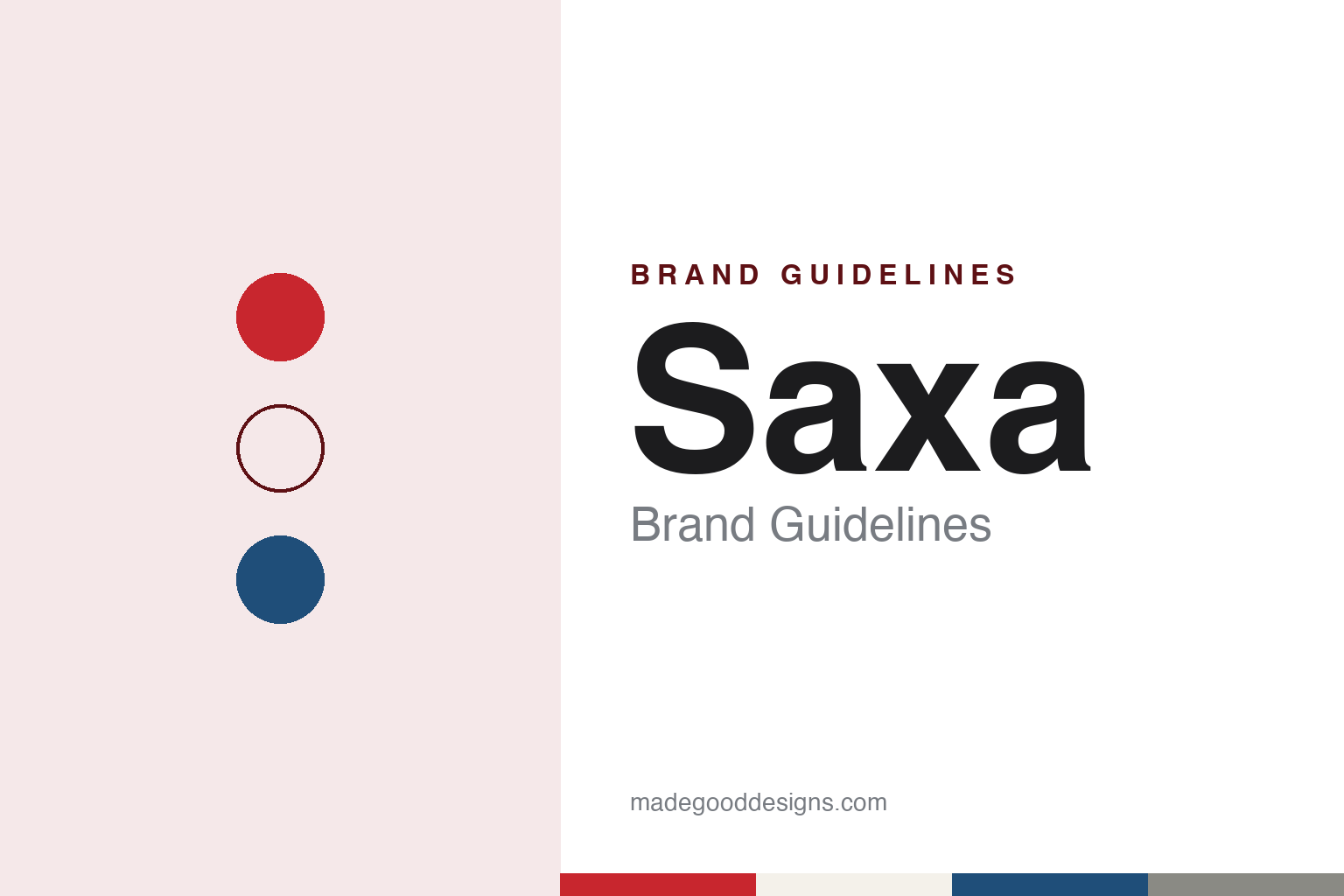
Saxa Brand Guidelines
The 1907 Middlewich salt in the drum pack.
Aa
Two constants: a drum red, salt white and sea blue palette and a refined heritage serif register. Abstract homage — not a Saxa product or mark; no pack, logo or product is reproduced.
A Middlewich salt
A salt town, a 1907 launch and a bigger owner.
Saxa comes from Middlewich, in Cheshire, one of the old salt towns of the Cheshire plain. The Middlewich Diary, a local history site, says Saxa was launched in 1907 by the Middlewich Salt Company, a firm later absorbed by Cerebos, and that the name became the core brand of both companies. English Wikipedia also dates the brand to 1907, and when the packs were redesigned in 2017 the trade title Packaging News described Saxa as on the shelves since that year.
The Middlewich Heritage Trust’s online museum traces the site behind the brand. It says Verdin Cooke set up the Bowfields open-pan salt works on Booth Lane in 1903; that the Middlewich Salt Company opened its works on the site in 1908; and that a vacuum plant built there in the 1920s began the move away from the old open-pan method of boiling brine. According to the same account, the range of works and the quality of salt there made the site a good investment for Cerebos, which took over the whole of it in the 1930s.
Cerebos was itself a salt business. English Wikipedia says its free-running table salt was developed by George Weddell, a Scottish chemist working for the British firm Mawson & Swan, and sold by a partnership of the three men, with Cerebos Ltd registered in 1894. Under Cerebos, Middlewich became a primary site, the Heritage Trust says: a neighbouring British Salt works opened in 1969, partly on Cerebos land, and supplied salt to it. Prince Philip visited the remodelled Middlewich plant that June, according to the Winsford Chronicle as cited by English Wikipedia. The Heritage Trust lists Saxa among several salts packed there, alongside Sifta, Stag and Cerebos itself.
Colour
A drum pack, a refined serif and abstract patterns.
Saxa’s best-known asset is its pack. When Premier Foods asked the Leeds design agency Robot Food to refresh the brand in 2017, the agency kept the cylindrical carton: Packaging News reported in July 2017 that, because the original pack format was a key asset, the team stayed loyal to the “iconic drum shape” to strengthen recognition. The previous serif logo lettering was refined and the holding device behind it simplified, the same report said.
Around those fixed points the agency changed a great deal. According to the design site Logo-Designer.co, a contemporary sans serif was introduced for the variant name and descriptor, the words “Est. 1907” were added to underline the brand’s age, and photographs on the packs gave way to newly drawn illustrations. Each salt was given its own abstract pattern: dashes and swirls inspired by ocean waves for the sea salts, and a blocky design meant to recall the texture of rock for the coarse rock salt, the agency explained. The packs moved to a matte finish, Packaging News said.
The redesign covered fine table salt, cooking salt, rock salt, sea salt and Saxa So-Low, and it brought the first Saxa salt and pepper grinders, Logo-Designer.co reported. Robot Food said salt was a quickly evolving category, in which premium ranges, flavour innovation and new brands were all challenging Saxa’s place as category leader. For a premium range of flavoured sea salts it used brighter colours and hand-drawn illustrations. In its own case study the agency says the redesign took the brand from a 17% decline to 3% year-on-year growth; that figure is the agency’s claim. The Dieline also featured the packs in August 2017.
Saxa’s look has long reached beyond the shop shelf. The Middlewich Diary recalls Saxa Salt railway wagons with peaked, felt-covered roofs, which railway workers called “cottage tops,” and a Hornby-Dublo model version that ran on many toy layouts.
Typography
Design and documentation.
The seven brands in this group all sit in the British store cupboard: Princes, John West, Batchelors, Ambrosia, Bird’s, Paxo and Saxa. British store-cupboard brands in general sit at many different points in the trade, from names that still carry a founder’s surname to names that now belong to much larger food groups, and a single brand can be sold everywhere from a corner shop to a supermarket shelf.
A store-cupboard brand’s identity is usually carried less by a single product than by a pack, a name and the meal or kitchen job it promises, because the company behind the name may have changed hands, moved its factory or grown far beyond the town where it started. That makes the questions behind each name worth asking plainly: who started it, who owns it now, and where its products are actually made and packed.
Each guide separates what independent sources record from what the company says about itself — its founding story, its owners over time, where its products are made and how its packaging has changed — and marks plainly what rests only on the company’s own word.
Aa
A refined heritage serif for a salt brand that dates itself to 1907. (Specimen set in Libre Baskerville, a serif STAND-IN; NOT the Saxa logo.)
Saxa
From Cerebos to Rank Hovis McDougall to Premier Foods.
Saxa has changed hands with the companies around it. In 1968 the flour and food group Rank Hovis McDougall (RHM) bought the Cerebos food group, English Wikipedia says; The Times, as cited there, put the price at £61 million. RHM later passed through the hands of Tomkins, from 1992, and the private equity firm Doughty Hanson, from 2000, before returning to the London Stock Exchange in 2005. The Independent counted Saxa in 2000 among “Britain’s best-known food brands,” and the marketing scholar Mats Urde listed it alongside Bisto and Hovis in the Journal of Consumer Marketing in 1994.
In March 2007 Premier Foods completed its £1.2 billion takeover of RHM, and Saxa became a Premier brand. A review of the enlarged group’s factories followed within months: in July 2007 Premier said it would close six sites, including Middlewich, and focus dry food production on Worksop, Knighton and Ashford, Bakery and Snacks reported. The Crewe Chronicle reported in June 2008 that Premier had defended cutting more than 280 jobs at Middlewich, and that production of Saxa salt and Bisto gravy granules there was due to end fully that September.
Saxa is now produced at Worksop, in north Nottinghamshire. English Wikipedia names Worksop and Ashford, in Kent, as the factories that took over its production. When Premier Foods announced a £36 million investment at Worksop in 2025, the trade title Food & Drink International reported that the site, which employs around 500 people, produces Saxa products alongside Bisto, Oxo, Batchelors and several cooking sauces. Premier Foods plc is based in St Albans, Hertfordshire.
The name has a separate life abroad. In Australia, Saxa belongs to Kraft Heinz, which bought most of the assets of Cerebos Pacific in 2018, English Wikipedia says, citing Food Business News; RHM had sold Cerebos Pacific to Japan’s Suntory in 1990.
For a design guide, Saxa shows how a single pack shape can carry a salt brand through more than a century of owners, keeping the drum while the patterns around it change. Compare Bisto, the gravy brand that was also made at Middlewich until 2008, and Maldon, the Essex sea salt. For this guide we use a drum red, a salt white and a sea blue with a serif, an unofficial interpretation; no product or logo is reproduced.
Explore & save
Keep Saxa’s identity on hand — save it to a board in the Made Good inspiration library.
Saxa identity set
Pin the Saxa drum red, salt white and sea blue palette and the refined heritage serif register to your own board.


