Lyle’s Brand Guidelines
The golden syrup tin that kept its lion and bees for more than a century.
Aa
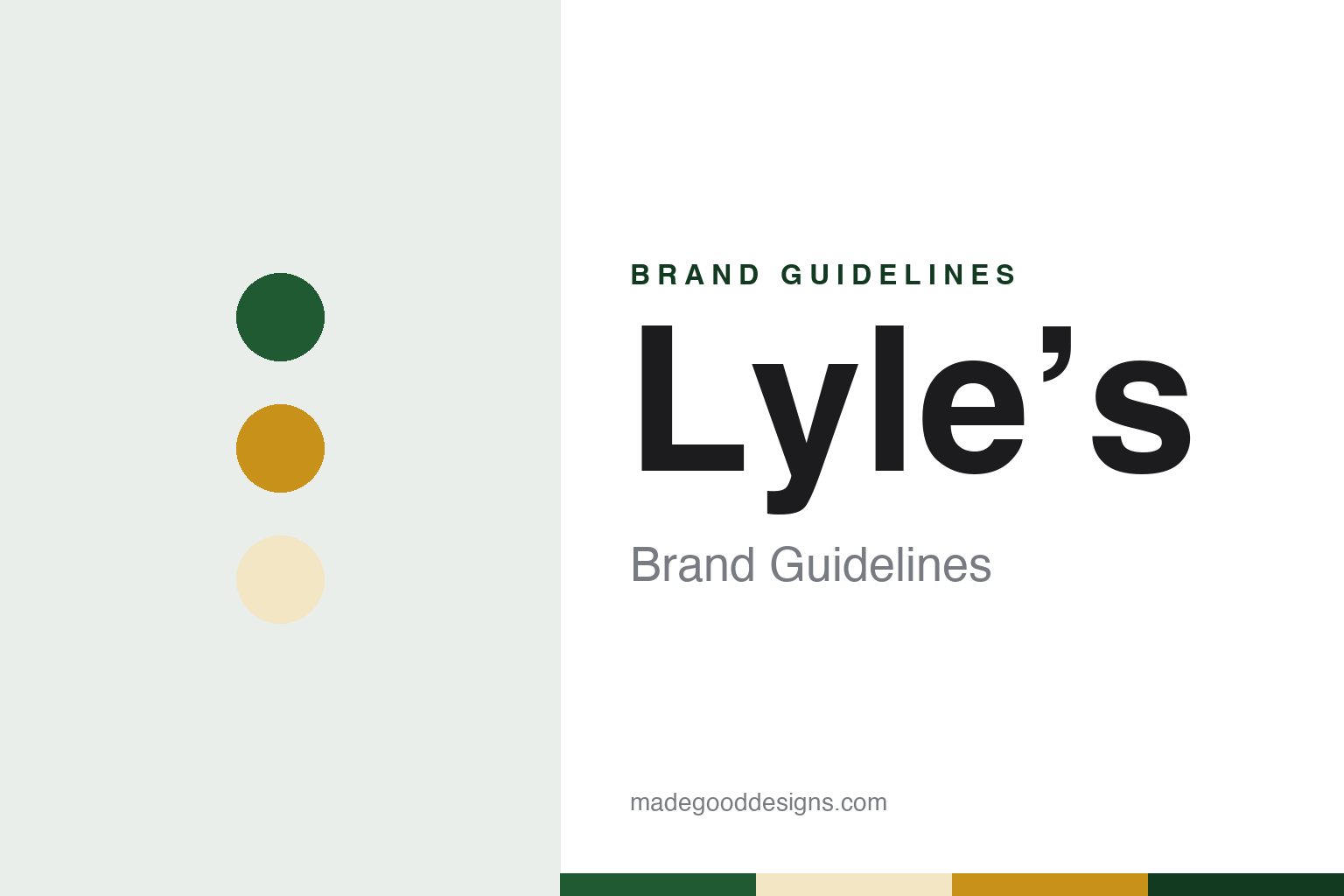
Two constants: a Lyle’s green and gold palette and a Victorian serif register. Abstract homage — not a Lyle’s product or mark; no tin, lion, logo or label is reproduced.
Plaistow Wharf
A Greenock refiner’s syrup in east London.
Lyle’s Golden Syrup comes from a refinery on the Thames in east London built by a Scot. Abram Lyle (1820–1891) was a cooper’s son from Greenock, on the Firth of Clyde, who built up a shipping business and, according to English Wikipedia, in 1865 joined four partners in buying a defunct sugar house in the town, which became the Glebe Sugar Refinery. After the principal partner, John Kerr, died in 1872, Lyle sold his shares and looked for a site of his own.
He found it in London. In 1881, with his sons, he bought two wharves at Plaistow, in what is now West Silvertown, to build a refinery, English Wikipedia says. The company’s 2008 history says the refinery started melting sugar in 1883, while the Tate & Lyle Sugars website today dates the start at Plaistow Wharf to 1882. About a mile and a half away stood the Thames Refinery of Lyle’s rival, the Liverpool sugar refiner Henry Tate.
The syrup began as a by-product. Cane refining left a treacly syrup that usually went to waste, and Lyle’s refinery turned it into a sweetener for the table and for cooking. English Wikipedia credits the recipe to the chemist Charles Eastick and his brother John Joseph Eastick, working at the Plaistow refinery. The company’s 2008 history says the syrup, nicknamed “Goldie,” was first poured into wooden casks and sold to employees and local customers, and that within a few months a tonne a week was being sold. It was first filled into tins in 1885, the company says, and the BBC reported in 2008 that those first tins were canned at Plaistow Wharf.
Lyle died in 1891 and his sons carried on the business as Abram Lyle & Sons. In 1921 it merged with Henry Tate & Sons to form Tate & Lyle, which according to English Wikipedia then refined around half of the UK’s sugar.
Colour
The lion and the bees.
The tin is the brand. It carries a picture of a dead lion with a swarm of bees and the words “Out of the strong came forth sweetness,” from the story of Samson in chapter 14 of the Book of Judges: Samson kills a lion and, passing the spot later, finds that bees have made honey in its carcass, which he turns into a riddle. Abram Lyle, an elder of a Presbyterian church in Greenock, chose the quotation himself, English Wikipedia says. The company wrote in 2008 that no one knows why he chose the wording — whether it referred to the tin or to the company.
The lion and bees were registered together as Lyle’s trademark in 1904, according to the company’s 2008 history, which also records that during the First World War the “tin” was made of thick cardboard because metal was needed for the war effort. The company’s own pages date its Royal Warrant to 1911 (in 2008) and to 1922, under George V (today), and it says the tin now carries “By Appointment to His Majesty the King.” The company also says Captain Scott took a supply of the syrup on his Antarctic expedition of 1910.
In September 2006 the BBC reported that Guinness World Records had named Lyle’s Golden Syrup Britain’s oldest brand, its green and gold packaging almost unchanged since 1885; the title appeared in the following year’s book, and the company dates it to 2007. According to CNN, Guinness noted only “slight technical changes during the war due to shortages of materials.” The BBC quoted Dr Kate Thomas of Bryn Mawr College, who said the lion, the bees and the biblical quotation testified to “a peculiarly Victorian mix of moralism, industrial drive and budding concern for social welfare.”
The range grew around the tin. The company dates Lyle’s Black Treacle to 1950, its first easy-pour bottle to 1996, its squeezy dessert syrups to 2005 and its baking and breakfast bottles to 2013. For the syrup’s 125th anniversary in 2008, the BBC reported, gold tins were sold alongside the green ones for a year; the company says seven special-edition tins were made.
Typography
Sugar, flour and spice on the British shelf.
The seven brands in this group all sell baking, sugar, flour and spice products, and all of them are sold under their own names on British shelves: Lyle’s, Tate & Lyle, Silver Spoon, Billington’s, McDougalls, Homepride and Schwartz. British baking and store-cupboard brands in general sit at many different points in the trade, from names that still carry a founder’s surname to names that now belong to much larger food groups, and a single brand can be sold everywhere from a corner shop to a supermarket baking aisle.
A store-cupboard brand’s identity is usually carried less by a single product than by a pack, a name and the kitchen task it promises to help with, because the company behind the name may have changed hands, moved its factory or grown far beyond the town where it started. That makes the questions behind each name worth asking plainly: who started it, who owns it now, and where its products are actually made and packed.
Each guide separates what independent sources record from what the company says about itself — its founding story, its owners over time, where its products are made and how its packaging has changed — and marks plainly what rests only on the company’s own word.
Aa
A Victorian serif — the register of an 1880s tin. (Specimen set in Playfair Display, a serif STAND-IN; NOT the Lyle’s logo.)
Lyle’s
A new lion for the bottles.
In February 2024 Lyle’s changed its logo for the first time since the 1880s. The new mark, CNN reported, shows a more abstract lion’s head with a single bee above it, and appears on the bottles and dessert toppings; the classic tin keeps the original lion and bees. The company said the new identity was meant to “refresh the brand’s legacy to appeal to a 21st century audience,” and its brand director, James Whiteley, said “consumers need to see brands moving with the times.” Reactions were mixed, CNN reported, with several Christian commentators among the critics.
The brand no longer belongs to the company whose name it shares. On 1 July 2010 Tate & Lyle PLC announced the sale of its EU sugar operations, including the Lyle’s Golden Syrup factory in London and its sugar and syrup brands, to American Sugar Refining for £211 million in cash. American Sugar Refining, which trades as ASR Group, is owned by Florida Crystals Corporation, according to its UK business, Tate & Lyle Sugars, which runs Lyle’s today.
The syrup is still made at Plaistow Wharf in Silvertown, the company says. It describes the site as the home of Lyle’s Golden Syrup, about a mile from the Thames Refinery, and says more than a million tins leave it every month — the same monthly figure the BBC reported in 2006. In 2023 the brand returned to television with a campaign it calls “Absolutely Golden.”
For a design guide, Lyle’s shows how a single Victorian image can carry a brand for well over a century, and how a newer mark can sit beside it rather than replace it. Compare Tate & Lyle, the sugar brand from the same refining business, and Silver Spoon, British Sugar’s brand, which English Wikipedia says also sells a golden syrup. For this guide we use tin green and syrup gold with a serif, an unofficial interpretation; no product or logo is reproduced.
Explore & save
Keep Lyle’s’s identity on hand — save it to a board in the Made Good inspiration library.
Lyle’s identity set
Pin the Lyle’s green and gold palette and the Victorian serif register to your own board.