Cathedral City Brand Guidelines
The Cornish Cheddar named for a Somerset cathedral.
Aa
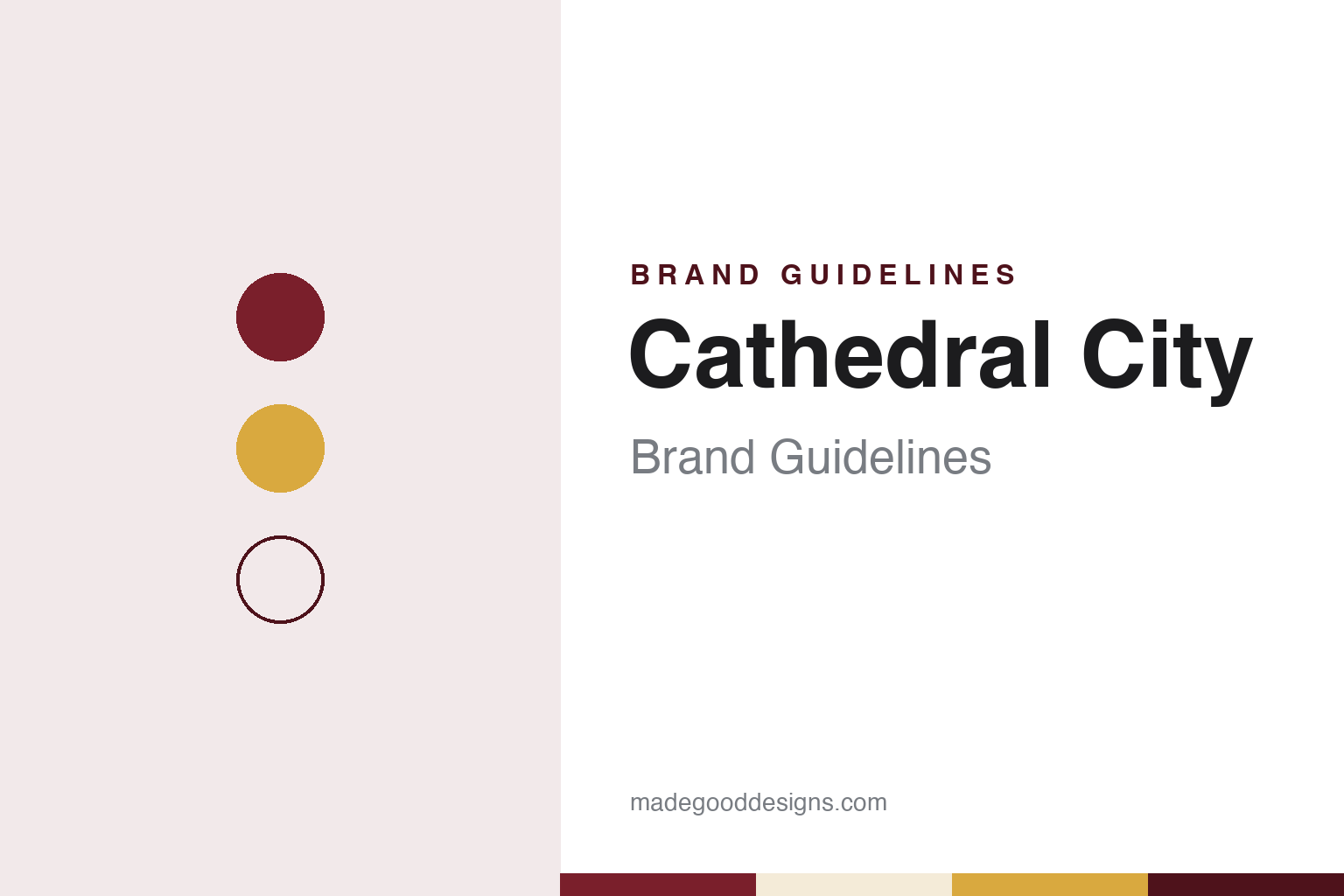
Two constants: a burgundy, cream and cheddar gold palette and a sign-painted slab serif register. Abstract homage — not a Cathedral City product or mark; no pack, logo or cathedral drawing is reproduced.
From Wells to Davidstow
A Somerset food company, a cathedral and a Cornish creamery.
Cathedral City is a Cheddar made in Cornwall and named for a city in Somerset. The brand’s first owner was Mendip Foods, a company based in Wells, the Somerset cathedral city, and English Wikipedia says the brand and its logo are based on Wells Cathedral. When the branding agency BrandOpus redrew the logo in 2022, the design news site Logo Designer reported that it still referred to Wells, the home of the food company that first owned the brand. The company today says it has been making its Cheddar for “over 60 years”; Design Week, writing in 2022, described Cathedral City as founded more than 50 years earlier.
The cheese’s home since the mid-1990s has been a creamery near the village of Davidstow, north of Bodmin Moor in Cornwall. English Wikipedia says the site was started in 1950 on a windswept hilltop and began making cheese in 1951. It later belonged to Unigate and, from 1979, to the Milk Marketing Board, which then marketed the milk of dairy farmers in England and Wales. The board’s processing business became Dairy Crest at the start of the 1980s; English Wikipedia gives 1980 in one article and 1981 in another. In 1993, it says, Dairy Crest decided to make Davidstow its main cheese plant and invested £6 million there.
In July 1995 Dairy Crest bought the Cathedral City brand from Mendip Foods and moved production to Davidstow, English Wikipedia says, noting that the Cornish parish has neither city status nor a cathedral. Dairy Crest was privatised and listed on the London Stock Exchange in 1996. A £55 million redevelopment of the creamery opened in 2005, and English Wikipedia describes Davidstow as the largest cheese factory in the UK. The cheese is made there and then, English Wikipedia says, taken to a national distribution centre at Nuneaton in Warwickshire to mature; Cathedral City packing moved to Nuneaton in 2009 from a creamery at Marchwiel in north Wales.
Colour
Burgundy, a redrawn cathedral and sign-painted letters.
Cathedral City’s current look dates from May 2022, when the agency BrandOpus overhauled its logo, type system and packaging and added motion video and sound assets, Design Week reported. Logo Designer reported that BrandOpus had also handled the previous redesign, in 2016, and that the new packs were due to roll out across UK retailers that month. Packaging design site Dieline listed the scope as brand strategy, identity, brand world, digital and packaging.
The cathedral stayed at the centre of the mark but was redrawn. BrandOpus senior designer Nicole Hammersley told Design Week that the agency shifted the building to a front-on view “at the heart of a bustling city,” with trees, birds and new characters around it, in an illustration style inspired by block screen printing that can be widened into a full cityscape. The lettering moved to a new typeface inspired by sign painting. Hammersley said the brand wanted to deepen its connection with shoppers at an uncertain time, naming Brexit, COVID and inflation, and to appeal to new customers.
The colour was kept. The primary burgundy was retained and paired with creams, golds and deeper burgundies for what the agency called “breadth and warmth,” Design Week reported, and Logo Designer quoted the designers describing the burgundy as “a beacon on the shelf.” Other parts of the system include stamp-like “makers’ marks” that show where ingredients are sourced and other quality checks, a navigation system of brightly coloured banners for the different ranges, and product names that begin with “Our…”. BrandOpus also made animations and a sonic identity built on pizzicato strings and the sounds of daily life. Its chief executive, Nir Wegrzyn, said heart and soul were “rooted deep in Cathedral City’s DNA.” At the time, Logo Designer reported, citing Kantar Worldpanel, the brand had a 44.4% market penetration in the UK.
Typography
Design and documentation.
The seven brands in this group all sell butter, cheese or other dairy products, and they come from Denmark, Ireland, France, the United States and Britain: Lurpak, Kerrygold, Président, Babybel, Philadelphia, Cathedral City and Yeo Valley. Dairy brands in general sit at many different points in the trade, from farmer-owned co-operatives and family firms to names that now belong to much larger food groups, and a single brand can be sold everywhere from a corner shop to a supermarket chiller.
A dairy brand’s identity is usually carried less by a single product than by a pack, a name and the kitchen or table it promises, because the company behind the name may have changed hands, licensed its name to another maker or grown far beyond the place where it started. That makes the questions behind each name worth asking plainly: who started it, who owns it now, and where its butter, cheese or yoghurt is actually made and packed.
Each guide separates what independent sources record from what the company says about itself — its founding story, its owners over time, where its products are made and how its packaging has changed — and marks plainly what rests only on the company’s own word.
Aa
A sign-painted slab serif for a Cheddar named for a cathedral. (Specimen set in Alfa Slab One, a slab serif STAND-IN; NOT the Cathedral City logo or its typeface.)
Cathedral City
Dairy Crest, Saputo and a Cheddar for export.
Dairy Crest reshaped itself around cheese and spreads in the 2010s. In 2015 it sold its milk processing business, together with the Frijj milkshake brand, to Germany’s Müller for £80 million, English Wikipedia says. Then, in a deal valuing the company at £975 million, the Canadian dairy group Saputo bought Dairy Crest, completing the purchase on 15 April 2019, Farmers Weekly reported. From July 2019 the business traded as Saputo Dairy UK, although Dairy Crest Limited remained the principal legal entity, English Wikipedia says; the trade site Dairy Reporter covered the renaming that month.
Farmers Weekly called Cathedral City “the nation’s favourite cheese brand,” a phrase the brand also uses about itself. At the time of the takeover, the paper reported, Davidstow made about 50,000 tonnes of cheese a year, with plans to reach 77,000 tonnes within several years, and its milk came from around 330 farmers in the South West, all within 80 miles of the creamery, through the producer group Dairy Crest Direct. The company says today that all the milk in its cheese is British and comes from dedicated farms in the West Country.
Saputo has taken the brand abroad. Cathedral City cheeses became available in Canada in August 2020, Food in Canada reported, and the brand entered the US market in September 2020 with three Cheddar products, according to The Grocer. It also has its own sites for Germany and Spain. At home, YouGov’s BrandIndex ranked Cathedral City the top brand in Britain’s chilled and frozen packaged foods sector in October 2024, English Wikipedia says.
For a design guide, Cathedral City shows how a cathedral, a burgundy and a set of sign-painted letters can carry a Cornish Cheddar named after a Somerset city. Compare Tillamook, the Oregon farmer-owned co-op’s cheese, and Kerrygold, the Irish dairy brand. For this guide we use a burgundy, a cream and a cheddar gold with a slab serif, an unofficial interpretation; no product or logo is reproduced.
Explore & save
Keep Cathedral City’s identity on hand — save it to a board in the Made Good inspiration library.
Cathedral City identity set
Pin the Cathedral City burgundy, cream and cheddar gold palette and the sign-painted slab serif register to your own board.