Cawston Press Brand Guidelines
The Norfolk apple juice that became a sparkling-can brand.
Aa
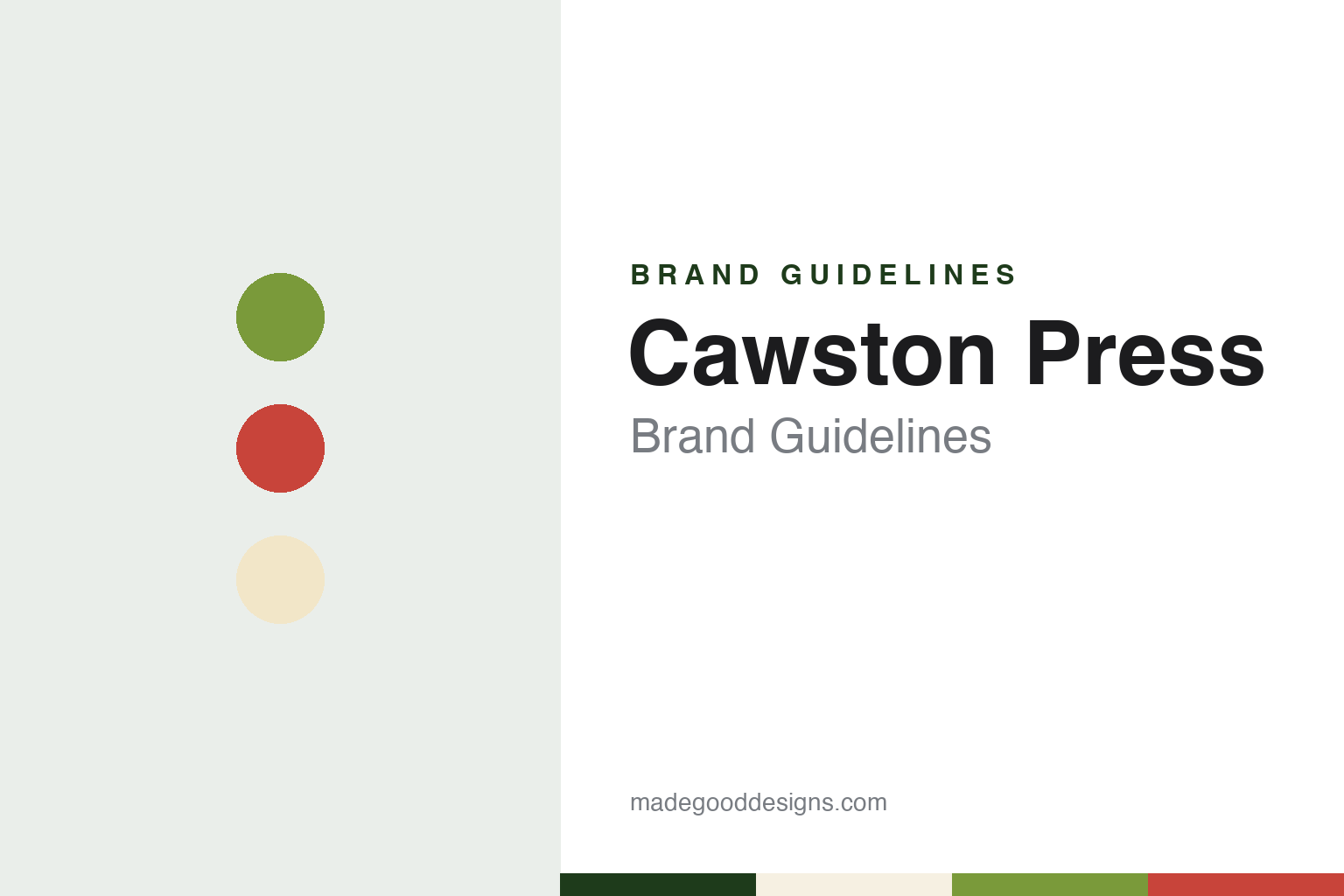
Two constants: an orchard green, rhubarb red and pressed-apple cream palette and a woodcut-era slab serif register. Abstract homage — not a Cawston Press product or mark; no pack, can or logo is reproduced.
Cawston Vale
A Norfolk apple juice, a Copella link and a buy-back.
Cawston Press began life under another name. Speciality Food magazine reported in May 2014 that the business was first established in Norfolk in 1986 as Cawston Vale, an apple juice brand, and The Grocer has named its co-founders as Simon Dunn and Stephen Unwin. Cawston is a village in north Norfolk, and the brand kept that place name through both of its identities.
Its early history ran alongside a better-known juice. Unwin was managing director of Copella, the Suffolk apple juice maker, and Speciality Food reported that when Tropicana bought Copella in the 1990s, the new owner was unsure what to do with Cawston Vale; in 2000 Unwin acquired the brand himself. Dunn’s own career, The Grocer noted, also took in Copella and the cereal maker Jordans. Compare Copella, the Suffolk juice at the other end of that story.
The way the juice was made became the point of the brand. Speciality Food described a shift away from juice made from concentrate towards pressing fruit at its peak, with British apples picked and pressed in October and November and the juice pasteurised rather than preserved, so it could be sold in long-life packs. Early blends paired apple with ginger, rhubarb or elderflower, and the range collected several Great Taste awards, the magazine said.
In 2009 the business was reborn as Cawston Press. The corporate adviser Spayne Lindsay describes the company as founded in 2009 following a management buy-in of Cawston Vale, and Marketing Week named Mark Palmer as a co-founder in 2017. Food Manufacture reported in 2025 that Palmer and Unwin co-own the business, with Steve Kearns, who joined in 2015, as managing director.
Colour
A new name, woodcut drawings and a can.
The name change was a design project. The London branding agency Pearlfisher says it renamed, refreshed and redesigned the brand, giving it a new name, a tone of voice and a visual language built on woodcut-style illustrations; the aim was to make shoppers look again at the ambient juice aisle, where long-life juices sit unchilled. Coverage of the launch in early 2010 listed five juices — Apple, Apple & Ginger, Apple & Elderflower and Apple & Rhubarb among them — in Waitrose, Ocado, Booths and speciality food shops from January 2010. Pearlfisher says sales rose by 249% after the relaunch.
The brand then moved beyond the carton. Food Manufacture reported that the first products were one-litre juice cartons that found a following in delis and farm shops, followed by 200ml fruit water cartons in 2013. The bigger step came in 2014 with 330ml sparkling cans, a format with no history in the company. Marketing Week reported in 2017 that the first run was 250,000 cans each of two flavours, that more than 10 million cans were sold in 2016 and that sparkling drinks by then made up about half the business. Sparkling Rhubarb, launched in 2014, became the best-selling line, Food Manufacture said in 2025.
The cans also entered the record of design effectiveness. The Sparkling Cans were a case study in the Beverages category of the 2017 Design Effectiveness Awards run by the Design Business Association, whose summary says that Cawston Press beat its business growth target by 25% and doubled export sales with the range, in a declining market and as a small company with no heritage in carbonated drinks.
The brand’s rule for itself is “No Jiggery Pokery,” which the company uses to describe drinks made with pressed juice, no concentrates and no sweeteners. Ahead of the UK’s Soft Drinks Industry Levy in 2018, Food Manufacture reported, it reworked its sparkling range so that pressed fruit juice alone sweetened the drinks, with no added sugar.
Typography
Design and documentation.
The seven brands in this group all make juices, squashes or soft drinks, and all of them are sold in Britain: Robinsons, Copella, Cawston Press, Rubicon, J2O, Shloer and Old Jamaica. British drinks brands in general sit at many different points in the trade, from names that still recall a founder or a farm to names that now belong to much larger drinks groups, and a single brand can be sold everywhere from a corner shop to a pub bar to a supermarket shelf.
A soft-drink brand’s identity is usually carried less by a single recipe than by a bottle or can, a name and the moment it promises, because the company behind the name may have changed hands, moved its production or grown far beyond the place where it started. That makes the questions behind each name worth asking plainly: who started it, who owns it now, and where its drinks are actually made and packed.
Each guide separates what independent sources record from what the company says about itself — its founding story, its owners over time, where its drinks are made and how its packaging has changed — and marks plainly what rests only on the company’s own word.
Aa
A slab serif with the weight of a woodcut, for a brand renamed after a press. (Specimen set in Zilla Slab, a serif STAND-IN; NOT the Cawston Press logo.)
Cawston Press
Independent owners, outside partners and new categories.
Cawston Press has funded itself largely from people close to the business. In May 2018, Food Manufacture reported, it raised £1 million in equity from existing shareholders, staff in the UK, Australia and the US, and a small group of private investors from the food and drink industry, to support a US launch begun in 2017 and a move into France that summer. In April 2021 it sold a minority shareholding to the Princes Group; Spayne Lindsay, which advised on the deal, quoted Palmer welcoming Princes as “a small minority shareholder” in what it called a corporate-venturing style investment.
The drinks are not made in Norfolk today. Food Manufacture reported in 2025 that production is entirely outsourced to three manufacturing partners in the UK, while a team of around 30 at London Bridge handles recipe development and blending. The same report said the brand sells roughly half through grocers, including Tesco, Sainsbury’s, Asda, Co-op and Waitrose, and half through hospitality, and that it was certified as a B Corp in February 2024.
Recent deals have taken the company past juice. In January 2026 Cawston Press bought Loah, a range of 0.5% fruit-flavoured beers whose founder, Hugo Tapp, stayed on to run it, Grocery Gazette and Talking Retail reported. In August 2026 Food Manufacture reported that it had taken full ownership of LA Brewery, the alcohol-free kombucha brand founded in 2017 by Louise Avery, after investing in it earlier in the year; Palmer had already been an investor and board member there.
For a design guide, Cawston Press shows how a rename, a woodcut drawing style and a single can format can turn a regional apple juice into a national soft-drink brand. Compare Copella, the Suffolk apple juice Unwin once ran, and Robinsons, the British squash. For this guide we use an orchard green, a rhubarb red and a pressed-apple cream with a slab serif, an unofficial interpretation; no product or logo is reproduced.
Explore & save
Keep Cawston Press’s identity on hand — save it to a board in the Made Good inspiration library.
Cawston Press identity set
Pin the Cawston Press orchard green, rhubarb red and pressed-apple cream palette and the woodcut-era slab serif register to your own board.