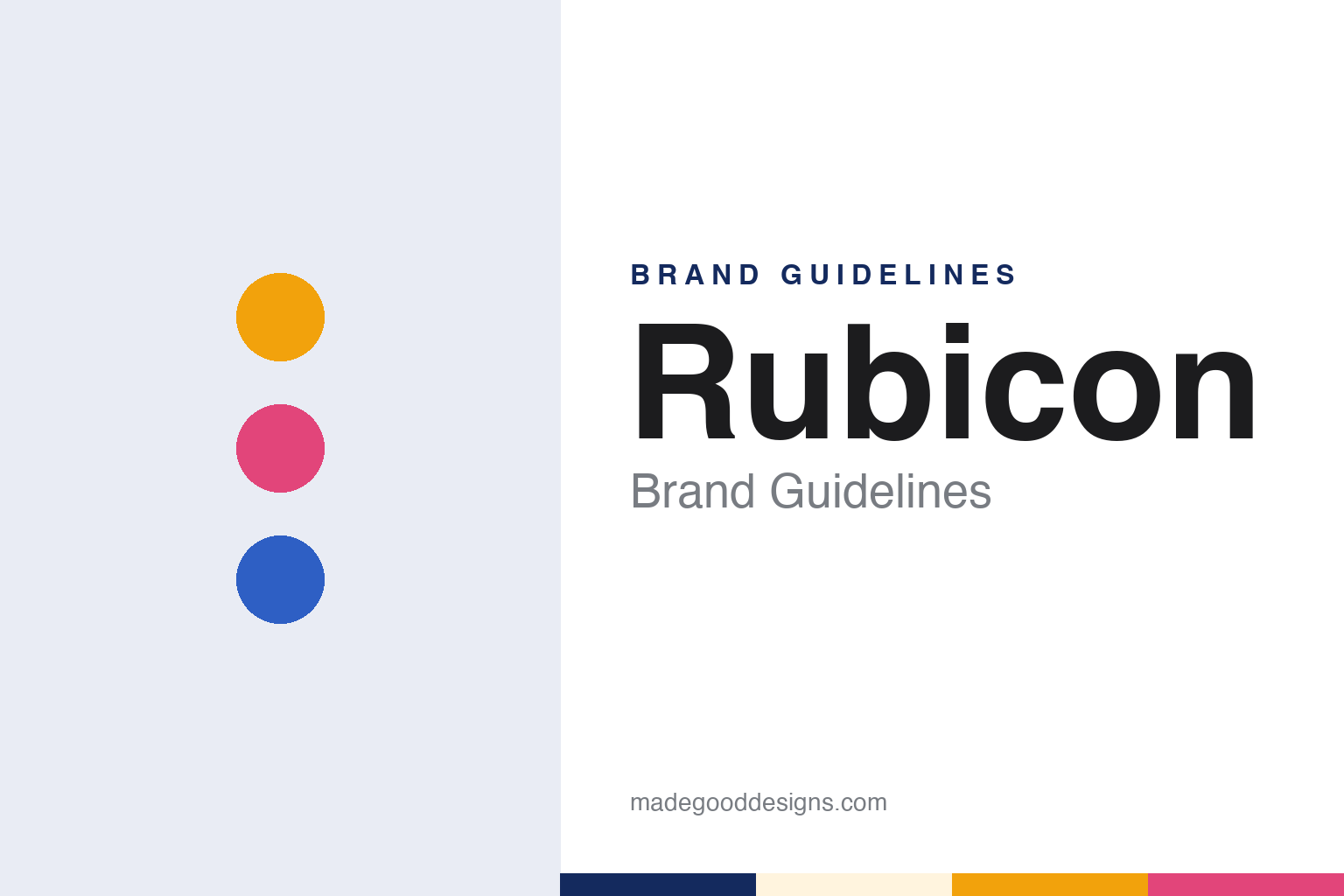
Rubicon Brand Guidelines
The London exotic-fruit drink that started with Passionade.
Aa
Two constants: a carton blue, mango and guava pink palette and a bold rounded display sans register. Abstract homage — not a Rubicon product or mark; no can, carton or logo is reproduced.
Passionade
A kitchen, a lounge and a passion-fruit drink.
Rubicon began as a two-man business in London. A profile of the company in PricewaterhouseCoopers’ Asian Business Forum newsletter of March 2007 says it was founded by Vish Vekaria and Naresh Nagrecha in 1981, and that its first product, Rubicon Passionade, went on sale in April 1982; Marketing Week also gave 1981 as the founding year in 2008, while English Wikipedia uses 1982. Product development took place in Vekaria’s kitchen and the administration in Nagrecha’s lounge, the newsletter says, and the two men acted as directors, sales staff, drivers and labourers. English Wikipedia describes the founders as Asian immigrants who set out to supply exotic fruit juice drinks to Britain’s ethnic communities.
The first customers were small shops. In its first year Rubicon sold 100,000 cases of Passionade, persuading shopkeepers to stock it by getting them to taste it, the PwC profile says, and a second product, Sparkling Mango Crush, doubled sales in the second year. In 1986 the company moved into juice drinks in Tetra Pak cartons, starting with a mango juice drink in a distinctive blue carton that the profile calls an instant success.
Rubicon reached the mainstream in the 1990s. In the middle of that decade, according to the profile, its products were relaunched and the brand moved from traditional niche outlets into supermarkets such as Tesco and Sainsbury’s, with a range that came to cover mango, passion fruit, guava, lychee, guanabana, coconut, pomegranate and papaya. Vekaria told PwC that the key was making drinks that taste exactly like the fruit named on the pack. Turnover, the profile says, rose from about £300,000 in 1982 to £28 million in 2006, with products sold in more than 25 countries.
Colour
A Welsh factory, a Scottish buyer and a split brand.
Rubicon built its own manufacturing late. In 1999, the PwC profile says, it bought a site at Tredegar in South Wales to build an in-house production plant, which by 2007 had been running for about three years and had created 41 jobs; the company also had a plant in Canada. Its fizzy drinks came from elsewhere: when the sale of the company was announced, Marketing Week reported that Rubicon’s carbonated drinks had been made by the Scottish soft-drinks group A.G. Barr under a co-manufacturing arrangement for some 20 years.
That partner became the owner. On 5 August 2008 A.G. Barr, the maker of Irn-Bru, announced a conditional agreement to buy Groupe Rubicon for an initial cash payment of £59.8 million, plus about £1.25 million for the freehold of the Tredegar plant, Marketing Week and Reuters reported. Rubicon had sales of £27.3 million in 2007. The deal excluded brand rights outside the European Union, apart from some neighbouring states including Russia. English Wikipedia says the brand outside the UK and Europe has stayed with the Nagrecha family, and that Rubicon drinks for Canada are made under licence by a company in Richmond Hill, Ontario.
Under A.G. Barr, Rubicon became one of the group’s core brands alongside Irn-Bru and Boost, English Wikipedia says, citing the group’s results. Production moved with the group’s investment. In 2014 A.G. Barr closed the Tredegar carton plant, where up to 67 jobs were lost, and moved carton production to a new £4 million facility at its Milton Keynes site, Packaging News reported in September 2014. Rubicon Drinks Ltd is now registered in Milton Keynes; as of 2011 its head office had been in Wembley.
Typography
Design and documentation.
The seven brands in this group all make juices, squashes or soft drinks, and all of them are sold in Britain: Robinsons, Copella, Cawston Press, Rubicon, J2O, Shloer and Old Jamaica. British drinks brands in general sit at many different points in the trade, from names that still recall a founder or a farm to names that now belong to much larger drinks groups, and a single brand can be sold everywhere from a corner shop to a pub bar to a supermarket shelf.
A soft-drink brand’s identity is usually carried less by a single recipe than by a bottle or can, a name and the moment it promises, because the company behind the name may have changed hands, moved its production or grown far beyond the place where it started. That makes the questions behind each name worth asking plainly: who started it, who owns it now, and where its drinks are actually made and packed.
Each guide separates what independent sources record from what the company says about itself — its founding story, its owners over time, where its drinks are made and how its packaging has changed — and marks plainly what rests only on the company’s own word.
Aa
A heavy rounded sans for a brand that sells itself on big fruit flavours. (Specimen set in Baloo 2, a sans STAND-IN; NOT the Rubicon logo.)
Rubicon
Cricket breaks, new agencies and “Big Flavour Behaviour.”
Rubicon’s marketing grew with the brand. In 2007, its own website said, it sponsored the Urban Music Awards. In 2011 The Drum reported that it was sponsoring Sky Sports’ coverage of the Cricket World Cup, and English Wikipedia says the brand also sponsored Sky’s World Twenty20 coverage, with the line “Time for a Rubicon break” heard before the adverts.
Its agencies have changed several times under A.G. Barr. Industry press reported in December 2018 that the group had appointed the independent agency Red Brick Road as Rubicon’s retained creative agency after a pitch, to give the brand a new positioning and run its social media; the incumbent, BMB, had held the account since 2015. The range kept widening: in February 2021 The Grocer reported the launch of Rubicon Raw, an energy drink range, and English Wikipedia also lists a coconut water.
The current platform is “Big Flavour Behaviour.” Marketing Beat reported in May 2025 that it was the first Rubicon campaign from Lucky Generals, which had won A.G. Barr brands earlier that year: four 20-second films built around eccentric characters and flavours such as Orange Mango, Cherry Raspberry, Mango and Passion, with bus wraps in Manchester, Glasgow and Birmingham and media planned by the7stars. The agency described Rubicon as “an unfiltered showstopper in a can.” In January 2026 Scottish Grocer reported a brand refresh under the same platform, with new Tropical and Cherry Burst flavours, led by Rubicon brand director Lisa McKenna.
For a design guide, Rubicon shows how a drink made for a community’s tastes can grow into a mainstream brand while keeping the names of its fruits at the centre of the pack. Compare J2O, another British fruit-drink brand, and Robinsons, the British squash. For this guide we use a carton blue, a mango orange and a guava pink with a bold rounded sans, an unofficial interpretation; no product or logo is reproduced.
Explore & save
Keep Rubicon’s identity on hand — save it to a board in the Made Good inspiration library.
Rubicon identity set
Pin the Rubicon carton blue, mango and guava pink palette and the bold rounded display sans register to your own board.