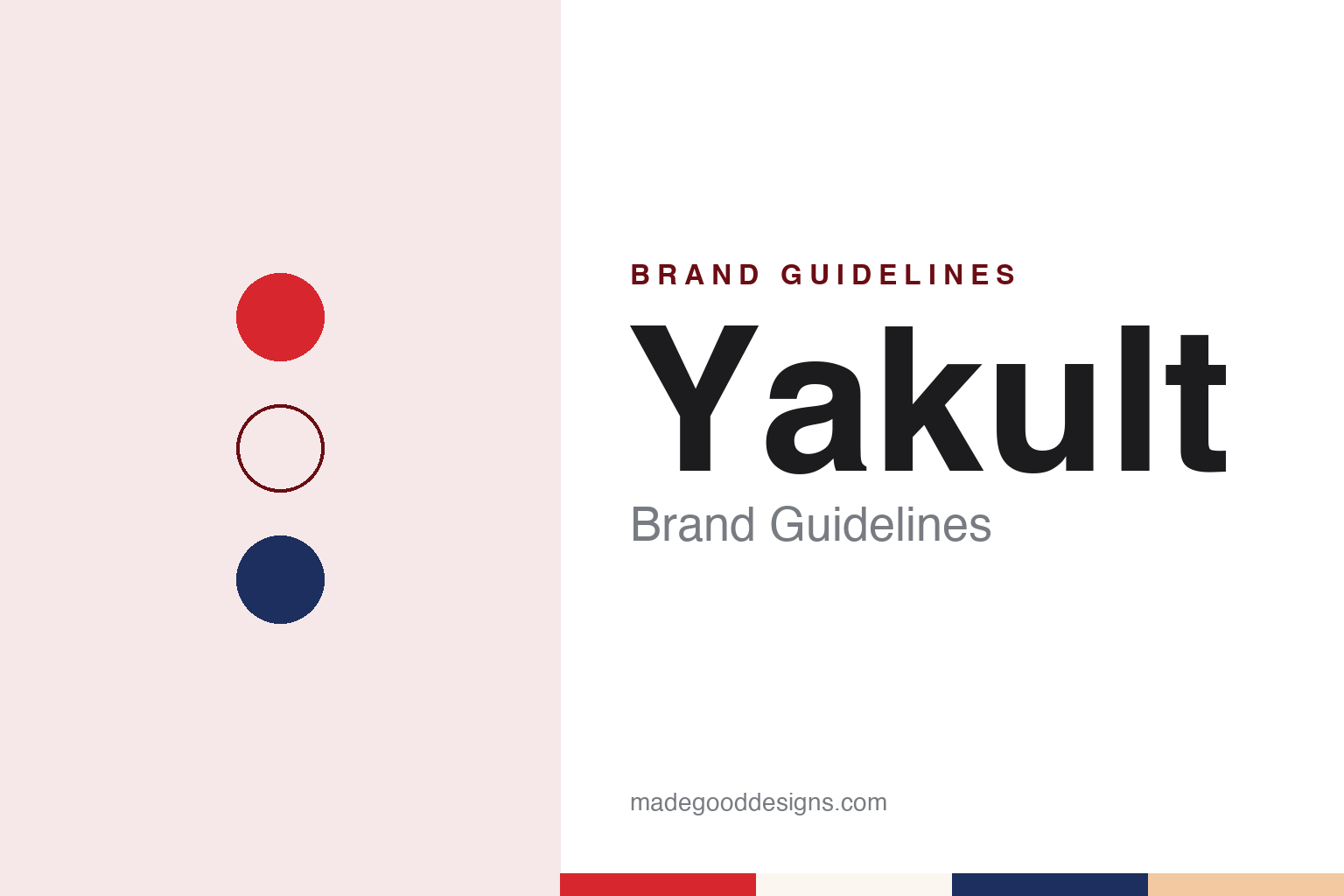
Yakult Brand Guidelines
The Fukuoka milk drink in a bottle by Isamu Kenmochi.
Aa
Two constants: a cap red, milk white and deep navy palette and a rounded friendly sans register. Abstract homage — not a Yakult product or mark; no bottle, logo or pack is reproduced.
A lab in Kyoto, a shop in Fukuoka
A medical researcher, a bacterial strain and an Esperanto name.
Yakult began in a university laboratory. Minoru Shirota (1899–1982), a researcher in the microbiology department of Kyoto Imperial University’s medical school, succeeded in 1930 in strengthening and culturing a strain of lactic acid bacteria now named Lacticaseibacillus casei Shirota, Japanese Wikipedia says, citing Yakult Honsha’s own company overview. Five years later, in 1935, a small outfit called the Shirota Hogokin Kenkyujo began making and selling a sweetened fermented milk drink made with that strain in Tojinmachi, Fukuoka, on the southern island of Kyushu. A memorial stone put up in 2009 by the local Yakult sales company now marks the site, Japanese Wikipedia notes.
The name is an invention. It comes from jahurto, the Esperanto word for yogurt, English and Japanese Wikipedia agree, and the “Yakult” trademark was registered in 1938. Shirota wanted the drink to be cheap enough for anyone to buy, and Japanese Wikipedia records his business motto that a bottle should cost no more than a postcard or a single cigarette. The Financial Times described the same commitment to affordable pricing in 2013 as part of the philosophy the company calls “Shirota-ism.”
From the start Yakult was sold by delivery, because the product needed explaining to customers, Japanese Wikipedia says. At first it went out mainly through milk shops; from 1940 specialist Yakult sales associations were set up across Japan, at one point numbering about 500. In 1955 Yakult Honsha was established in Tokyo to coordinate the regional sales companies. Its first president was Noboru Nagamatsu, a businessman who had backed Shirota’s project, from 1955 to 1963; Shirota himself was president from 1963 to 1970, according to the list of presidents given by Japanese Wikipedia. A 2018 Japanese biography of Nagamatsu calls him Yakult’s founder, while Japanese Wikipedia calls Shirota the company’s de facto founder.
Colour
A plastic bottle by Isamu Kenmochi.
The object most people know is the bottle. Until 1968 Yakult came in glass: a small bottle shaped like a miniature milk bottle, closed with a paper stopper, Japanese Wikipedia says, and just after the Second World War individual sales outlets even used their own bottles, in several sizes. Glass was laborious to collect and return, and once the company began recruiting women as its delivery staff in 1963, the weight of the glass became a real burden.
In October 1968 Yakult switched to a plastic container. Its design is credited to the interior designer Isamu Kenmochi by the Japan Institute of Invention and Innovation, which lists the container among its 100 innovations of postwar Japan, and by the Japan Institute of Design Promotion. The narrow waist was made first to fit the guide belts of the production line, Japanese Wikipedia says, but it also makes the bottle easy to grip, checks the flow so the drink does not rush out all at once, and keeps the bottle stable on the line. The body is polystyrene and the lid a sealed cap of aluminium foil. The 65 ml size was chosen so that older people and children could finish a bottle in one go. The foil caps once came in seven colours, one for each day of the week, Japanese Wikipedia says; today they are red.
The shape has since been recognised twice. In 2008 the bottle received a Good Design Long Life Design Award from the Japan Institute of Design Promotion, which gives the award to long-established designs. Legal protection took longer. Yakult applied to register the bottle’s shape as a three-dimensional trademark in 1997, was refused by the Japan Patent Office and lost its challenge all the way to the Supreme Court. After the Intellectual Property High Court accepted the Coca-Cola bottle as a three-dimensional trademark in May 2008, Yakult applied again that September. On 16 November 2010 the same court overturned the patent office’s refusal and the shape was registered, the company announced that day.
Typography
Design and documentation.
The seven brands in this group are pantry, sauce, snack and cultured-drink names from Japan, China, South Korea and the United States: Yakult, Calpis, Kewpie, Lao Gan Ma, Huy Fong Foods, Ottogi and Pocky. Asian pantry and drink brands in general sit at many different points in the trade, from family firms that still carry a founder’s name to product names that belong to much larger food groups, and a single brand can be sold everywhere from a neighbourhood grocer to a supermarket shelf on another continent.
A pantry or drink brand’s identity is usually carried less by a single recipe than by a bottle, a jar, a box and the name printed on it, because the company behind the name may have changed hands, licensed its product abroad or grown far beyond the city where it started. That makes the questions behind each name worth asking plainly: who started it, who owns it now, and where its products are actually made and packed.
Each guide separates what independent sources record from what the company says about itself — its founding story, its owners over time, where its products are made and how its packaging has changed — and marks plainly what rests only on the company’s own word.
Aa
A rounded friendly sans for a brand built around a small, easy-to-hold bottle. (Specimen set in Nunito, a sans STAND-IN; NOT the Yakult logo.)
Yakult Honsha
Yakult Ladies, factories abroad and a baseball team.
The delivery network became part of the brand. Since 1963 Yakult has employed women, known as Yakult Ladies, to deliver its drinks to homes by bicycle or motorcycle. Their numbers in Japan fell from 65,700 in 1973 to 42,500 in 2009, the Asahi Shimbun reported in 2009. Some Yakult products in Japan are sold only through home delivery and not in ordinary shops, Japanese Wikipedia says. Sales in Japan peaked in 1972, at an average of 16 million bottles a day, according to COMZINE, the magazine of NTT Comware.
Expansion abroad began in Taiwan in 1964. The first factory outside Japan opened in São Bernardo do Campo, Brazil, in 1968, and companies in Hong Kong and South Korea followed in 1969. In the early 1980s Carlos Kasuga, a Mexican of Japanese descent, set up Yakult Mexico, Forbes México reported in 2013. The drink reached Australia, Britain and the United States in 1994, and in 2014 a factory in Fountain Valley, California, began production, the Orange County Business Journal reported. In Japan, Japanese Wikipedia lists company plants and subsidiary factories from Iwate and Fukushima in the north to Saga and Fukuoka in the south. Flavours vary by market: in Singapore, an orange version sold since 1980 was replaced by peach from July 2026, The Straits Times reported.
Yakult Honsha has been listed on the Tokyo Stock Exchange since 1980 and since 1970 has owned the professional baseball club now called the Tokyo Yakult Swallows. In April 2020 it moved its head office to the WATERS takeshiba building in Minato, Tokyo. The French group Danone first bought shares in April 2000 and came to hold about 21%; in 2018 it sold most of that stake, cutting it to around 7%, Reuters, Bloomberg and FoodBev reported. Yakult has also operated in India through a 50:50 joint venture with Danone, Business Standard reported in 2012.
For a design guide, Yakult shows how one small bottle, in use since 1968, can carry a brand across decades and markets. Compare Calpis, Japan’s other century-old cultured-milk drink, and Meiji, the Tokyo confectioner and dairy maker. For this guide we use a cap red, a milk white and a deep navy with a rounded sans, an unofficial interpretation; no product or logo is reproduced.
Explore & save
Keep Yakult’s identity on hand — save it to a board in the Made Good inspiration library.
Yakult identity set
Pin the Yakult cap red, milk white and deep navy palette and the rounded friendly sans register to your own board.