Cirio Brand Guidelines
The Turin canner that began with peas in 1856.
Aa
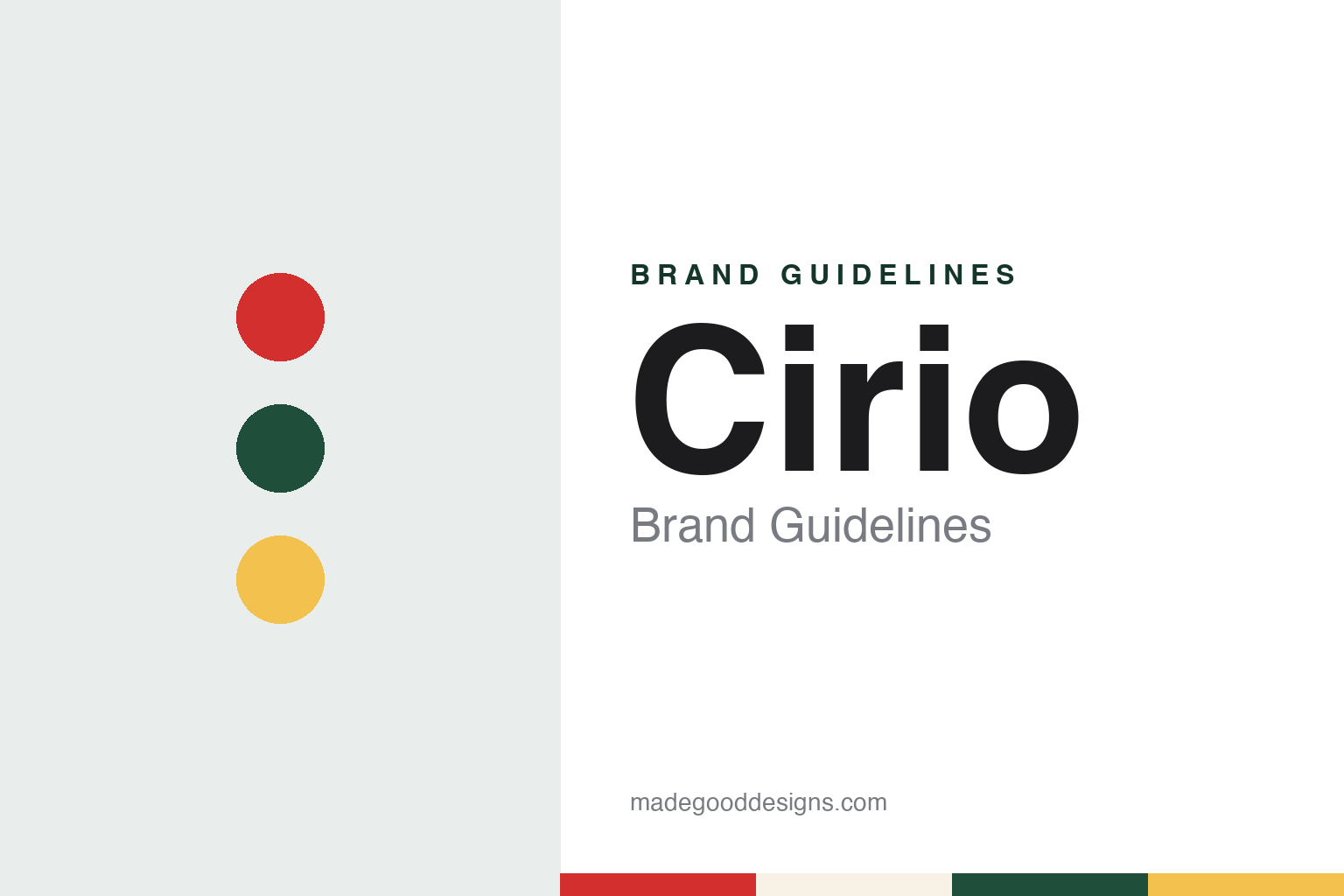
Two constants: a pelato red, pea green and can gold palette and a nineteenth-century serif register. Abstract homage — not a Cirio product or mark; no tin, logo or label is reproduced.
Porta Palazzo
A market trader, a borrowed French method and a pea.
Cirio is one of the oldest names in Italian food. Its founder, Francesco Cirio, was born in Nizza Monferrato, in Piedmont, the son of a grain dealer; the company says he was already trading at the Porta Palazzo produce market in Turin by the age of 14, and Italian Wikipedia says he bought vegetables there cheaply at closing time to resell in the outer districts of the city.
In 1856, aged 20, he set up in Turin to preserve food in sealed containers by appertisation, the method invented by the Frenchman Nicolas Appert. Italian Wikipedia places the first premises in Via Borgo Dora, with a hearth holding two boilers. The first success was not tomatoes but peas, both the company and Italian Wikipedia say; other vegetables and fruit followed, and the tomato came to be the product most closely tied to the name, above all the peeled tomato, the “pelato Cirio.”
Recognition came at the 1867 Exposition Universelle in Paris, where the company says Cirio’s products won prizes, before exports spread “from Liverpool to Sydney.” Italian Wikipedia lists plants and depots in Castellammare di Stabia, Milan, Berlin, London, Brussels, Paris, Belgrade and Vienna. After the unification of Italy Cirio opened canneries in the south and reclaimed abandoned farmland to supply them, the company says. Francesco Cirio died in Rome on 9 January 1900.
Colour
Naples, the Signorini family and a name on everything.
The business that outlived its founder was southern. In 1900, Italian Wikipedia says, the company became the Cirio Società Generale delle Conserve Alimentari, and its flagship plants were at Vigliena, in the San Giovanni a Teduccio district of Naples, where the national head office stayed until the 1980s, and at Pontecagnano, near Salerno. A partner, Pietro Signorini, took over the running of the company and built new canneries for tomatoes, fruit and vegetables around Naples; after his death in 1916 his brother Paolo continued the work, the company says.
From the mid-1920s, the company says, advertising and promotion made Cirio one of the best-known names in Italian food, and the brand was put on a wide range of goods, from canned vegetables, meat and fish to pasta, coffee, milk and jams. Italian Wikipedia reproduces a Cirio advertisement from the Argentine publication La Nación of 7 July 1929. The company’s history page still heads its middle decades with the line “Come natura crea, Cirio conserva” — as nature creates, Cirio preserves.
Sport carried the name too. Cirio first appeared on a football shirt in 1982, with SSC Napoli, for three seasons until 1985; in the 1990s it sponsored Lazio from 1996 to 2000 and the Brazilian club São Paulo from 1997 to 1999, Italian Wikipedia says.
Italian Wikipedia’s gallery shows three marks in recent decades: one used from 1985 to 2010, a second from 2010 to 2013, and the current logo from 2013, when the company says Cirio renewed its image. In 2021 the brand was entered in the Italian ministry’s register of historic brands of national interest, and in 2023, the company says, an Italian definitive stamp in the historic-brands series was dedicated to Francesco Cirio.
Typography
Design and documentation.
The seven brands in this group all make the seasonings, stocks, tomatoes and sauces that sit behind a meal, and they come from Switzerland, Germany, Italy, Britain, Hong Kong and the United States: Maggi, Knorr, Mutti, Cirio, Patak’s, Lee Kum Kee and Old El Paso. Brands in this part of the store cupboard in general sit at many different points in the trade, from family firms that still carry a founder’s surname to names that now belong to much larger food groups, and a single brand can be sold everywhere from a corner shop to a supermarket shelf on another continent.
A sauce or stock brand’s identity is usually carried less by a single product than by a jar, a cube, a tin, a name and the kitchen it promises, because the company behind the name may have changed hands, moved its factory or grown far beyond the town where it started. That makes the questions behind each name worth asking plainly: who started it, who owns it now, and where its products are actually made and packed.
Each guide separates what independent sources record from what the company says about itself — its founding story, its owners over time, where its products are made and how its packaging has changed — and marks plainly what rests only on the company’s own word.
Aa
A bookish nineteenth-century serif for a brand that dates its recipes to 1856. (Specimen set in Libre Baskerville, a serif STAND-IN; NOT the Cirio logo.)
Cirio
State ownership, a default and a cooperative.
Cirio’s ownership has changed hands several times since the Signorini era. The family ran the company until 1970, when it was sold to SME, the food holding of the state industrial group IRI, and it was privatised in 1993, the company says. Italian Wikipedia says the group of the Roman financier Sergio Cragnotti acquired Cirio in 1994; English Wikipedia says Cragnotti, also president of Lazio, headed the Cirio food group.
The Cragnotti period ended in a default. On 8 November 2002 a Cirio bond of €150 million went unpaid, the news agency ANSA recalled in 2017; under cross-default clauses the group’s other bonds, about €1.2 billion issued between 2000 and 2002, fell due with it, and consumer associations put the number of savers affected at about 35,000. After bondholders rejected a rescue plan in July 2003, the group was placed under extraordinary administration later that year, ANSA reported. Italian Wikipedia says the procedure allowed the productive business to be separated from the group’s other liabilities.
In 2004 the industrial business, Cirio-De Rica, was sold for €168 million to Conserve Italia, La Gazzetta del Mezzogiorno reported in September 2004. Conserve Italia is an agricultural cooperative consortium founded in 1976 and based at San Lazzaro di Savena, near Bologna, whose other brands include Valfrutta and Yoga. It lists tomato plants at Pomposa and Dodici Morelli in the province of Ferrara, Ravarino near Modena, Albinia in Tuscany and Mesagne in Apulia, and processes about 600,000 tonnes of fruit and vegetables a year. Cirio says its tomatoes are 100% Italian, from a certified Italian supply chain. Since 2004 the company has added passata in a PET bottle, a Cirio Selezioni line in 2020 built on tomato varieties from Apulia, Sicily and Tuscany, and EPD environmental product declarations from 2019, it says.
For a design guide, Cirio shows how a nineteenth-century founder’s name can outlast its family, the state and a financial collapse, and still sell a tin of peeled tomatoes. Compare Mutti, the Parma tomato family firm, and Bianco DiNapoli, a California canned tomato. For this guide we use a pelato red, a pea green and a can gold with a serif, an unofficial interpretation; no product or logo is reproduced.
Explore & save
Keep Cirio’s identity on hand — save it to a board in the Made Good inspiration library.
Cirio identity set
Pin the Cirio pelato red, pea green and can gold palette and the nineteenth-century serif register to your own board.