Thursday Cottage Brand Guidelines
The West Country jam maker now made at Tiptree.
Aa
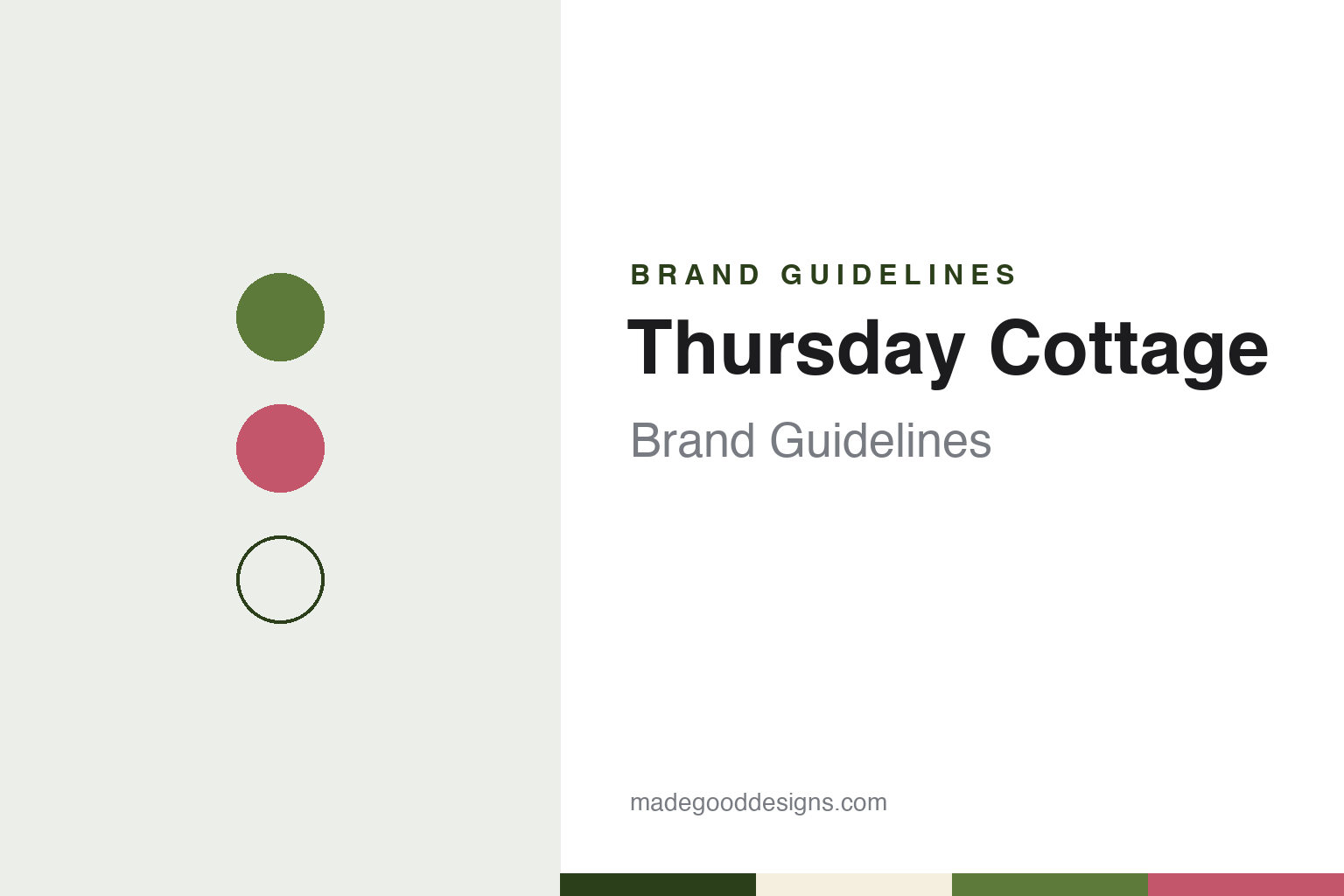
Two constants: a greengage, rhubarb and cottage cream palette and a country book serif register. Abstract homage — not a Thursday Cottage product or mark; no jar, label or logo is reproduced.
Spaxton to Uplyme
A cottage in Somerset and a farm near Lyme Regis.
Thursday Cottage is a small British maker of jams, marmalades and fruit curds, owned since 2002 by Wilkin & Sons, the Essex company behind Tiptree. Its name is the name of a house. The company says the business was started in 1963 in a cottage of the same name outside Spaxton, a village in Somerset, and English Wikipedia’s article on Wilkin & Sons describes Thursday Cottage as originally a Somerset producer of natural jams, preserves and marmalades.
For most of its independent life, though, it was run from further south. The company says that “for many years” Thursday Cottage was owned and run by Hugh and Pam Corbin “from Lyme Regis,” and Wilkin & Sons’ anniversary timeline describes the brand as originally from Lyme Regis, in Dorset. The Thursday Cottage website of the late 1990s and early 2000s, archived by the Wayback Machine, gave the business a farm address at Uplyme, near Lyme Regis, and described its “idyllic rural setting on the Dorset/Devon borders of southern England,” from which its preserves were sent to fine-food shops, farm shops and health-food outlets across the United Kingdom. It called the company Thursday Cottage Ltd, “the jam specialists,” said it made nothing other than jams, marmalades and curds, and listed diabetic jams and marmalades among them.
The business won recognition beyond the West Country. Pam Corbin’s literary agency, Greene & Heaton, says the couple’s company supplied many of the best independent retailers around the world, including Fortnum & Mason, and that in 2001 it was given the Guild of Fine Food’s accolade of “The Best Specialty Food Producer,” which the agency calls no mean feat for a jam maker. It was during those years, the agency says, that Pam Corbin built up her expertise in preserving.
Colour
Open pans, small batches and a jam maker turned author.
Pam Corbin went on to a second career as a writer on preserving. Since giving up professional jam-making, her agency says, she has worked with the cook and broadcaster Hugh Fearnley-Whittingstall and appeared in several River Cottage television series. She wrote Preserves, the second of the River Cottage Handbooks, published by Bloomsbury in 2008 and in the United States by Ten Speed Press in 2010, as well as the River Cottage handbook on cakes. Her own book of preserves, Pam the Jam, was published by Bloomsbury in 2020, its title taken from her nickname.
The method is what the brand sells. Wilkin & Sons says Thursday Cottage products are made in small batches with open-pan cooking, and that the jars are filled by hand “when we can,” because, it says, that puts more whole fruit into each jar and gives a heartier, fruitier taste. It says the ingredients, the cooking and the distinctive taste and character of the products have changed little since the company was based in the West Country. It names “traditional and unusual fruits” among its ingredients, such as greengages, pink grapefruit for marmalade and rhubarb with ginger, and the company says the small team’s work has been recognised in recent years by Great Taste Awards.
The range has grown around that core. Today’s Thursday Cottage website sells jams, marmalades, spreads and curds alongside reduced-sugar, organic and “High Spirited” lines and gift sets, and it offers wholesale supply and private-label production to other businesses. Wilkin & Sons describes the brand as makers of handmade jams and marmalades, and the Thursday Cottage site describes its products as award-winning jams, marmalades and spreads.
Typography
Design and documentation.
The seven brands in this group all make jam, preserves or sweet spreads, and they come from France, Belgium, the United States, Britain and Italy: Christine Ferber, Lucien Georgelin, Materne, Sarabeth’s, Mrs Bridges, Thursday Cottage and Nutella. Jam and spread brands in general sit at many different points in the trade, from small kitchens that still carry a founder’s name to names that now belong to much larger food groups, and a single brand can be sold everywhere from a village shop to a supermarket shelf.
A jam or spread brand’s identity is usually carried less by a single recipe than by a jar, a label and the breakfast table it promises, because the company behind the name may have changed hands, moved its kitchens or grown far beyond the place where it started. That makes the questions behind each name worth asking plainly: who started it, who owns it now, and where its jars are actually filled.
Each guide separates what independent sources record from what the company says about itself — its founding story, its owners over time, where its products are made and how its jars and labels have changed — and marks plainly what rests only on the company’s own word.
Aa
A country book serif for a jam maker named after a Somerset cottage. (Specimen set in Lora, a serif STAND-IN; NOT the Thursday Cottage logo.)
Thursday Cottage
A separate brand on the Tiptree farm.
Wilkin & Sons bought Thursday Cottage in August 2002, according to the timeline it published for its 140th anniversary in 2025, which describes the brand as “makers of handmade jams and marmalades” and says Thursday Cottage now shares the factory site at Tiptree. The Thursday Cottage website, which Wilkin & Sons runs, says the Corbins “sold it to us in 2002” and that the production unit is now based at Trewlands Farm in Tiptree, in the Essex countryside, where a variety of handmade jams, marmalades and curds are still made. It also says the Tiptree site is a nut-free factory where both Tiptree and Thursday Cottage products are made.
The owner has a long history of its own. Wilkin & Sons has made jam at Tiptree since 1885 and has not been sold. English Wikipedia says employees own almost half of the business through a trust, with trading profits used to buy back shares for it, and the company’s 2025 anniversary page puts the employee trust at more than 52 per cent of the voting rights. Wikipedia lists Thursday Cottage among the Wilkin & Sons brands alongside Tiptree, and the two names are sold side by side on the company’s own online shop. So a jam business that began in a Somerset cottage in 1963 and grew up on the Devon and Dorset border is now made in Essex, under its own name, on a small production unit of its own.
For a design guide, Thursday Cottage shows how a house name and a hand-made promise can travel with a brand from one end of England to the other. Compare Tiptree, its sister brand on the same Essex farm, and Frank Cooper’s, the Oxford marmalade that has also changed hands. For this guide we use a greengage green, a rhubarb pink and a cottage cream with a serif, an unofficial interpretation; no product or logo is reproduced.
Explore & save
Keep Thursday Cottage’s identity on hand — save it to a board in the Made Good inspiration library.
Thursday Cottage identity set
Pin the Thursday Cottage greengage, rhubarb and cottage cream palette and the country book serif register to your own board.