Benedetto Cavalieri Brand Guidelines
The Maglie pasta maker of spaghettoni and crazy wheels.
Aa
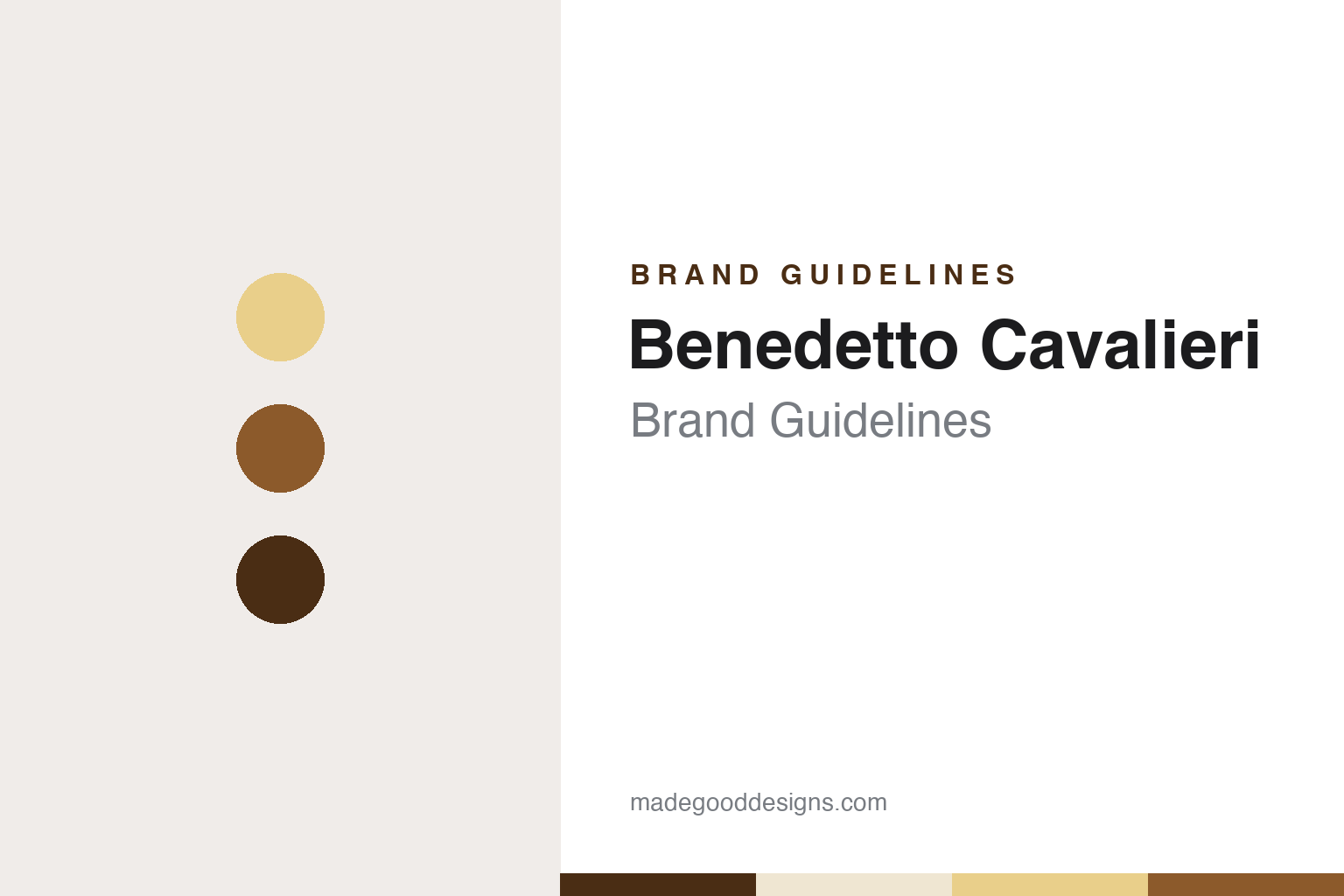
Two constants: a semolina gold, die bronze and deep brown palette and a family-name serif register. Abstract homage — not a Benedetto Cavalieri product or mark; no pack, logo or pasta is reproduced.
Grain before pasta
A wheat-trading family, a mill and a pasta works in the Salento.
Pastificio Benedetto Cavalieri makes dried durum-wheat pasta in Maglie, a town in the Salento, the peninsula at the heel of Puglia. The family business is older than its pasta. The company says the Cavalieri family was already growing durum wheat in Puglia in the 1800s, and that after the agricultural crisis that followed Italian unification it moved first into trading wheat abroad and then into building mills. It dates that commercial activity to 1872, under Andrea Cavalieri. Unioncamere’s national Register of Historic Enterprises, in which the firm is listed, also records 1872 as its start date, with milling as the original activity and pasta making as the later one.
The pasta works came in 1918. Benedetto Cavalieri, Andrea’s son, was born in Fasano, in the province of Brindisi, in 1879, Italian Wikipedia says, and moved to Maglie, where he opened the “Molino e Pastificio Benedetto Cavalieri,” a mill and pasta factory in one. The Fasano news site Osservatorio Oggi, in a profile first published in 2015, gave the opening date as 6 July 1918. The company says the founder chose durum wheat from the hills of Puglia and Basilicata and adopted the motto “First choice pasta guaranteed with name and surname!”.
The company also credits Benedetto with an early change in how the pasta was dried. Instead of drying it in the street, as was customary at the time, he used what the company calls the “Cirillo Method”: dedicated rooms warmed by hot-water radiators and stirred by large-bladed fans, run under the eye of the head pasta maker. In the 1950s he handed the business to his son Andrea, who, the company says, gave it a modern management structure and new machinery. Andrea’s son, also named Benedetto, is the current administrator and has led the company for more than 40 years. His son Andrea, whom the company calls the fourth generation of pasta makers, joined in 2007 and works in the business with his wife, Marina. The company describes itself as a family story of more than a century.
Colour
Slow drying, bronze dies and two signature shapes.
Cavalieri’s pasta is built around what the company calls the “Delicate Method”: long kneading, slow pressing, drawing through bronze dies and drying at a low temperature. The company says the dough is kneaded cold, at no more than 35°C, and that its dies are made of a special bronze alloy with a funnel milled into every hole, so that the dough passes through “gently.” It defines low temperature as drying air of no more than 54°C and gives drying times of 20 to 40 hours, depending on shape and thickness, against what it describes as industrial high-temperature systems of up to 120°C and as little as three hours. Those figures are the company’s own; Italian Wikipedia and the Osservatorio Oggi profile give drying times of up to 44 hours. After drying, the company says, the pasta rests in a conditioned room before it is weighed and packed.
Two shapes carry the name. Spaghettoni, a thick spaghetti, are dried for about 40 hours, the company says; Italian Wikipedia gives their diameter as 2.5 mm, and Gambero Rosso described them in 2024 as spaghetti that keep the U-shaped bend they take on during drying. The company still quotes a 2000 article in the American magazine Wine Spectator, by Sam Gugino, which praised the pasta’s “delightful chewiness.”
The second is Ruote Pazze, “crazy wheels,” a pasta wheel whose rim, hub and spokes have three different thicknesses. The company says the name, used in the Salento, comes from the shape’s imperfect circle, that the wheels keep their form after cooking, and that the die for them has been at the factory since 1918; Gambero Rosso reported in 2024 that the shape already appears in a factory inventory dated 1938. The company says the National Association for the Specialty Food Trade gave awards at the New York Fancy Food Show to its Spaghettoni in 2001 and to Ruote Pazze in 2002, and that Ruote Pazze are mentioned in Mine vaganti, the 2010 film by Ferzan Özpetek.
Typography
Design and documentation.
The seven brands in this group all make pasta, and all of them come from Italy: Granoro, Pastificio dei Campi, Di Martino, Setaro, Benedetto Cavalieri, Agnesi and Giovanni Rana. Italian pasta makers in general sit at many different points in the trade, from small family workshops that still carry a founder’s surname to names that now belong to much larger food groups, and the same word, pasta, covers both dried shapes made from durum wheat semolina and fresh or filled pasta sold from the chiller.
A pasta brand’s identity is usually carried less by a single shape than by a pack, a name and the place it promises, because the company behind the name may have changed hands, moved its factory or grown far beyond the town where it started. That makes the questions behind each name worth asking plainly: who started it, who owns it now, and where its pasta is actually made and packed.
Each guide separates what independent sources record from what the company says about itself — its founding story, its owners over time, where its pasta is made and how its packaging has changed — and marks plainly what rests only on the company’s own word.
Aa
A family-name serif for a pasta maker that signs its packs. (Specimen set in Libre Caslon Text, a serif STAND-IN; NOT the Benedetto Cavalieri logo.)
Benedetto Cavalieri
A small mill with a teaching role and an export trade.
The company has stayed small and in the family. Italian Wikipedia says its pasta is not sold through the large supermarket chains but from the factory, in specialist food shops and online, and that its export markets include Australia and the United States. The Osservatorio Oggi profile put daily output at about 150 quintals, or 15 tonnes, and the number of export countries at more than 20. The company says its range runs to about 40 shapes, including a line of organic whole-wheat pasta, alongside gift boxes, and that its wheat comes from chosen fields on the hills of Puglia and Basilicata, grown without heavy use of chemical fertilisers.
Since 2005 the factory has been a learning centre for the University of Gastronomic Sciences at Pollenzo, in Piedmont, according to both the company and Italian Wikipedia; the company describes it as Slow Food’s university, attended by students from five continents. In April 2026 the firm joined the Unione Imprese Centenarie Italiane, an association of Italian companies more than a century old, as its sixth member from Puglia, the association announced. The company’s press pages collect coverage in La Cucina Italiana, Gambero Rosso and Forbes, including a 2018 La Cucina Italiana recipe for its Spaghettoni from the restaurant Aimo e Nadia.
For a design guide, Benedetto Cavalieri shows how a family name, a founding date and two unusual shapes can carry a small pasta maker’s identity far beyond its town. Compare Rustichella d’Abruzzo, another bronze-die pasta maker, and Divella, a much larger Apulian pasta company. For this guide we use semolina gold, die bronze and a deep brown with a serif, an unofficial interpretation; no product or logo is reproduced.
Explore & save
Keep Benedetto Cavalieri’s identity on hand — save it to a board in the Made Good inspiration library.
Benedetto Cavalieri identity set
Pin the Benedetto Cavalieri semolina gold, die bronze and deep brown palette and the family-name serif register to your own board.