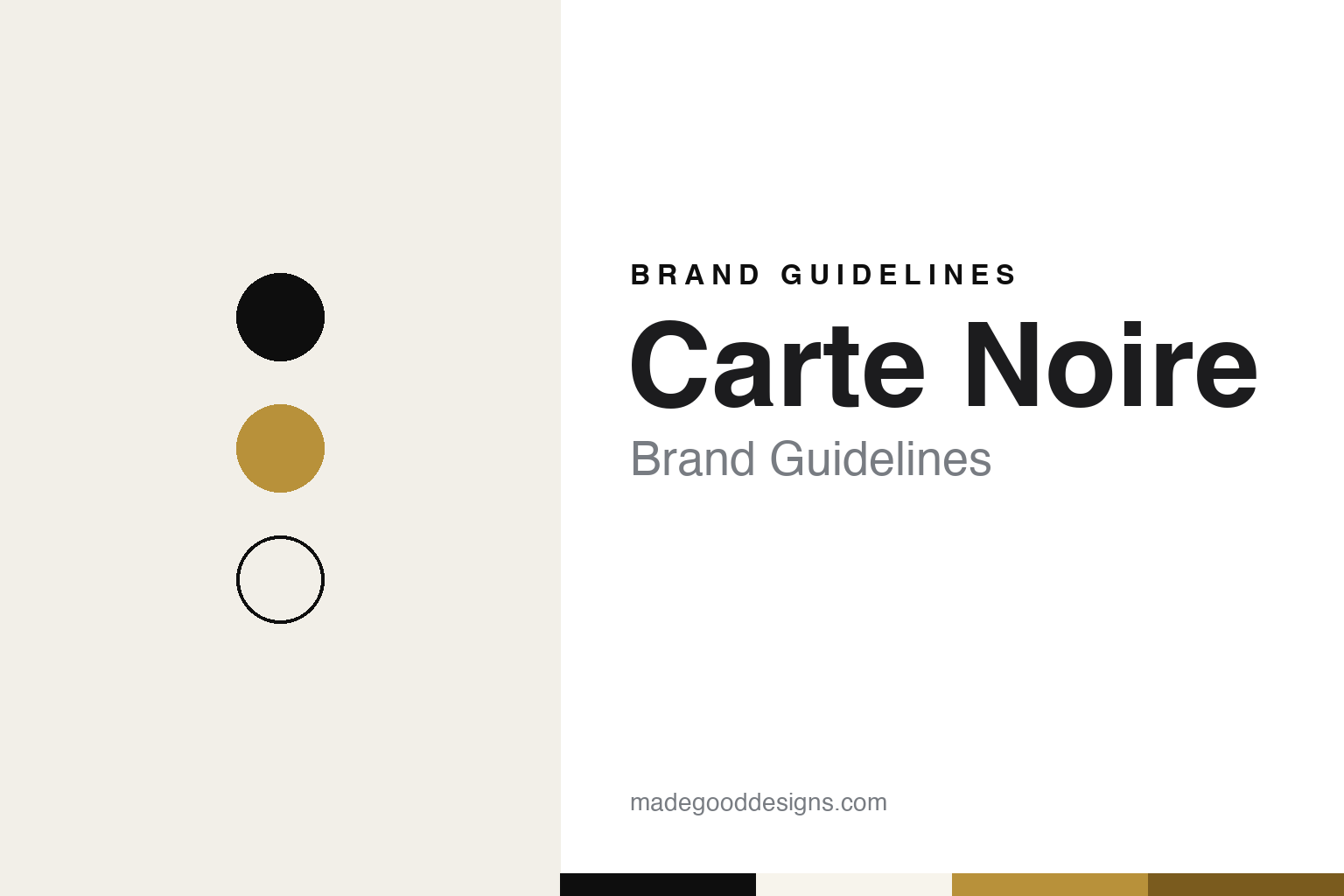
Carte Noire Brand Guidelines
René Monnier’s 1978 pure-arabica coffee in black and gold.
Aa
Two constants: a black, white and gold palette and a perfume-house serif register. Abstract homage — not a Carte Noire product or mark; no pack, label or logo is reproduced.
The arabica revolution
A coffee man, a price shock and a soft black pack.
Carte Noire was launched in France in 1978 by René Monnier, the founder of the coffee company Grand’Mère, French Wikipedia says, citing Franceinfo. At the time, three brands shared the French coffee market: Maison du Café, Grand’Mère and Jacques Vabre. Most coffee on the shelf was a blend of arabica and robusta.
The company tells the story as a reaction to a price shock. After world coffee prices rose in 1976, it says, Monnier refused the fall in quality that followed and launched something different: a premium coffee made only of arabica, priced above the competition and built on Latin American beans, especially from Brazil. The company calls its first product the first Carte Noire ground coffee, 100% arabica, and describes the brand as a pioneer of the pure-arabica segment at the end of the 1970s.
The pack was as new as the coffee. In an era when ground coffee still came in rigid tins and boxes, Carte Noire was sold in a soft vacuum pack, which the trade magazine Stratégies described in 1998 as more sensual to the touch. To keep it fresh, the company says, the airtight pack had a valve through which the gas given off after roasting could escape.
Monnier borrowed his marketing from another French industry. The company says he adopted the traditional codes of French luxury and perfume, with the colours black, white and gold, and had the pack printed “Premier grand cru, pur arabica,” wording it says reinforced the idea of very high quality. It says the laurel wreath on today’s packs still marks that founding innovation. French Wikipedia, citing the brand’s range pages, describes a gold ribbon carrying a white label marked “Carte Noire” on a black ground as common to all its packs, and black and gold as the brand’s colours in its logo and its products alike.
Colour
Jacobs Suchard, Philip Morris, Kraft, Mondelēz, Lavazza.
Carte Noire did not stay independent for long. In 1982 Jacobs Suchard, which already owned the Jacques Vabre and Jacobs coffee brands, bought the Grand’Mère company and Carte Noire with it, French Wikipedia says, citing the brand-history site Prodimarques. In 1990 the brand passed to Philip Morris, whose Kraft General Foods arm owned Maxwell House and Kenco, and in 1993 it joined Kraft Jacobs Suchard, the European food company formed that year by merging Kraft General Foods Europe with Jacobs Suchard, Les Échos reported in September 1993.
Kraft Foods became an independent company in 2007 and split in two in 2012, when Carte Noire went to Mondelēz International. Its next sale was forced by competition law. To win the European Commission’s approval for merging its coffee business with D.E Master Blenders 1753 into Jacobs Douwe Egberts, Mondelēz had to let Carte Noire go. Le Monde reported in July 2015 that the Italian roaster Lavazza was negotiating to buy it, and the sale was completed in February 2016. Les Échos put the price at €750 million; Italy’s Il Sole 24 Ore reported €700 million.
The coffee is roasted in Lavérune, on the edge of Montpellier in the Hérault. In 2009, when the plant still also roasted Jacques Vabre and Grand’Mère for Kraft, Kraft Foods said it produced about 45,000 tonnes a year for France and export markets, and for the plant’s fortieth anniversary that year its 36.7-metre storage tower, usually green, was repainted in the black and gold of the Carte Noire pack, French Wikipedia says, citing Kraft and the Midi Libre newspaper. Prodimarques put Carte Noire’s share of the French coffee market at 20% in 2009.
Under Lavazza the site works for Carte Noire alone. The company says Lavazza has invested €60 million since 2016 to modernise it, adding high-output lines for soft pods and Nespresso-compatible capsules and a new tangential roaster; that the Lavérune site now has 10 production lines and 9 roasters, produces 30,000 tonnes of coffee a year and handles all Carte Noire production; and that its green coffee is mainly arabica from Brazil, Honduras and Colombia.
Typography
Design and documentation.
The seven brands in this group all sell coffee, and they come from Britain, France, Switzerland, the United States and Italy: Kenco, Carte Noire, Percol, Nescafé, Caribou Coffee, Gloria Jean’s and Caffè Mauro. Coffee brands in general sit at many different points in the trade, from family roasters that still carry a founder’s surname to names that now belong to much larger food and drink groups, and a single brand can be sold everywhere from a café counter to a supermarket shelf.
A coffee brand’s identity is usually carried less by a single product than by a pack, a name and the cup it promises, because the company behind the name may have changed hands, moved its roastery or grown far beyond the town where it started. That makes the questions behind each name worth asking plainly: who started it, who owns it now, and where its coffee is actually roasted and packed.
Each guide separates what independent sources record from what the company says about itself — its founding story, its owners over time, where its coffee is made and how its packaging has changed — and marks plainly what rests only on the company’s own word.
Aa
A high-contrast serif for a coffee that borrowed the codes of French perfume. (Specimen set in Playfair Display, a serif STAND-IN; NOT the Carte Noire logo.)
Carte Noire
A coffee called desire, and the cinema.
Carte Noire’s advertising made it as much as its pack did. French Wikipedia dates the signature “Carte Noire, un café nommé désir” — “a coffee called desire” — to 1985; the company dates the campaign of that name to 1993 and says it marked the brand’s identity for good. Its films showed a couple seemingly carried away by the smell of coffee, a black veil and the song “Try to Remember,” written by the American composer Harvey Schmidt. Pascal Bourdin of the agency Euro RSCG, which handled the campaign in 1998, told Stratégies that the spots were meant to carry values of seduction and dream; the film director Jean-Jacques Annaud directed them.
The brand tied itself to film beyond its own commercials. French Wikipedia says it sponsored Michel Drucker’s Cinéstars on TF1 from 1989 to 1994, partnered with Canal+ on its cinema coverage from 1997, backed the Prix Louis-Delluc and later the Prix Jean-Gabin and Prix Romy-Schneider, and has sponsored the Prix Ciné Roman Carte Noire, a prize for a novel suited to adaptation, since 2001. The company adds that it partnered the Cannes film festival in 1993 and 1994 and has worked with directors including Jalil Lespert and Valérie Donzelli and with the actress Rossy de Palma.
The desire theme ended in 2011, when the brand changed its slogan to “Carte Noire, le temps de vivre plus fort” with the Télépopmusik track “Breathe” and a film by the British director Sean Ellis, French Wikipedia says. The company lists later platforms: “Les plus belles couleurs du noir” in 2016, “Intensément vivant” in 2020 and, most recently, “L’élan d’un grand café.” It now describes itself as official partner of the French national rugby teams.
The range grew around the original ground coffee. The company dates Carte Noire Infini, a premium decaffeinated coffee, to 1992; an instant coffee to 1994; soft pods to 2003; Nespresso-compatible capsules to 2013; and organic coffees certified AB and UTZ to 2017. French Wikipedia adds Velours Noir, a milder blend, in 1987, and Tassimo pods in 2004.
For a design guide, Carte Noire shows how a supermarket coffee can borrow the black, white and gold of French perfume and keep it for almost half a century. Compare Lavazza, its owner since 2016, and Kenco, its stablemate under Philip Morris, Kraft and Mondelēz from 1990 to 2016. For this guide we use black, a ribbon gold and a label white with a high-contrast serif, an unofficial interpretation; no product or logo is reproduced.
Explore & save
Keep Carte Noire’s identity on hand — save it to a board in the Made Good inspiration library.
Carte Noire identity set
Pin the Carte Noire black, white and gold palette and the perfume-house serif register to your own board.