Lacta Brand Guidelines
The Greek milk chocolate from the Pavlides factory, now owned by Mondelēz.
Aa
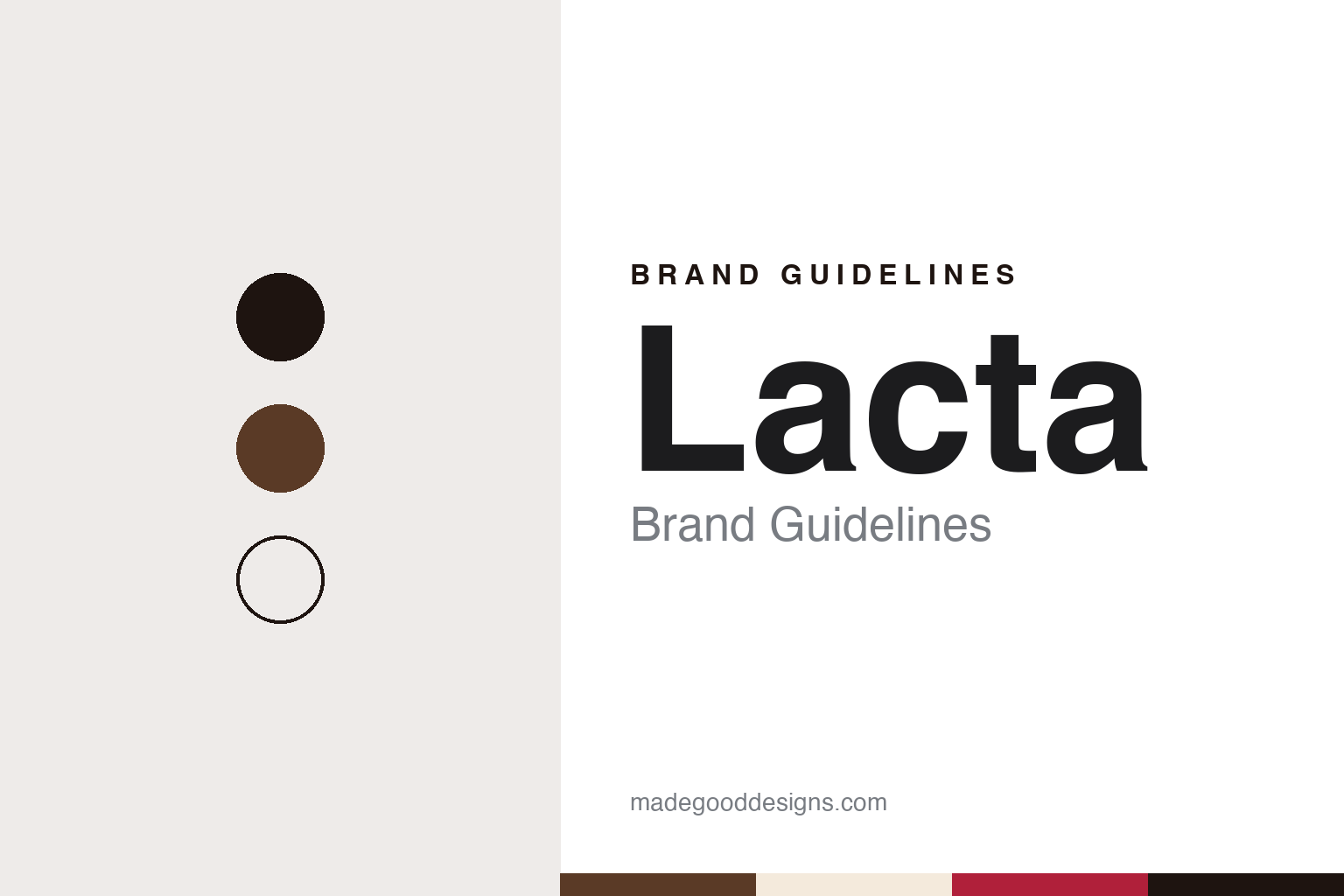
Two constants: a Lacta milk-chocolate brown, cream and red palette and a Warm sans register. Abstract homage — not a Lacta product or mark; no pack, logo or wrapper is reproduced.
Pavlides
A milk chocolate from Greece’s oldest chocolate maker.
Lacta is a Greek milk chocolate, and its story begins with an older company. English Wikipedia describes Lacta as a series of chocolate products created in 1962 by the Pavlides confectioner of Athens; Greek Wikipedia, more cautiously, says the products were introduced in the 1960s. Both describe Pavlides as a business founded in Athens in 1841, and Greek Wikipedia names its founder as Spyridon Pavlides. An archived history of the brand, the source English Wikipedia cites, says Lacta milk chocolate was created at the Pavlides factory on Pireos Street, the long avenue running from central Athens towards Piraeus.
That history traces Pavlides from a confectioner’s shop on the corner of Aiolou and Vyssis streets in central Athens, known for baklava, sugared almonds and loukoumi, to a chocolate factory on Pireos Street, which it dates to 1876. The Pavlides story itself is told in our Pavlides guide. Lacta was a later product of that company, made more than a century after the confectioner’s shop opened.
English Wikipedia’s disambiguation page lists two chocolate businesses called Lacta, the Greek one and a separate Brazilian company, so the name alone does not identify the brand. This guide is about the Greek chocolate, whose website is lacta.gr.
Colour
From Jacobs Suchard to Kraft to Mondelēz.
Lacta has belonged to multinational owners for more than three decades. The archived brand history says Pavlides combined with the Swiss confectionery and coffee group Jacobs Suchard in 1988, and that in 1991 Kraft, which it says had been active in Greece since 1970, bought the Pavlides chocolate business; it adds that Kraft Foods Hellas had held 100% of the chocolate company since 2001. English Wikipedia gives the same 1991 date for the sale of Pavlides to Kraft Foods. Kraft Foods, English Wikipedia notes, was later renamed Mondelēz International, and the Lacta website today carries a Mondelēz International copyright line. Within Mondelēz, Lacta sits alongside other national chocolate brands that began as independent makers, such as Côte d’Or in Belgium and Freia in Norway.
Not every account agrees on the dates. In a 2010 Advertising Age article, Panos Sambrakos, executive creative director of the agency OgilvyOne Worldwide in Athens, described Lacta as a Greek product launched in the 1970s and bought by Kraft in the 1980s.
Beyond the plain milk chocolate bar, English Wikipedia lists many forms and flavours of Lacta, including versions with Oreo, hazelnut and strawberry yoghurt, and names its markets as Greece, Cyprus and Albania. Greek Wikipedia also notes that Lacta is distributed in Cyprus. English Wikipedia says Lacta bars remain among the best-selling chocolate bars in Greece, and Sambrakos called it the best-selling bar in the country in 2010.
Typography
Food and documentation.
The seven brands in this group all make food, and all of them come from Greece, Switzerland or France: Lacta, Allatini, Papadopoulos, Minerva, Zweifel, Ragusa and Francine. Food brands from these three countries sit at many different points in the trade, from family firms that still carry a founder’s surname to names that now belong to much larger food groups, and a single brand can be sold everywhere from a corner shop to a supermarket shelf.
A food brand’s identity is usually carried less by a single product than by a pack, a name and the meal or snack it promises, because the company behind the name may have changed hands, moved its factory or grown far beyond the town where it started. That makes the questions behind each name worth asking plainly: who started it, who owns it now, and where its products are actually made and packed.
Each guide separates what independent sources record from what the company says about itself — its founding story, its owners over time, where its products are made and how its packaging has changed — and marks plainly what rests only on the company’s own word.
Aa
A warm sans — the sweetest piece of your life. (Specimen set in Inter Tight, a sans STAND-IN; NOT the Lacta logo.)
Lacta
The sweetest piece of your life.
Lacta’s advertising has been built on love. Its long-running endline, which Advertising Age translated as “Lacta is the sweetest piece of your life,” was created by Ogilvy, and the Greek version, “Το πιο γλυκό κομμάτι της ζωής σας,” still appears on the Lacta website, which also promotes a campaign called “365 days of love.”
Its best-documented campaign was a film. Advertising Age reported in March 2010 that Kraft had crowdsourced a 27-minute branded film, “Love in Action,” made with OgilvyOne in Athens. The public was invited to send in real love stories, and 1,307 were posted; a jury of Kraft and OgilvyOne executives and the screenwriter George Kapoutzidis chose a story about a musician and a new army recruit who meet on a train. Some 11,500 people registered to vote on casting, the characters’ names and their clothes, and some appeared as extras. The plan was to show it online, but the Greek channel MEGA offered to broadcast it on Valentine’s Day, and it reached more than 335,000 television viewers, the magazine said. The film showed the chocolate in only three shots; “Our client didn’t want the audience to be distracted by the product,” Sambrakos told the magazine. “He wanted it to be entertainment first.”
The production was run in public as well. Full screen tests for the leading roles were posted online for voting, and updates from the two-week shoot went out on Facebook and on Kraft’s blog. In its first weeks online the film was viewed 150,000 times and drew more than 20,000 fans on Facebook, and the song featured in it became a hit, Advertising Age reported. Sambrakos said the agency would continue the idea of making films out of real love stories, and was redesigning the Lacta website.
An earlier OgilvyOne project for Lacta, in 2009, was an interactive web story called “Love at First Site,” about an English girl and a young Greek man on the island of Paros, with codes on Lacta wrappers that unlocked tips for the story, Advertising Age reported.
For a design guide, Lacta shows how a national chocolate can keep a local voice under a global owner by owning one emotion. Compare Côte d’Or and Freia, two other national chocolates now owned by Mondelēz. For this guide we use a milk-chocolate brown, cream and a red with a sans, an unofficial interpretation; no product or logo is reproduced.
Explore & save
Keep Lacta’s identity on hand — save it to a board in the Made Good inspiration library.
Lacta identity set
Pin the Lacta milk-chocolate brown, cream and red palette and the Warm sans register to your own board.