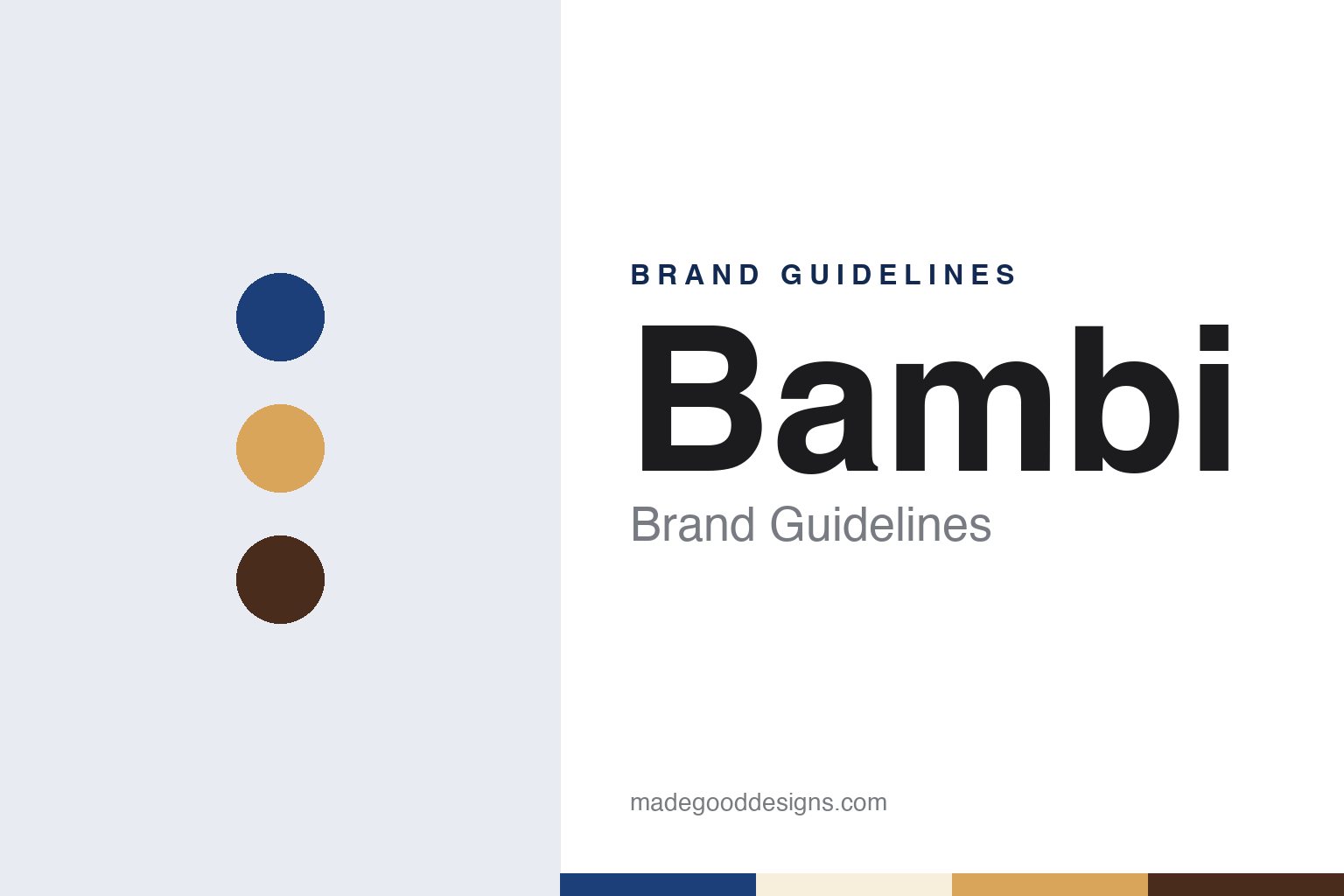
Bambi Brand Guidelines
The Požarevac biscuit maker behind Plazma.
Aa
Two constants: a deep blue, biscuit gold and cocoa palette and a rounded friendly sans register. Abstract homage — not a Bambi product or mark; no pack, logo or biscuit is reproduced.
A biscuit town
A children’s biscuit factory in eastern Serbia.
Bambi was founded in 1967 in Požarevac, a town in eastern Serbia, then part of socialist Yugoslavia. English Wikipedia says the company was set up on the initiative of Momčilo Filipović and later Petar Tutavac, with the support of the League of Communists of Yugoslavia; Serbian Wikipedia, citing a 2022 report by the public broadcaster RTS, names the same two men. The company says it began as a factory for children’s biscuits, with 37 employees and an annual output of 167 tonnes.
Its best-known product came almost at once. Plazma, which English Wikipedia describes as a soft biscuit, dates from 1967 according to the English and Serbian Wikipedia articles on the biscuit, while English Wikipedia’s article on the company gives 1968 as the year production began. English Wikipedia describes Plazma as originally a variation of the Italian Plasmon biscuit. Serbian Wikipedia says the Plazma name was chosen by Filipović, the company’s director and founder, while the start of production is linked to Tutavac.
How the biscuit came to Požarevac is told in two ways. One account, published by the Serbian site Dnevno in 2014 and repeated by Edukacija in 2015, says Tutavac had worked for Plasmon and returned home to Požarevac after lay-offs that followed Heinz’s purchase of the Italian company in 1963. Filipović gave a different version in an interview with Večernje novosti, as summarised by The Nutshell Times in October 2020: he had wanted to expand a wheat mill in Leskovac into biscuit making, found the town keener on its textile industry, and, after long negotiations, acquired the rights and technology from Italian producers. In that telling the factory was then built in Požarevac and Tutavac, a master baker from a small biscuit factory in Croatia, joined the team and rose to technical director. Tutavac died in 2022, RTS reported, describing him as the first Yugoslav biscuit maker and the creator of Plazma.
Colour
Plazma, Lane and a portfolio of biscuits.
Plazma became the company’s signature. Serbian Wikipedia, citing the brand’s own history, says it was the most successful brand in Yugoslavia by 1974, and that in 2004 Serbia’s trade ministry and the newspaper Pregled named it the best Serbian brand. Outside Serbia and the former Yugoslavia it has been sold under the name Lane, English and Serbian Wikipedia say. Over the years the range has grown well beyond the original biscuit: Serbian Wikipedia lists a ground Plazma, a chocolate Plazma in 2008, a posna Plazma for Orthodox fasting periods in 2011, a no-added-sugar version in 2012 and a salted Plazma launched in 2017 to mark the brand’s fiftieth year.
Packaging has changed with the range. Serbian Wikipedia says that in 2000 a competition was held to find a girl whose likeness would appear on redesigned Plazma packaging, and that in 2006, citing the brand’s history, the whole Plazma portfolio was redesigned as a smaller Mini Plazma arrived in a pouch. The company itself has changed its look too: Serbian Wikipedia shows a logo used from 2006 to 2017, and English Wikipedia says Bambi changed its logo in mid-2017 while introducing new products. A Plazma campaign in 2020, which the company calls “Equality starts at home,” won a Disrupt award that year, Serbian Wikipedia says, citing the Plazma website. The current Plazma slogan is “Sve što ti treba” — “All you need.”
Plazma is not the only name. On its website Bambi lists Wellness biscuits, Zlatni Pek lenten biscuits, the Josh snacks and Bambi Napolitanke wafers alongside Plazma, and says it holds the right to use the “Čuvarkuća” mark, which identifies domestic products, on Plazma and Zlatni Pek.
Typography
Design and documentation.
The seven brands in this group all make food, and they come from Poland, Ukraine, Russia, Austria and Hungary, Croatia, the Czech Republic and Serbia: Sokołów, Roshen, Krasny Oktyabr, Kotányi, Kraš, Hamé and Bambi. Food brands in general sit at many different points in the trade, from family firms that still carry a founder’s surname to names that now belong to much larger food groups, and a single brand can be sold everywhere from a corner shop to a supermarket shelf.
A food brand’s identity is usually carried less by a single product than by a pack, a name and the meal or treat it promises, because the company behind the name may have changed hands, moved its factory or grown far beyond the town where it started. That makes the questions behind each name worth asking plainly: who started it, who owns it now, and where its food is actually made and packed.
Each guide separates what independent sources record from what the company says about itself — its founding story, its owners over time, where its food is made and how its packaging has changed — and marks plainly what rests only on the company’s own word.
Aa
A rounded friendly sans for a biscuit brand that began with children’s biscuits. (Specimen set in Fredoka, a sans STAND-IN; NOT the Bambi logo.)
Bambi
A concern, three owners and one factory town.
Bambi has passed through several owners since the end of Yugoslavia. English Wikipedia says that in mid-2004 it became part of the Danube Foods Group, managed by the Salford Investment Fund. In 2006, the company says, it merged with Banat of Vršac to form the Bambi-Banat concern; Serbian Wikipedia says that when Banat was sold to Swisslion-Takovo in 2016, its products returned to the Banat logo they had given up for the Bambi one. In 2015 Bambi, along with the dairy Imlek and the water bottler Knjaz Miloš, passed to the London investment fund Mid Europa Partners and co-investors, the newspaper Blic reported. On 18 February 2019 Coca-Cola HBC announced it would buy Bambi from Mid Europa, FoodBev and Forbes reported that day, and the company dates its entry into the Coca-Cola HBC group to 2019. The company’s name today is Koncern Bambi a.d., and it lists its head office in Novi Beograd and its factory in Požarevac.
Bambi’s biscuits are made in Požarevac. Serbian Wikipedia, citing a 2013 company page, says the concern had two factories in the town, Bambi 1 from 1967 and Bambi 2 from 1986, with a third site in the Braničevo district merged into the second in 2008. The company says it produces between 110 and 120 tonnes of biscuits a day there, and that a new 310-metre Plazma line began work in 2022, nearly doubling Plazma output.
On 29 June 2024 a fire broke out at the Požarevac factory. Serbian Wikipedia, citing Blic and Forbes reports from 2024, says about 500 square metres burned; the fire was quickly contained, but the Plazma line stopped, and some varieties went missing from shops. In November 2024 the company said it had restarted Plazma production at reduced capacity, on a line able to make about a third of its former output, and that it planned to restart its remaining lines and keep investing in the factory.
For a design guide, Bambi shows how a single plain biscuit, two founders’ stories and a factory town can carry a company through socialist Yugoslavia, private-equity ownership and a global bottler. Compare Kraš, the Zagreb confectioner whose Petit Beurre English Wikipedia names as an early Plazma rival, and Bahlsen, the Hanover biscuit maker. For this guide we use a deep blue, a biscuit gold and cocoa with a rounded sans, an unofficial interpretation; no product or logo is reproduced.
Explore & save
Keep Bambi’s identity on hand — save it to a board in the Made Good inspiration library.
Bambi identity set
Pin the Bambi deep blue, biscuit gold and cocoa palette and the rounded friendly sans register to your own board.