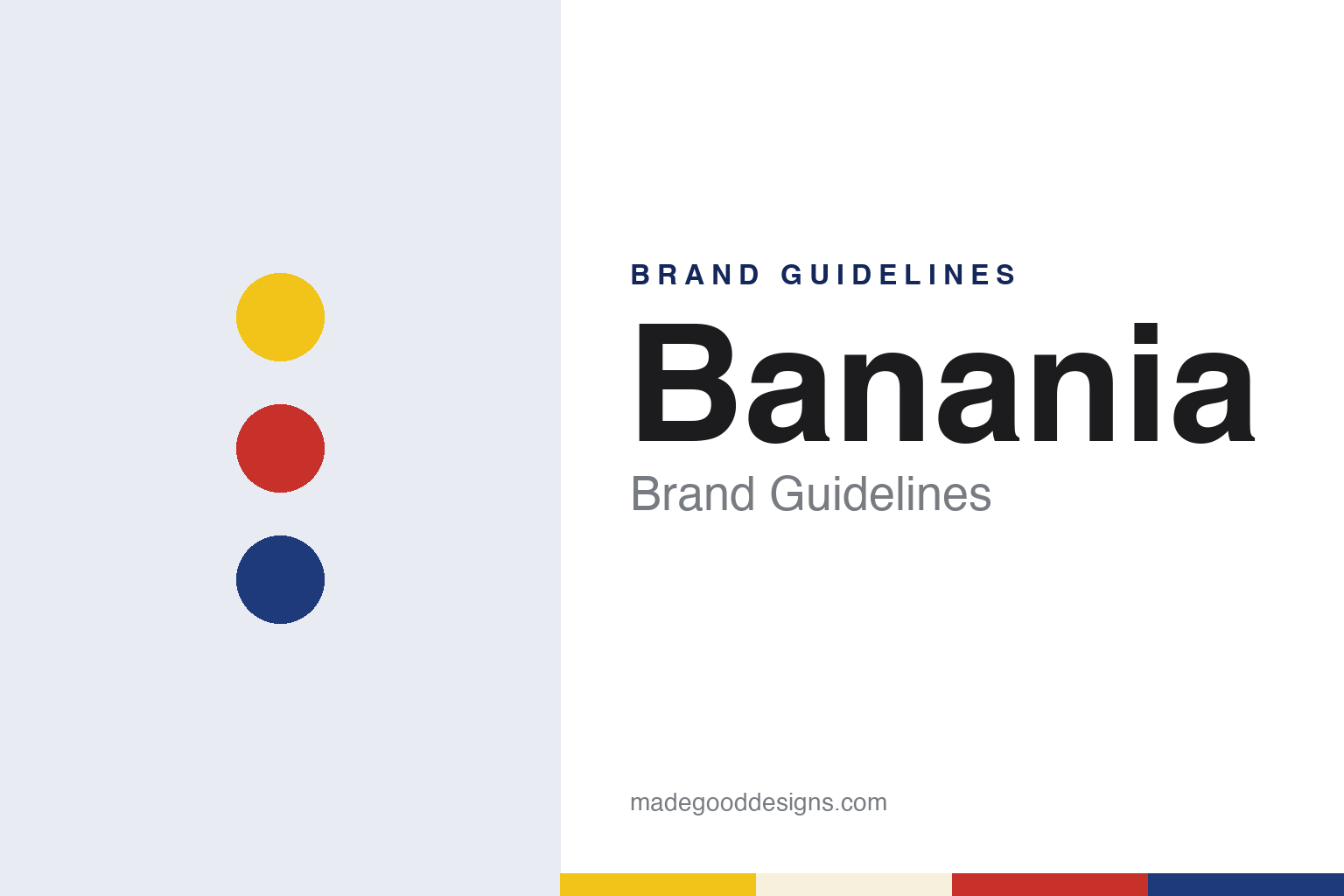
Banania Brand Guidelines
A 1914 breakfast powder with a long, contested poster history.
Aa
Two constants: a banana yellow, poster red and deep blue palette and a poster-era serif register. Abstract homage — not a Banania product or mark; no tin, poster, character or logo is reproduced.
A name chosen in 1914
A journalist, a recipe and a name registered as war began.
Banania is a French chocolate breakfast powder made with cocoa and banana flour, and its founder was a journalist, Pierre-François Lardet. The company tells his story this way: on a trip to Nicaragua in 1909 he came across a drink made from banana flour, cocoa, crushed cereals and sugar, and back in Paris in 1912 he set out to reproduce it commercially, working out the proportions with a pharmacist friend. French Wikipedia, citing a 1993 history in the Revue des marques, repeats the account and notes, citing Linternaute in 2008, that this version of events is disputed.
The name came out of a shortlist. The company lists Bananette, Bananose, Bacao, Banacao and Banarica among the names considered before Banania was chosen and registered on 31 August 1914, a month after the First World War began; French Wikipedia says the final choice was made by Lardet’s wife, Blanche. Production began that year in Courbevoie, just west of Paris. French Wikipedia, citing Le Parisien in 2008, says the business later moved its manufacturing to Maisons-Laffitte, and the Courbevoie works was demolished in 1975. When the Courbevoie plant closed in June 1940, production carried on in Clermont-Ferrand.
The first advertising sold the powder as fortifying food. The company says its first image was “L’Antillaise,” a woman from the French Caribbean drawn by H. Tishon, and that during the war Lardet sent fourteen wagons of the powder to the front. In 1921 Lardet went into partnership with the hotelier Albert Viallat, who took over at the head of the company in 1924; French Wikipedia says Lardet, left as a minority shareholder, was pushed aside. Albert Lespinasse, who joined in 1927, ran the company from 1953 to 1972; French Wikipedia calls him Lardet’s nephew, while the company calls him Viallat’s.
Colour
A soldier, a slogan and decades of objection.
The image most associated with the brand is also its most contested. At the end of 1915, French Wikipedia says, Banania replaced its early emblems with a Senegalese tirailleur — a West African infantryman of the French colonial army — wearing a fez, drawn by the Franco-Italian artist Giacomo de Andreis. English Wikipedia, citing the historian Brett Berliner’s Ambivalent Desire (2002), says the slogan “Y’a bon” imitated a pidgin French attributed to these soldiers and was in fact an invention; French Wikipedia says it was added to the image in 1917.
The character was redrawn many times. The company names illustrators including Sepo, who made the tirailleur younger in 1935, Georges Élisabeth, Hervé Morvan, Chaval and Siné, and says Jacques Bazaine directed poster and pack graphics from 1953; it also says the brand received the Oscar de la Publicité in 1960 and the Grand Prix de la Publicité in 1965. English Wikipedia says the yellow ground of the packs alludes to the banana, with red and blue taken from the soldier’s uniform.
Criticism grew over the century. The poet Léopold Sédar Senghor wrote in Hosties noires (1948) of tearing down “les rires Banania” from the walls of France, and Frantz Fanon cited the grinning tirailleur in Black Skin, White Masks (1952). French Wikipedia says the slogan was increasingly criticised from the 1970s as a racist stereotype and a symbol of colonialism. Its dating of the slogan’s retirement varies: it says the historic slogan and logo were dropped when the brand was sold in 1967 and replaced by a more stylised design, and elsewhere that the slogan ran until 1977. The company says that in 1987 the soldier’s smile gave way to a smiling sun.
The old imagery came back after 2003. French Wikipedia says the new owner reused the slogan and visual, drawing objections from groups including the Collectif des Antillais, Guyanais et Réunionnais. In 2006 the company signed an agreement with that collective and the anti-racism movement MRAP to drop the phrase, Le Monde and L’Express reported. On 19 May 2011 the Versailles Court of Appeal, ruling for MRAP, ordered Nutrimaine, the company that holds the trademark, to stop selling any product bearing “Y’a bon,” L’Express reported the next day.
Typography
Design and documentation.
The seven brands in this group all make food, and all of them come from France: Herta, Fleury Michon, Banania, Tipiak, Cassegrain, Saupiquet and Bjorg. French food brands in general sit at many different points in the trade, from family firms that still carry a founder’s surname to names that now belong to much larger food groups, and a single brand can be sold everywhere from a village grocer to a hypermarket shelf.
A food brand’s identity is usually carried less by a single product than by a pack, a name and the meal or snack it promises, because the company behind the name may have changed hands, moved its factory or grown far beyond the town where it started. That makes the questions behind each name worth asking plainly: who started it, who owns it now, and where its food is actually made and packed.
Each guide separates what independent sources record from what the company says about itself — its founding story, its owners over time, where its food is made and how its packaging has changed — and marks plainly what rests only on the company’s own word.
Aa
A poster-era serif for a brand whose story was told in advertising art. (Specimen set in Fraunces, a serif STAND-IN; NOT the Banania logo.)
Banania
From a pharmaceutical group to a French holding.
Banania has changed hands several times, and the sources date the middle of the chain differently. French Wikipedia says the brand was sold in 1967 to the pharmaceutical group Clin-Midy, the same year Banania created the Benco brand; that Clin-Midy sold it to Bestfoods in 1988; and that it passed to Unilever when Unilever bought Bestfoods in 2000. The company’s own timeline says that at the end of 1987 the Midial group, which included Banania, Benco and the Yabon desserts, was sold to the Corn Products Corporation, and that Unilever bought Banania in 1990.
Both accounts agree on what came next. In 2003 the French holding company Nutrial, led by Pierre-Hervé Gautier, bought Banania, Benco and Yabon from Unilever, according to an AFP report of 2 May 2003 and L’Usine Nouvelle, as cited by French Wikipedia. The trademark is held by Nutrimaine, a Nutrial company, which also publishes the brand’s website. French Wikipedia says the Yabon desserts and their factory at Verneuil-sur-Avre were sold in 2005, leaving production at a single plant in Faverolles, in the Somme; Process Alimentaire reported in January 2017 that Catherine Hostein had become president of Nutrimaine Banania.
That last French plant did not last. A restructuring plan was approved in March 2019 and the Faverolles site, with about 40 staff, closed on 15 April 2019, the Courrier picard reported in an article carried by La Voix du Nord; French Wikipedia says production moved to Germany that year. The company’s timeline lists later products including a traditional cook-in recipe from 1999, a spread from 2012 and a stronger-cocoa version from 2014, and says it has licensed the name for seasonal chocolates, biscuits and objects since 2007. Old Banania tins, posters and thermometers are common collectors’ items, French Wikipedia notes.
For a design guide, Banania shows how a breakfast pack built on advertising art carried a colonial image that the brand was later required to drop. Compare Monbana, the cocoa-powder maker founded by Louis Guattari, whom Lardet met during the First World War, and Ovaltine, another long-running breakfast drink. For this guide we use banana yellow, a poster red and a deep blue with a serif, an unofficial interpretation; no product or logo is reproduced.
Explore & save
Keep Banania’s identity on hand — save it to a board in the Made Good inspiration library.
Banania identity set
Pin the Banania banana yellow, poster red and deep blue palette and the poster-era serif register to your own board.