Kofola Brand Guidelines
The Czechoslovak cola born in a pharmacy lab.
Aa
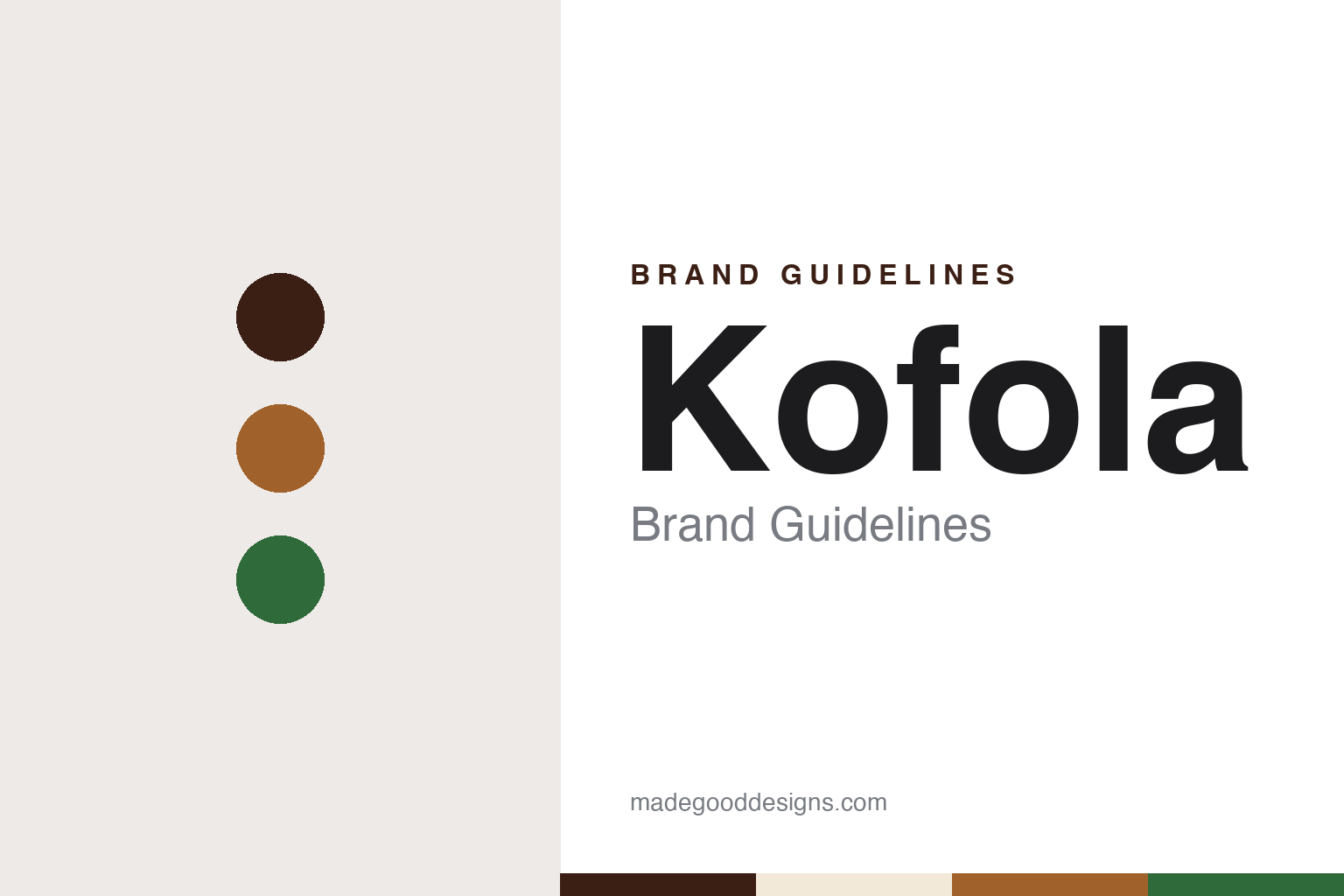
Two constants: a cola brown, caramel and herb green palette and a rounded bold sans register. Abstract homage — not a Kofola product or mark; no bottle, logo or label is reproduced.
A cola from the drug lab
Surplus caffeine, a state task and a herbal syrup.
Kofola is a cola that began in a pharmaceutical research institute rather than a soft-drink company. English Wikipedia says it originated at the Czechoslovak Research Institute of Medicinal Plants in Prague in 1959, during research into a possible use for the surplus caffeine produced when coffee was roasted. The company tells the story from a little earlier: it says that in 1957 a state task was issued to create a domestic drink that could stand comparison with Western colas, and that the task went to the pharmaceutical group SPOFA in Prague, into which the Opava drug maker Galena had been merged. Galena itself had been founded as a national enterprise in Opava in 1952, making medicines and tinctures and growing plant cultures, the company says.
The work was led by the pharmacist and scientist Zdeněk Blažek. Czech Wikipedia credits him with developing the drink at the research institute, and the company says his team spent two years refining the formula before settling on a mix of fourteen herbal and fruit ingredients plus caffeine. The result was a dark, sweet-and-sour concentrate called KOFO, and the drink made from it was named Kofola. The company says the same syrup is still used today. Czech Wikipedia adds that Jaroslav Knap, a pharmacy graduate, helped scale up production at Galena’s works in Opava-Komárov, the site that later became part of Teva.
Kofola went on sale in 1960. Demand grew so fast during the 1960s, the company says, that Czechoslovakia ran short of the herbs it needed and had to import them. Czech Wikipedia puts annual production in the early 1970s at 179.4 million litres; the company rounds the figure to 180 million litres a year and describes Kofola as a fixture of village shops, works canteens and pubs, sold in returnable bottles. It was also poured on draught, and English Wikipedia notes that it is still a popular choice in restaurants because it can be served from kegs. The company also claims a longer lineage, naming the Opava pharmacist Gustav Hell, whose firm G. Hell & Comp. made a kola-nut syrup in the late nineteenth century, as Kofola’s forerunner.
Colour
A coffee bean, a love slogan and a Christmas piglet.
Kofola’s look has been built on a small number of long-lived ideas. The company says that in 1968 it introduced a logo in the shape of a coffee bean, which lasted for three decades, together with its first slogans, posters and advertising on vehicles. Czech Wikipedia says the coffee-bean logo was used until 2000 and that the current mark resembles a liquorice leaf; English Wikipedia describes it instead as resembling a coffee flower, so the two sources differ on what the newer symbol depicts.
The modern advertising has leaned on one idea: love. The company dates the slogan “Když ji miluješ, není co řešit” — roughly, “when you love her, there’s nothing to worry about” — to 2001, while Czech Wikipedia places the campaign in 2002; the line is still in use. In 2003 came a Christmas television commercial featuring a piglet, which English Wikipedia, citing the news site iDnes in 2015, calls one of the most successful advertisements on Czech television. The company says the spot became a seasonal fixture that viewers wait for as they wait for carols.
Flavours followed the same seasonal rhythm. The company says Kofola Citrus, launched in 2004, was the first flavoured version in more than forty years, and Czech Wikipedia says limited editions have appeared every year since 2007, including Christmas editions. A sugar-free Kofola arrived between 2006 and 2008 and the first cans in 2011, according to the company, and a 50th-birthday spot in 2010 retold how the drink came into being. In 2015 a campaign called “Fofola”, built around a lisping cartoon dog and an apricot flavour, spread from television into everyday speech, the company says; Czech Wikipedia counts some twenty spots featuring the dog in 2015 and 2016. The company says the campaign won gold Effie awards in the Czech Republic and Slovakia and a Euro Effie in 2016. Since 2022, under a project the company calls Cirkulka, Kofola has also come back in returnable glass bottles, alongside the group’s Vinea and Rajec brands.
Typography
Design and documentation.
The seven brands in this group all make food or drink, and all of them come from Central Europe — from Poland, Hungary, Croatia and the Czech Republic: Prince Polo, Tymbark, Hortex, Pick, Podravka, Vegeta and Kofola. Food and drink brands from the region in general sit at many different points in the trade, from names that began in state enterprises to names that now belong to much larger food groups, and a single brand can be sold everywhere from a village shop to a supermarket shelf.
A food or drink brand’s identity is usually carried less by a single product than by a pack, a name and the meal or snack it promises, because the company behind the name may have changed hands, moved its factory or grown far beyond the town where it started. That makes the questions behind each name worth asking plainly: who started it, who owns it now, and where its products are actually made and packed.
Each guide separates what independent sources record from what the company says about itself — its founding story, its owners over time, where its products are made and how its packaging has changed — and marks plainly what rests only on the company’s own word.
Aa
A rounded bold sans for a cola sold on love and foam. (Specimen set in Rubik, a sans STAND-IN; NOT the Kofola logo.)
Kofola
From a state drug maker to a Krnov soda works and a listed group.
After the Velvet Revolution of 1989, imported colas flooded the market and Kofola lost ground. Czech Wikipedia says production fell to a low of 26 million litres in 1996, and that a few years after 1990 Galena, which held the brand and made the KOFO syrup, was bought by the American drug company IVAX. The company says that in this period Kofola changed owners several times.
Its revival came from outside the pharmaceutical trade. In 1993, the company says, Kostas Samaras, an entrepreneur with Greek roots, bought a soda works in Krnov and began making carbonated drinks; Czech Wikipedia says the business, first called SP Vrachos and later Santa nápoje, belonged to the Samaras family. In the late 1990s it added the Jupí syrups and began building a plant at Rajecká Lesná in Slovakia, the company says. In 2000 it signed a licence agreement with IVAX’s Opava company, then the brand’s owner, and began bottling Kofola, and in 2002 it bought the registered trademark and the original recipe outright, according to both the company and Czech Wikipedia. Santa nápoje renamed itself Kofola in 2003, Czech Wikipedia says, and the company took the name Kofola ČeskoSlovensko in 2012.
The firm then grew into a regional drinks group. It merged with the Polish drinks maker Hoop in 2008, when the private-equity firm Enterprise Investors acquired about 42% of the combined company, the business news service Investment Intelligence reported that November; it bought the maker of the Semtex energy drink in 2009 and the Slovenian mineral-water brand Radenska, which Czech Wikipedia dates to December 2014. Its shares began trading on the Prague Stock Exchange in December 2015, iHNed.cz reported. Later purchases included the Czech herbal-tea maker Leros in 2018, reported by Hospodářské noviny that March, the Korunní and Ondrášovka mineral waters in 2020, and a majority stake in Pivovary CZ Group, owner of the Holba, Zubr and Litovel beers, a deal Seznam Zprávy reported in November 2023 and the company dates to 2024. Czech Wikipedia says the Polish Hoop brand was sold in 2019.
The Samaras family still controls the business. Czech Wikipedia says the holding company Aetos, which represents the family’s interests, owns about two-thirds of Kofola ČeskoSlovensko. Jannis Samaras stepped down as chief executive of the Czech and Slovak business in 2018 to concentrate on the wider group, handing over to Daniel Buryš, the company says. The group is based in Ostrava, where it says a new head office and an interactive Kofola museum are being built, and it says it makes its products in fifteen plants serving the Czech Republic, Slovakia, Slovenia, Croatia and Poland. Czech Wikipedia names Krnov and Rajecká Lesná among the plants that make Kofola.
For a design guide, Kofola shows how a coffee-bean logo, a love slogan and a Christmas piglet can carry a 1960 Czechoslovak cola through six decades and a change of owners. Compare Tymbark, the Polish juice and drinks brand, and Teh Botol Sosro, Indonesia’s bottled jasmine tea. For this guide we use cola brown, caramel and a herb green with a rounded sans, an unofficial interpretation; no product or logo is reproduced.
Explore & save
Keep Kofola’s identity on hand — save it to a board in the Made Good inspiration library.
Kofola identity set
Pin the Kofola cola brown, caramel and herb green palette and the rounded bold sans register to your own board.