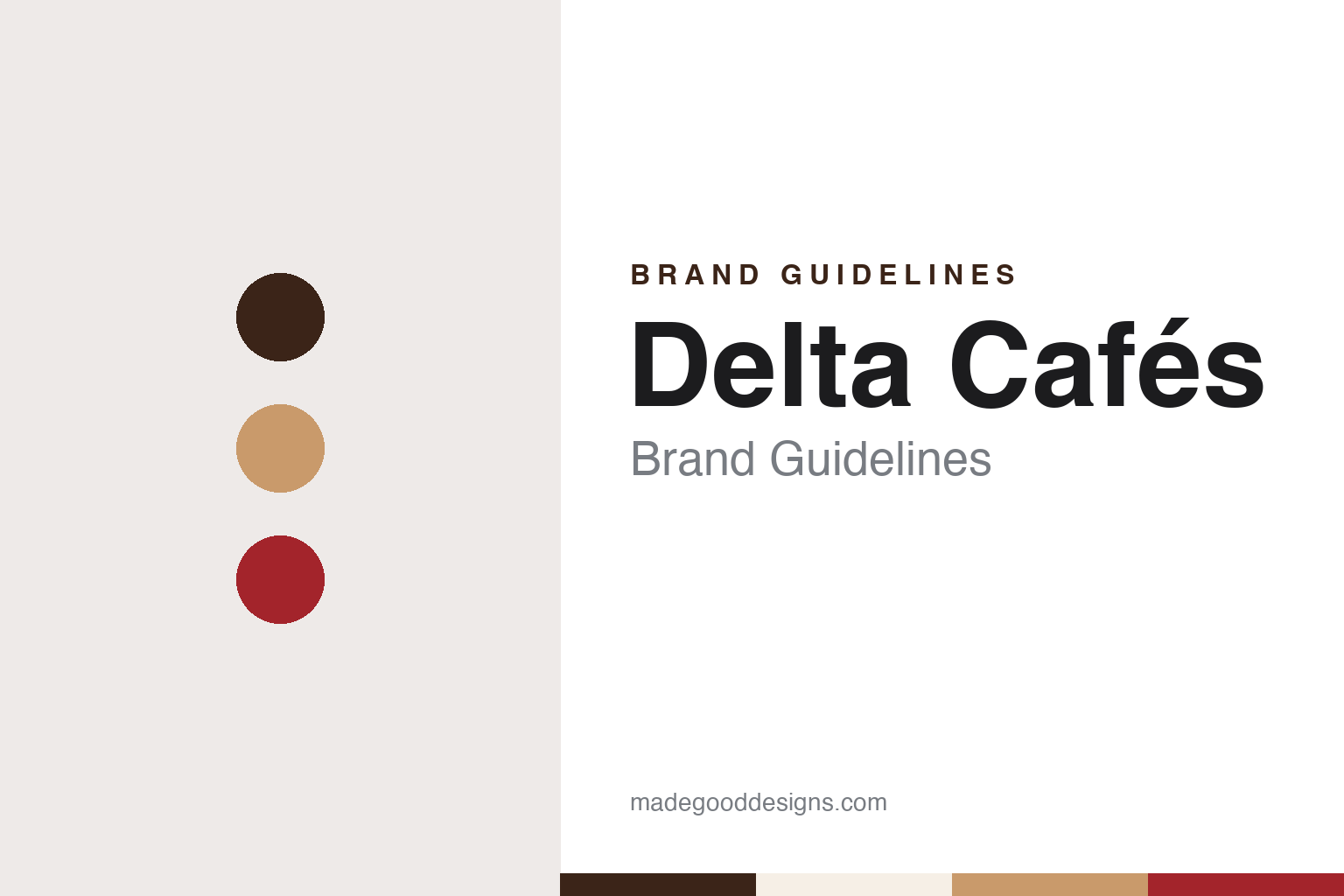
Delta Cafés Brand Guidelines
The Campo Maior roaster Rui Nabeiro built.
Aa
Two constants: a roast brown, crema and brick red palette and a confident geometric sans register. Abstract homage — not a Delta Cafés product or mark; no pack, logo or capsule is reproduced.
A roaster on the border
A grocery, a family roastery and a 50-square-metre warehouse.
Delta Cafés comes from Campo Maior, a small town in the Alentejo on Portugal’s border with Spain, and from one man who was born there, Rui Nabeiro. Portuguese Wikipedia, citing a 2010 interview in the Revista do Montepio, says Nabeiro came from a modest family and started work at around the age of 12, helping his mother in a small grocery and his father and uncles roasting coffee, at a time when the Spanish Civil War was still felt across the border and the frontier zone was a place of smuggling.
At 17 Nabeiro took charge of the small family roastery. To grow it he pushed sales of coffee into Spain, and later went into partnership with his uncles in a roasting company, Torrefação Camelo, known by a brand of the same name, in which he became managing partner, Portuguese Wikipedia says, citing the Rui Nabeiro chair at the University of Évora. Unhappy with that partnership, he left soon afterwards and set up a new company with his wife and children.
That company, founded in 1961, was Delta Cafés. Portuguese and English Wikipedia both describe its start in a small 50-square-metre warehouse with two roasters of 30 kg capacity and three workers, an account English Wikipedia sources to a 2016 profile in The CEO Magazine. Grupo Nabeiro tells the story the same way on its own history page, saying Nabeiro began by roasting 30 kilos of coffee a day. Sales offices followed in Lisbon in 1963 and Porto in 1964, and the Delta brand was soon distributed across the country. After the revolution of April 1974, Portugal risked running short of coffee; Nabeiro travelled to Angola, then heading towards independence, bought a large quantity of coffee and shipped it to Lisbon, the business paper Jornal de Negócios recounted, a move that strengthened Delta’s position in the market.
Colour
A factory, a market lead and a capsule system.
The 1980s turned Delta into an industrial business. Portuguese Wikipedia says that in 1984 the commercial side of the company was separated from the industrial side, which became Novadelta, S.A., and Grupo Nabeiro dates the building of the Novadelta factory in Campo Maior to the same year, describing it as the largest coffee factory in the Iberian Peninsula at the time. Expansion into Spain followed in 1986, starting with an office in Badajoz, just across the border, and in 1993 the group opened Tecnidelta, a factory making equipment for hotels, restaurants and food distribution.
By 1994, Grupo Nabeiro says, Delta had become the national market leader, and that year it opened the Museu do Café, a coffee museum, in Campo Maior; English Wikipedia gives a 42% market share for 1994 and a 38% share in the 2000s. In 1998 Delta was the official coffee of Lisbon’s Expo ’98, and the same year the group was reorganised into 22 companies grouped by strategic area, Portuguese Wikipedia says. In 2014 the group added a coffee science centre, the Centro de Ciência do Café, in Campo Maior.
The brand’s biggest product launch came in 2007, when it introduced Delta Q, a single-serve espresso system of capsules and dedicated machines that English Wikipedia compares with Nestlé’s Nespresso. Grupo Nabeiro says the same year brought the launch of its Adega Mayor wine brand, and that in 2020 it introduced Delta Q eQo, a biodegradable capsule. The company sums up its approach in the motto “Um Cliente, Um Amigo” — “one customer, one friend” — and says Delta Cafés has led the Portuguese roast-coffee market for more than two decades and is present in more than forty countries.
Typography
Design and documentation.
The seven brands in this group all make food or drink, and all of them come from Portugal or Greece: Compal, Delta Cafés, Pavlides, Misko, Loux, Fage and Kyknos. Food and drink brands in general sit at many different points in the trade, from family firms that still carry a founder’s surname to names that now belong to much larger food groups, and a single brand can be sold everywhere from a corner shop to a supermarket shelf.
A food or drink brand’s identity is usually carried less by a single product than by a pack, a name and the meal or moment it promises, because the company behind the name may have changed hands, moved its factory or grown far beyond the town where it started. That makes the questions behind each name worth asking plainly: who started it, who owns it now, and where its products are actually made and packed.
Each guide separates what independent sources record from what the company says about itself — its founding story, its owners over time, where its products are made and how its packaging has changed — and marks plainly what rests only on the company’s own word.
Aa
A confident geometric sans for a roaster that turned a border town into a coffee capital. (Specimen set in Montserrat, a sans STAND-IN; NOT the Delta Cafés logo.)
Delta Cafés
A family group, a founder remembered and a roaster abroad.
Delta Cafés has never left the family or the town. The brand belongs to Grupo Nabeiro, which English Wikipedia describes as a conglomerate with interests in agribusiness, real estate and hotels as well as coffee, and its industrial company, Novadelta, is still based in Campo Maior. Rui Nabeiro was also a public figure in the town: Portuguese Wikipedia, citing the encyclopedia Infopédia, says he was elected mayor of Campo Maior for the Socialist Party in 1977 and re-elected in 1980 and 1983. He was made a commander of the Order of Prince Henry in 2006, according to the records of the Portuguese presidency cited by Portuguese Wikipedia.
Rui Nabeiro died on 19 March 2023, aged 91, the Portuguese broadcaster Rádio Renascença reported that day, describing him as the founder of Delta. Portuguese Wikipedia, citing the press, says the town council of Campo Maior declared five days of municipal mourning. Portuguese Wikipedia names his grandson, Rui Miguel Nabeiro, as Delta’s current president.
Abroad, the brand has grown market by market. Grupo Nabeiro dates its Angolan business, Angonabeiro, to 1998, and lists the creation of Delta France in 2008, entry into Luxembourg in 2011, Brazil in 2012, China in 2015, Switzerland in 2016 and Poland in 2019. In October 2017 Delta began selling through the Alibaba e-commerce platform, O Jornal Económico reported, and in July 2018 it joined International Coffee Partners, an association of coffee companies, the marketing site Marketeer reported. In 2025, the group says, it created Delta House as an umbrella brand for its products and opened a Delta Coffee House Experience in Paris.
For a design guide, Delta Cafés shows how a regional roaster can keep its founder’s town and family at the centre of a national brand. Compare Trung Nguyên, the Vietnamese coffee house, and Compal, another Portuguese household name. For this guide we use roast brown, crema and brick red with a sans, an unofficial interpretation; no product or logo is reproduced.
Explore & save
Keep Delta Cafés’s identity on hand — save it to a board in the Made Good inspiration library.
Delta Cafés identity set
Pin the Delta Cafés roast brown, crema and brick red palette and the confident geometric sans register to your own board.