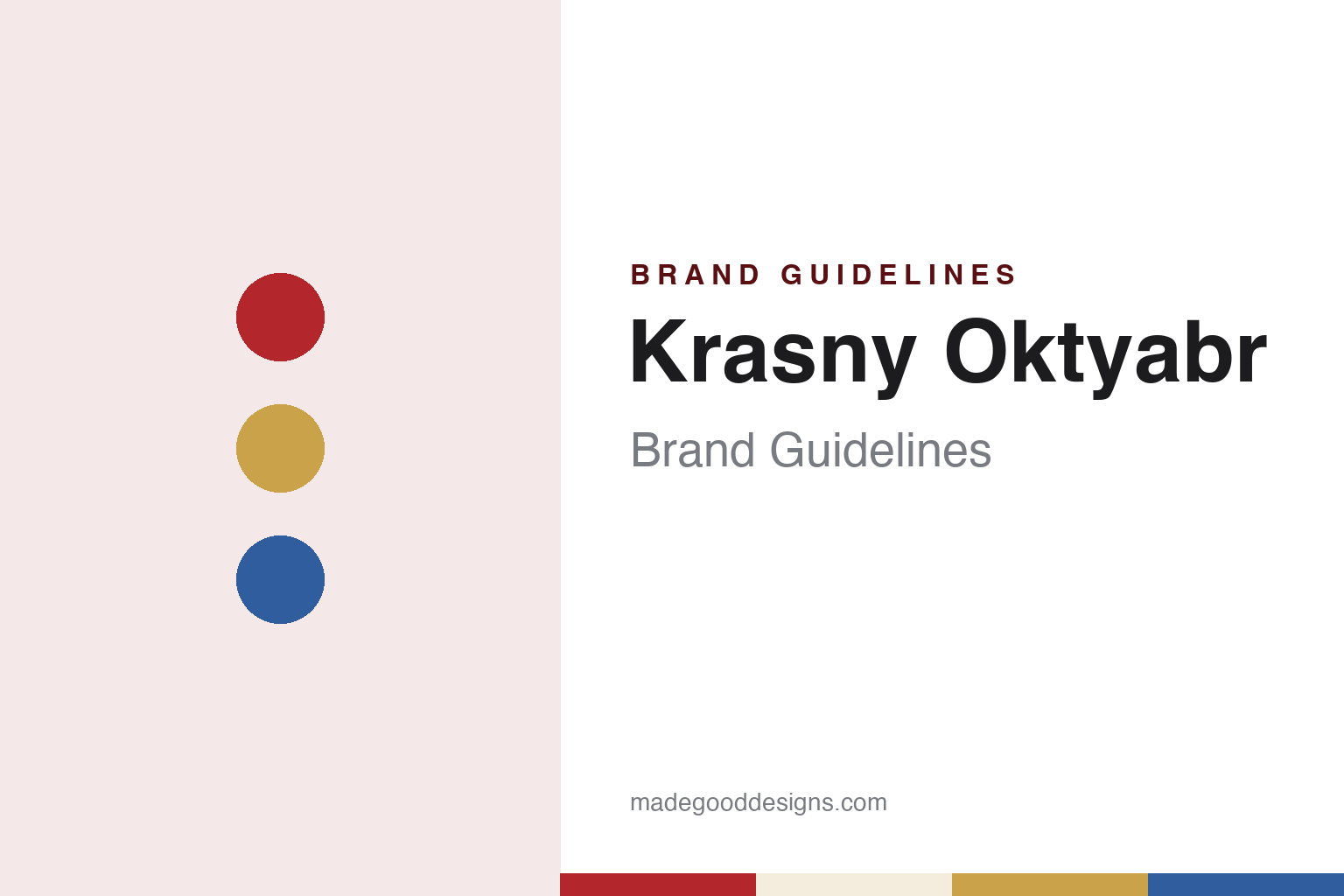
Krasny Oktyabr Brand Guidelines
The Moscow confectioner that began as Einem in 1851.
Aa
Two constants: a red October, gold leaf and cornflower palette and an imperial-era display serif register. Abstract homage — not a Krasny Oktyabr product or mark; no wrapper, logo or sweet is reproduced.
From Einem to Red October
A Württemberg confectioner, a partner and a riverside factory.
The Moscow confectioner now called Krasny Oktyabr — “Red October” — began under a German name. Russian Wikipedia says the firm counts its origins from December 1849, when the confectioner Theodor Ferdinand von Einem, a subject of Württemberg, supplied sweets to the imperial table, and that in 1851 he opened a workshop on the Arbat making sweets and chocolate. English Wikipedia, citing the company’s own history, gives 1851 as the founding year. By 1867 an official directory of Russian factories listed the business as a partnership running a steam factory for chocolate, sweets and tea biscuits, and it had already won bronze and silver medals at all-Russian manufacturing exhibitions in 1864 and 1865, Russian Wikipedia says.
In 1869 the businessman Julius Heuss joined Einem. Together they opened a confectionery shop on Teatralnaya Square, bought a modern steam engine abroad and built a first factory on the Sofiyskaya embankment of the Moskva river, according to Russian Wikipedia. Heuss later ran the business — The Moscow Times reported in 1994 that he became director in 1878 and held the post until 1907 — and kept the Einem name that Muscovites already knew. From 1889 he bought plots on the Bersenevskaya embankment, across the river from the Kremlin, where the architects A. V. Flodin and Alexander Kalmykov designed production buildings and apartment houses; by 1914 the ensemble had 23 buildings, the Moscow heritage journal Moskovskoe Nasledie reported in 2012.
Honours followed. Einem won a gold medal at the 1896 All-Russian Industrial and Art Exhibition in Nizhny Novgorod, two Grand Prix at the 1900 Paris Exposition and, in 1913, the title of purveyor to the imperial court, Russian Wikipedia says, citing the company. After the 1917 revolution the factory was nationalised as State Confectionery Factory No. 1, “formerly Einem”, and in 1922 it was renamed Krasny Oktyabr. An early Soviet advertisement still told buyers that its biscuits came from the Red October factory, the former Einem.
Colour
Imperial labels, Soviet lines and one famous headscarf.
Much of Krasny Oktyabr’s design history is printed on paper. Before the revolution, Einem labels were drawn by the artist Manuil Andreev, Russian Wikipedia notes. In the 1920s the renamed factory developed lines such as Golden Label chocolate and Kis-Kis toffee, and during the Second World War it turned to military supplies, including chocolate with a raised caffeine content, according to English and Russian Wikipedia; in 1966 the factory received the Order of Lenin. After the Soviet Union ended, the company kept the Krasny Oktyabr name for its recognition but began decorating its boxes and labels with Tsarist-era motifs, The Moscow Times reported in 1994.
Its best-known wrapper belongs to Alyonka, a milk chocolate bar made since 1965. Russian Wikipedia says the recipe was developed at Krasny Oktyabr in 1964 and also introduced at other Moscow factories, and that the factory’s early bars had no fixed wrapper design. The factory then ran a contest through the evening newspaper Vechernyaya Moskva for a photograph of a girl. The winner was a 1960 photograph by Alexander Gerinas of his infant daughter, Elena, in a silk headscarf, which had already appeared in the magazine Sovetskoe Foto in 1961. The factory’s staff artist Mikhail Maslov turned it into the wrapper illustration in 1965, giving the girl blue eyes and changing her mouth, the shape of her face and the direction of her gaze, Russian Wikipedia says.
The portrait later reached court. In 2000 Elena Gerinas sued Krasny Oktyabr over copyright; after more than two and a half years, and expert reviews of the portrait and the artwork, the court found the wrapper to be a new, independent work because of those changes, Russian Wikipedia says. The Moscow Times has reported that several women have claimed to be the girl on the bar and that the company denies the image shows a real child. Russian Wikipedia adds that in the privatisation years only Krasny Oktyabr registered Alyonka as a trademark, although many Soviet factories had made a bar of that name; the brand now belongs to United Confectioners.
Typography
Design and documentation.
The seven brands in this group all make food, and they come from Poland, Ukraine, Russia, Austria and Hungary, Croatia, the Czech Republic and Serbia: Sokołów, Roshen, Krasny Oktyabr, Kotányi, Kraš, Hamé and Bambi. Food brands in general sit at many different points in the trade, from family firms that still carry a founder’s surname to names that now belong to much larger food groups, and a single brand can be sold everywhere from a corner shop to a supermarket shelf.
A food brand’s identity is usually carried less by a single product than by a pack, a name and the meal or treat it promises, because the company behind the name may have changed hands, moved its factory or grown far beyond the town where it started. That makes the questions behind each name worth asking plainly: who started it, who owns it now, and where its food is actually made and packed.
Each guide separates what independent sources record from what the company says about itself — its founding story, its owners over time, where its food is made and how its packaging has changed — and marks plainly what rests only on the company’s own word.
Aa
An imperial-era display serif for a factory that kept its pre-revolutionary roots. (Specimen set in Playfair Display, a serif STAND-IN; NOT the Krasny Oktyabr logo.)
Krasny Oktyabr
Privatisation, a holding company and a factory turned arts quarter.
Krasny Oktyabr became a joint-stock company in 1992, Russian Wikipedia says, and The Moscow Times reported in 1994 that it had been privatised in 1993, one of the few large Moscow businesses to be privatised successfully while it competed with foreign companies such as Mars. In 1999 it bought the Samoylova confectionery factory in St Petersburg. In the 2000s it joined United Confectioners (Obyedinyonnye Konditery), a Moscow holding controlled by the Guta group, Russian Wikipedia says, alongside the Babaevsky and Rot Front factories. The trade magazine Candy Industry ranked United Confectioners 17th in its 2017 Global Top 100 of confectionery companies. Krasny Oktyabr itself has remained a separate company, with shares listed on the Moscow Exchange, Russian Wikipedia says.
Production left the riverside in 2007. Russian Wikipedia, citing the administration of Moscow’s central district, says it moved into a new 48,000-square-metre building at the Babaevsky factory on Malaya Krasnoselskaya street, raising capacity by 45%; Russian Wikipedia also lists Krasny Oktyabr branches in Ryazan, Kolomna and Yegoryevsk. The red-brick buildings on the Bersenevskaya embankment were largely kept and turned into offices, shops, galleries and event space. The ArtStrelka art centre opened in the former factory garages in 2004, Kommersant reported at the time, and later tenants included the Strelka Institute and the Lumiere Brothers Center for Photography. The New York Times described the site in 2010 as an island village for the arts.
For a design guide, Krasny Oktyabr shows how a confectioner can carry a revolutionary name, a pre-revolutionary heritage and a single wrapper portrait through more than a century and a half. Compare Wawel, Kraków’s chocolate maker, and Kalev, Estonia’s long-established confectioner. For this guide we use a Red October red, gold leaf and a cornflower blue with a display serif, an unofficial interpretation; no product or logo is reproduced.
Explore & save
Keep Krasny Oktyabr’s identity on hand — save it to a board in the Made Good inspiration library.
Krasny Oktyabr identity set
Pin the Krasny Oktyabr red, gold leaf and cornflower palette and the imperial-era display serif register to your own board.


