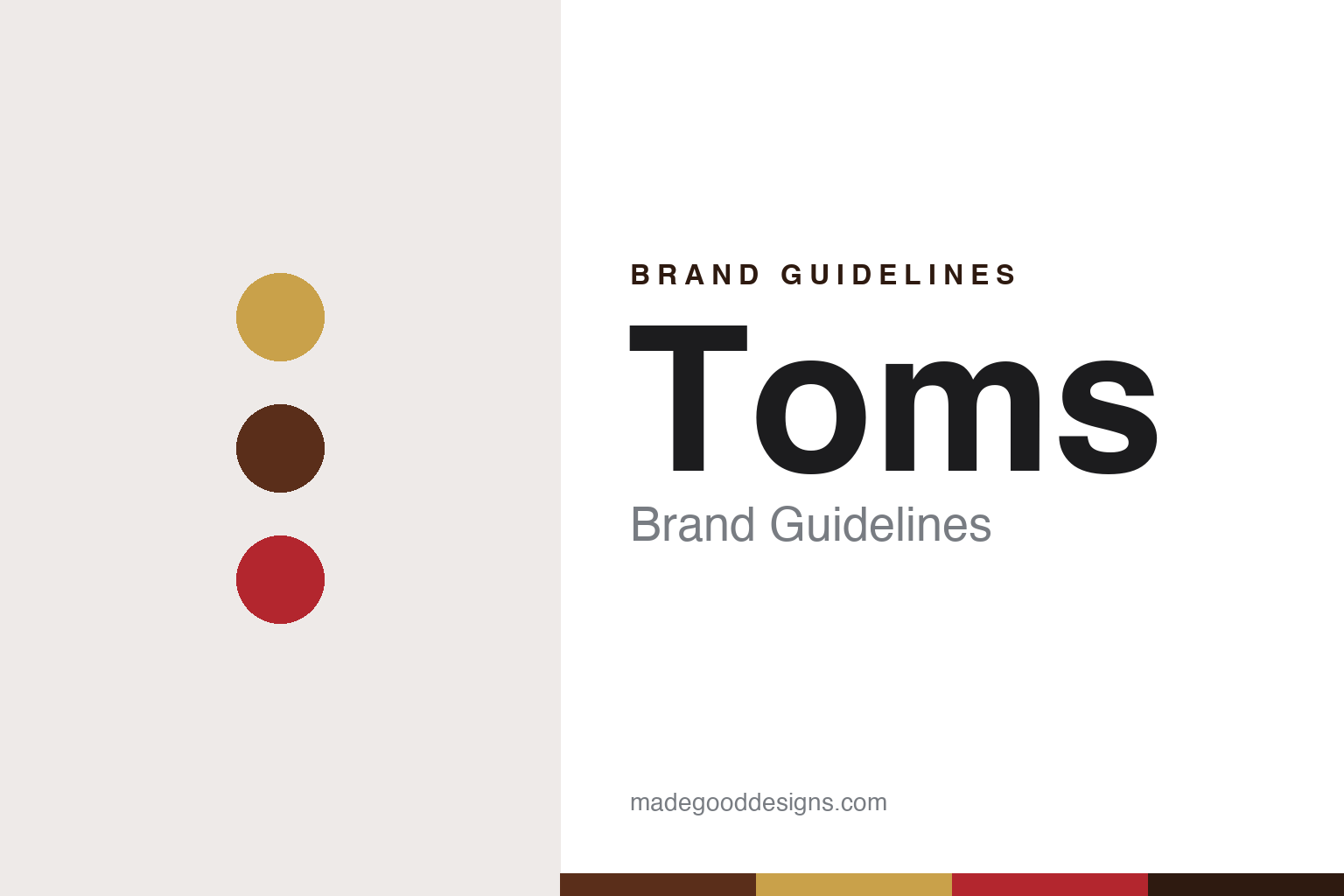
Toms Brand Guidelines
The Copenhagen confectioner behind the gold bar and the chocolate turtle.
Aa
Two constants: a Toms cocoa, gold and red palette and a confectioner sans register. Abstract homage — not a Toms product or mark; no chocolate, wrapper, logo or pack is reproduced.
Vesterbrogade
Two pharmacists and a name built from theirs.
Toms is a Danish confectioner, and the name on its gold bars and chocolate turtles began as a pharmacists’ business in Copenhagen. Danish Wikipedia says the company was entered in the Danish companies register on 23 February 1924, and lists three founders from that registration: the pharmacist and wholesaler Hans Trojel, a clerk, Frants Vilhelm Trojel, and the pharmacist and wholesaler Victor Hans Meyer. The Toms group’s own history, archived in 2023, names just the two pharmacists, Hans Trojel and V. H. Meyer. English Wikipedia, citing the group’s 2021 annual report, gives the first company name as Tom Chokoladefabrik A/S and the starting point as the founders’ shop on Vesterbrogade in Copenhagen; the Danish broadcaster DR also placed the founding on Vesterbrogade in 1924.
The name itself, by the company’s account, is built from the founders. Its history page says “Tom” came from the names Trojel and Meyer, and that the final “s” was added later because of the logo on sweet-vending machines, where the company did not like the word “Tom” standing on its own. That is the company’s own story, and it is the most specific thing it says about how its mark came about.
Its own production began soon after. Danish Wikipedia says Toms moved in 1925 to a new factory on Prags Boulevard in Copenhagen and began making its own products there; English Wikipedia places the founders’ first products on Prags Boulevard between 1925 and 1929.
Colour
Gold bars, turtles and a buying spree.
The company’s growth came under a new owner. Victor B. Strand, who already owned the Copenhagen firm Tørsleff & Co., bought Toms in 1942, according to both the group’s history and English Wikipedia. The group says Toms flourished under him after the Second World War, and credits him with launching three of its best-known products: Guld Barre, the gold bar; the chocolate turtles, including Toms Kæmpe Skildpadde, the “giant turtle”; and the Yankie Bar.
Strand also built a group by buying other Danish names. Toms bought Anthon Berg, the Copenhagen marzipan and chocolate house, in 1954, according to both English and Danish Wikipedia. In 1962, English Wikipedia says, it bought A/S J. Høeghs Lakrids og Sukkervarefabrikker, a liquorice and sugar-confectionery maker that was renamed Pingvin Lakrids; in 1971 it took over Galle & Jessen, and Danish Wikipedia says production of that company’s chocolate for bread then moved to Toms. Danish Wikipedia records the purchase of Bonbon in 2001, and English Wikipedia the purchase in 2011 of Hanseatische Chocolade GmbH of Bremen, owner of the Hachez brand.
The range today is wide. Danish Wikipedia lists chocolate bars such as Yankie Bar and Holly Bar, chocolate turtles and frogs, Guld Barre in many varieties, sliced chocolate for bread, gold caramels, alongside group brands including Ga-Jol, Bogø Chokolade and Spunk. When DR reported on the company in November 2024, it named turtles, gold bars, gold caramels, Anthon Berg and Galle & Jessen as among the best-known chocolates made at the group’s factory in Ballerup.
Typography
Design and documentation.
The seven brands in this group all make food, and all of them come from Denmark, Sweden or the Netherlands: Toms, Kelsen, Göteborgs Kex, Polarbröd, HAK, De Ruijter and Venz. Food brands from these countries sit at many different points in the trade, from family firms that still carry a founder’s surname to names that now belong to much larger food groups, and a single brand can be sold everywhere from a corner shop to a supermarket shelf.
A food brand’s identity is usually carried less by a single product than by a pack, a name and the meal or treat it promises, because the company behind the name may have changed hands, moved its factory or grown far beyond the town where it started. That makes the questions behind each name worth asking plainly: who started it, who owns it now, and where its food is actually made and packed.
Each guide separates what independent sources record from what the company says about itself — its founding story, its owners over time, where its food is made and how its packaging has changed — and marks plainly what rests only on the company’s own word.
Aa
A sturdy confectioner sans — for a name the company says was shaped by a vending-machine logo. (Specimen set in Archivo, a sans STAND-IN; NOT the Toms logo.)
Ballerup
An Arne Jacobsen factory, a foundation and a move to Poland.
For six decades Toms chocolate came from one building. In 1962 the company opened its factory in Ballerup, west of Copenhagen, designed by the architect Arne Jacobsen; English Wikipedia dates the design to 1961 and describes a 22,000-square-metre factory hall and a 3,000-square-metre administration building on a 220,000-square-metre site. DR reported in 2024 that the factory gave its name to the junction of Ring 4 and Ballerup Byvej, known as the “chocolate crossing.” Sweets and liquorice are made separately, at Avedøre Holme in Hvidovre, and Danish Wikipedia says the group also has a sugar-confectionery factory at Habo, near Jönköping in Sweden.
Toms is owned by a foundation. The group’s history says Strand set up a foundation in the mid-1970s to own and run the business, and that its founding documents were signed on 12 December 1974. Gerda og Victor B. Strands Fond owns all the shares of Toms Gruppen A/S, according to Danish Wikipedia, citing the foundation’s page, and English Wikipedia, citing the group’s 2010 annual report.
Where Toms chocolate is made is about to change. On 27 November 2024 DR reported that all of the group’s chocolate production would move within three to four years to a factory in Nowa Sól, in western Poland, which the group is expanding. Chief executive Annette Zeipel told DR that fewer than 100 of the roughly 170 people in Danish chocolate production would lose their jobs, that the sweets factory in Hvidovre would also receive investment, and that the group would keep its headquarters near Copenhagen. “We are up against very large players,” she said. Danish Wikipedia gives the move as taking effect from around 2027.
For a design guide, Toms shows how a confectioner can build a national identity from a few shaped products — a gold bar, a turtle, a named chocolate bar — and from a short name the company says was adjusted for a vending-machine logo. Compare Anthon Berg, the marzipan house Toms has owned since 1954, and Marabou, a Nordic chocolate name that is now made by a multinational group. For this guide we use cocoa brown, bar gold and a confectioner’s red with a sans, an unofficial interpretation; no product or logo is reproduced.
Explore & save
Keep Toms’s identity on hand — save it to a board in the Made Good inspiration library.
Toms identity set
Pin the Toms cocoa, gold and red palette and the confectioner sans register to your own board.