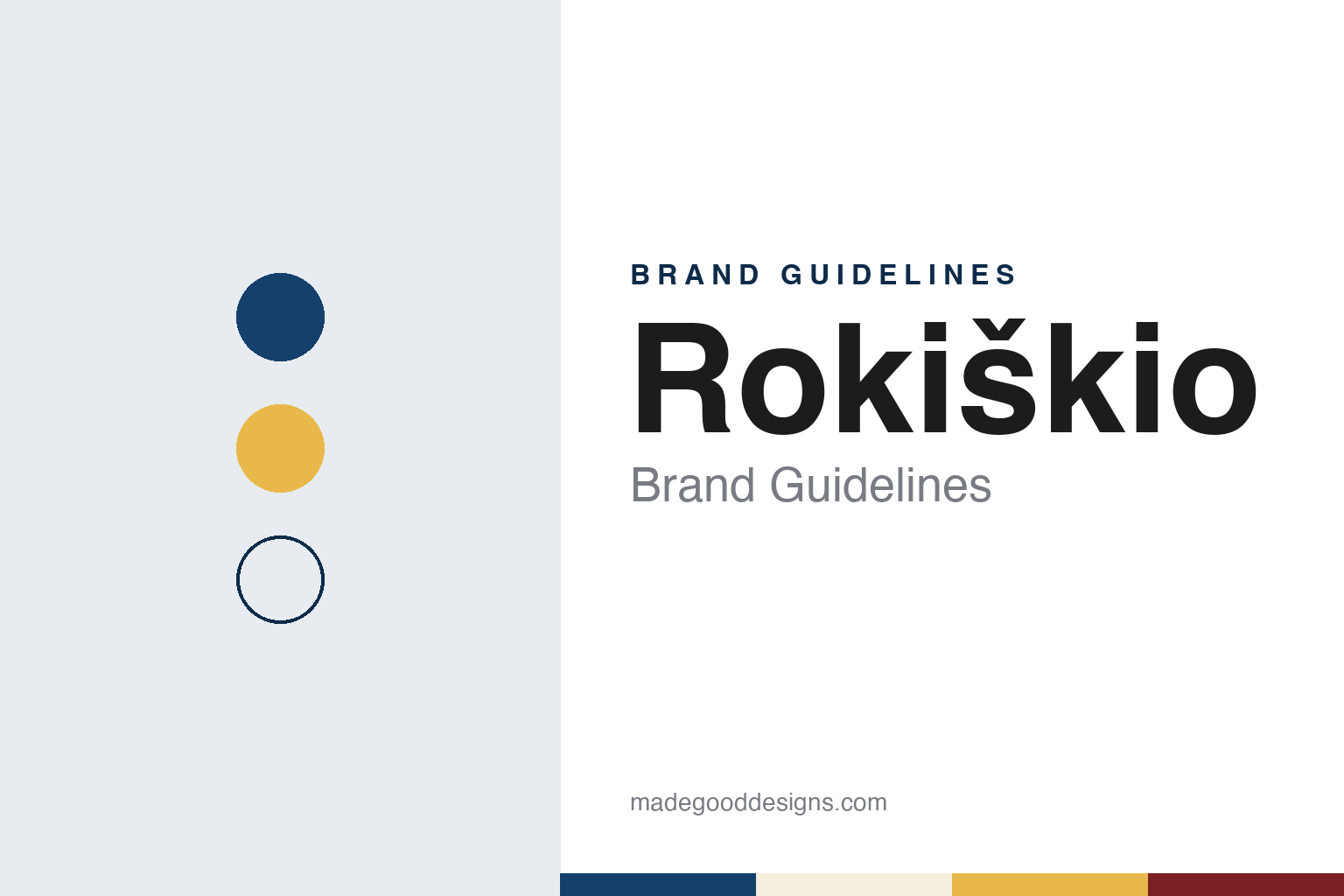
Rokiškio Brand Guidelines
The Lithuanian cheese plant that opened in 1966.
Aa
Two constants: a dairy blue, rind gold and milk cream palette and a sturdy grotesque sans register. Abstract homage — not a Rokiškio product or mark; no pack, logo or cheese is reproduced.
A cheese plant in Rokiškis
A manor dairy, a Soviet resolution and a first batch of cheese.
Rokiškio is the brand name of AB Rokiškio sūris, a dairy company based in Rokiškis, a town in north-eastern Lithuania. The name simply means “of Rokiškis”: Rokiškio sūris is Lithuanian for “Rokiškis cheese.” The company traces its roots to the dairy of the old Rokiškis manor. Its own history says the first records of dairy production there date from 1925; after the Second World War the manor dairy was turned into the Rokiškis co-operative dairy, and around 1957 to 1960, after a reconstruction and the installation of electric equipment, it began making skimmed-milk cheeses and casein.
The plant behind today’s brand was a Soviet project. The company says that on 14 July 1961 the Council of Ministers of the Lithuanian SSR passed a resolution to build a cheese factory in Rokiškis. The Lithuanian national encyclopedia, the Visuotinė lietuvių enciklopedija, records that construction began in 1964 and that the plant started work in 1966. According to the company, it opened in February 1966 with butter, pasteurised milk, curd and sour cream, and the first batch of rennet cheese followed on 22 March 1966.
The encyclopedia adds a technical first: the Rokiškis plant was the first in the Soviet Union to use a continuous cheese-making line, with vibrators used to fill the cheese moulds. The company says news of the new factory was shown on television as soon as it opened, and that in the Soviet years Rokiškis supplied dairy products well beyond Lithuania.
Colour
Privatisation, workers as shareholders and a dairy group.
Lithuania regained its independence in 1990, and the state plant changed hands soon after. The company says privatisation of the state enterprise “Rokiškio sūrių gamykla” began in 1991, and the encyclopedia records that it was privatised and, on 28 February 1992, became the joint-stock company AB Rokiškio sūris. The company says its first shareholders were its own employees, that the first foreign investors arrived in 1994, and that during the 1990s it absorbed smaller Lithuanian dairies. Its shares are listed on Nasdaq Vilnius under the ticker RSU1L, English Wikipedia notes.
One family has been closely tied to the company for decades. The company’s 2025 disclosure to investors says Antanas Trumpa has worked there since 1966, led it as director from 1971 to 2017, and has chaired its board since December 2017; Dalius Trumpa, who joined in 1991, has been its director since January 2018. The same disclosure, dated 31 December 2025, shows a holding company called Pieno pramonės investicijų valdymas, the Latvian company RSU Holding and members of the Trumpa family together holding just over 81% of the shares.
The business grew into a group with several sites. In 2007, the encyclopedia and the company record, a new company, Rokiškio pienas, was formed on the basis of the Utena dairy Utenos pienas, and the Ukmergė dairy was attached; a 2013 reorganisation created Rokiškio pieno gamyba, and in 2021 the Ukmergė branch became DairyHub.LT, which the company says specialises in cutting and packing hard cheese. Lithuanian Wikipedia says the Rokiškis site makes rennet cheeses and lactose, Utena makes fresh dairy products, butter and dried whey products, and Ukmergė makes curd and curd cheeses. The group also includes two Latvian companies, the company says.
Typography
Design and documentation.
The seven brands in this group all make food or drink, and all of them come from Ukraine or Lithuania: Konti, Svitoch, Nemiroff, Morshynska, Obolon, Švyturys and Rokiškio. Food and drink brands from these two countries in general sit at many different points in the trade, from names that grew out of a single town or plant to names that now belong to much larger groups, and a single brand can be sold everywhere from a corner shop to a supermarket shelf abroad.
A food or drink brand’s identity is usually carried less by a single product than by a pack, a name and the taste or occasion it promises, because the company behind the name may have changed hands, moved its production or grown far beyond the town where it started. That makes the questions behind each name worth asking plainly: who started it, who owns it now, and where its products are actually made and packed.
Each guide separates what independent sources record from what the company says about itself — its founding story, its owners over time, where its products are made and how its packaging has changed — and marks plainly what rests only on the company’s own word.
Aa
A sturdy grotesque sans for a brand named after its town. (Specimen set in Libre Franklin, a sans STAND-IN; NOT the Rokiškio logo.)
Rokiškio
Cheese for export, fresh dairy for home, and a 35 kg wheel.
Rokiškio is mainly a cheese business with a home-market dairy range beside it. The Visuotinė lietuvių enciklopedija lists hard and semi-hard rennet cheeses, fresh, processed and smoked cheeses, and fresh products from milk, kefir and butter to curd, glazed curd snacks, sour cream and yoghurt. It says about 70% of output is exported, chiefly to Italy, the Netherlands, Germany, Latvia and the United States, with cheeses made mainly for export and fresh dairy mainly for the Lithuanian market. English Wikipedia, citing Lithuanian news reports, says the company began shipping mozzarella to China in 2017.
The company sells under a family of names, each written in capitals on its website: ROKIŠKIO, GRAND, NAMINIS and TIKRAS among them. The company says the ROKIŠKIO line covers butter, hard and grated cheeses, spreadable cheeses, condensed milk and natural yoghurt, and that NAMINIS — “homemade” — gathers kefir, milk, butter, sour cream, cream and rennet cheeses, including larger “family pack” sizes, all made in Lithuania. Its showpiece is Rokiškio GRAND, a hard cheese that the company says is matured in Lithuania’s largest cheese wheel, at 35 kg, with about half a tonne of milk going into each wheel. The company says the Brussels-based International Taste Institute gave GRAND gold stars in its Superior Taste Award 2025, for the fourth time. Its English-language website greets visitors with the line “There is only one Rokiskis but Rokiskio cheese is enjoyed all around the world!”
The company has also published its own history in book form, with volumes for its 15th anniversary in 2007 and its 20th in 2012, Lithuanian Wikipedia lists.
For a design guide, Rokiškio shows how a town’s name, put on a Soviet-era cheese plant, can become the brand of a listed dairy group. Compare Bega, the Australian dairy co-operative turned cheese company, and Švyturys, another Lithuanian name on the shelf. For this guide we use a dairy blue, a rind gold and a milk cream with a sans, an unofficial interpretation; no product or logo is reproduced.
Explore & save
Keep Rokiškio’s identity on hand — save it to a board in the Made Good inspiration library.
Rokiškio identity set
Pin the Rokiškio dairy blue, rind gold and milk cream palette and the sturdy grotesque sans register to your own board.