Swisslion Brand Guidelines
The Vršac confectioner that bought Takovo and Eurokrem.
Aa
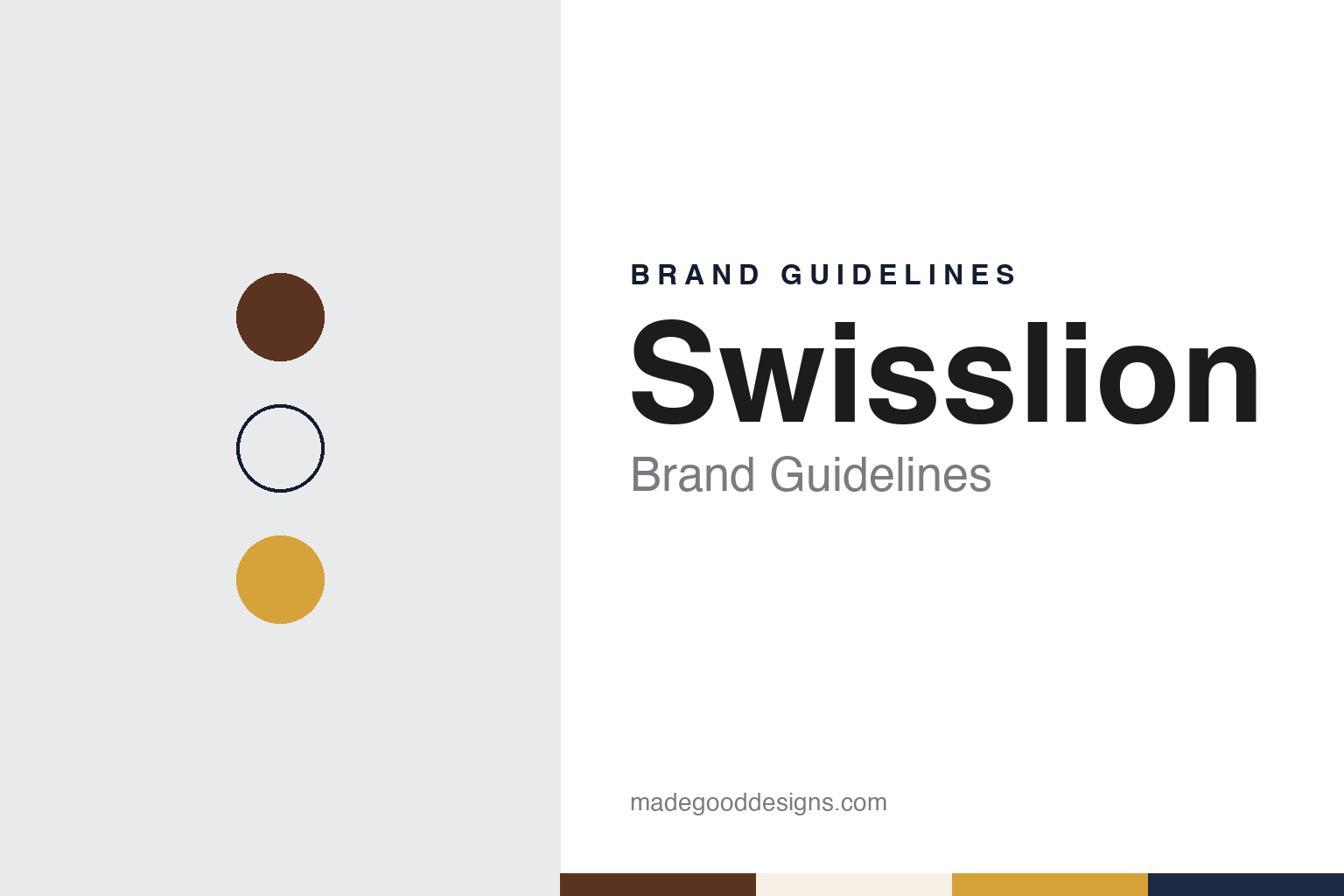
Two constants: a cocoa brown, hazelnut white and lion gold palette and a sturdy grotesque register. Abstract homage — not a Swisslion product or mark; no pack, jar or logo is reproduced.
Vršac first
A sweet factory in the Banat and a company from Novi Sad.
Swisslion is a Serbian food group, not a Swiss one. Serbian and English Wikipedia both date the company to 1991 and place its registered head office in Novi Sad, the capital of Vojvodina; English Wikipedia gives 10 June 1991 as the date of its current form. The company itself dates its story to 1997, when, it says, its first factory went into production in Vršac, a town in the Banat close to the Romanian border. Serbian Wikipedia says the business grew out of an earlier Vršac confectioner called VIK, which became the corporation Kondivik and then Swisslion d.o.o. Vršac.
The group is owned by Rodoljub Drašković, a businessman from Gacko in Herzegovina; English Wikipedia lists him as chief executive, holding part of the group directly and the rest through a holding company. In its own chronology the company says it installed 11 new production lines between 1997 and 2004, ten of them in Vršac and one in Macedonia, and that the Vršac factory adopted the HACCP food-safety system in 2003. Its Vršac factory mainly makes confectionery, English Wikipedia says.
The name on the packs changed in 2004. That year Swisslion bought PIK Takovo of Gornji Milanovac in a privatisation tender — the business portal VIBILIA reported in January 2004 that it had acquired a 70% stake — and the two businesses began trading as Swisslion-Takovo.
Colour
Takovo, Eurokrem and a two-tone spread.
Takovo brought Swisslion its oldest roots and its most famous product. Serbian Wikipedia traces Takovo to a sweet shop opened in Gornji Milanovac in 1941 by Ivan Milosavljević, which became a socially owned factory after the Second World War; in 1962 the state sweet and Turkish-delight factory “Takovo” and the agricultural co-operative “Progres” were joined to form PIK Takovo, although 1959 is usually given as its founding year. Under socialism it became one of Yugoslavia’s larger food companies, English Wikipedia says.
Its fortune was Eurokrem, a cocoa and hazelnut spread. English Wikipedia says the Eurocrem trademark was registered with the World Intellectual Property Organization in August 1967 by the Italian company A. Gandola & C., and that Gandola licensed it to Takovo in 1972; Serbian Wikipedia says Takovo’s director Jovan Tomović bought the licence and that the Eurokrem factory went into production in 1970, so the sources differ on the date. Serbian Wikipedia says output reached 13,000 tonnes a year by the early 1980s. The product’s identity is visual: one half of the jar is brown and cocoa-flavoured, the other white and hazelnut-flavoured, and English Wikipedia says advertising long showed a slice of bread spread half with each. Swisslion registered the Takovo Eurokrem trademark with WIPO in September 2008. In 2011 the group was making about 12,000 tonnes of it a year and exporting half, to the United States, western Europe and the former Yugoslav countries, the Croatian business portal limun.hr reported.
Around Eurokrem the group sells a wide range. English Wikipedia names Juvitana baby food, Eurodessert chocolates and Viljamovka pear brandy; Serbian Wikipedia adds Banat Kravica, YoYo and Juhu, and the company’s savoury range includes Griski and Krc Krc snacks. English Wikipedia says the group also makes private-label products for other companies. Gornji Milanovac, English Wikipedia says, makes ready meals, pasta, soups and fruit juices. In 2011 the company says it began making ice cream, and in 2018 it introduced a lion-cub mascot named Slavko.
Typography
Design and documentation.
The seven brands in this group all make food or drink, and all of them come from Serbia: Jaffa, Takovo, Štark, Swisslion, Knjaz Miloš, Imlek and Zlatiborac. Serbian food and drink brands in general sit at many different points in the trade, from family firms that still carry a founder’s name to names that now belong to much larger food groups, and a single brand can be sold everywhere from a village shop to a supermarket shelf.
A food or drink brand’s identity is usually carried less by a single product than by a pack, a name and the taste or occasion it promises, because the company behind the name may have changed hands, moved its factory or grown far beyond the town where it started. That makes the questions behind each name worth asking plainly: who started it, who owns it now, and where its products are actually made and packed.
Each guide separates what independent sources record from what the company says about itself — its founding story, its owners over time, where its products are made and how its packaging has changed — and marks plainly what rests only on the company’s own word.
Aa
A sturdy grotesque for a broad-range Serbian food group. (Specimen set in Archivo, a sans STAND-IN; NOT the Swisslion logo.)
Swisslion
Across the borders of the former Yugoslavia.
From the mid-2000s Swisslion-Takovo spread into neighbouring countries; today the company says it has factories in Serbia, Bosnia and Herzegovina and North Macedonia and trading branches in Montenegro, Bulgaria, Romania, Slovenia and Switzerland. The company says it expanded into Bosnia and Herzegovina by privatising the Trebinje tool factory and then building four food plants in Trebinje and Nevesinje; a new confectionery factory in Trebinje was inaugurated in January 2010, the business portals eKapija and limun.hr reported. In June 2008 Swisslion bought the Croatian company Euro Food Markt of Sisak, and in 2012 it moved its Jaffa-cake production from Sisak to Trebinje while keeping the Sisak plant running, eKapija reported. In March 2012 it opened a production unit in Resen, in North Macedonia, where it also has a site in Skopje.
At home it kept buying. In 2016 it took over the Banat confectionery factory in Vršac from the Bambi concern of Požarevac, Serbian Wikipedia says, and the company says Banat revived a forgotten range of chocolate products. Serbian Wikipedia says the Banat products then went back to the Banat logo they had given up for Bambi’s. In February 2017 it bought the wine producer Vršački vinogradi, B92 reported. In March 2017, the news agency Srna reported, the group handed its Trebinje tool company to the government of Republika Srpska over accumulated tax debts.
For a design guide, Swisslion shows how a young food group can build its identity on inherited Yugoslav brands, above all a two-tone jar of Eurokrem. Compare Takovo, the Gornji Milanovac company it absorbed, and Bambi, which sold it the Banat factory. For this guide we use cocoa brown, a hazelnut white and a lion gold with a sans, an unofficial interpretation; no product or logo is reproduced.
Explore & save
Keep Swisslion’s identity on hand — save it to a board in the Made Good inspiration library.
Swisslion identity set
Pin the Swisslion cocoa brown, hazelnut white and lion gold palette and the sturdy grotesque register to your own board.