Zlatiborac Brand Guidelines
The Mačkat smokehouse behind Serbia’s cured meats.
Aa
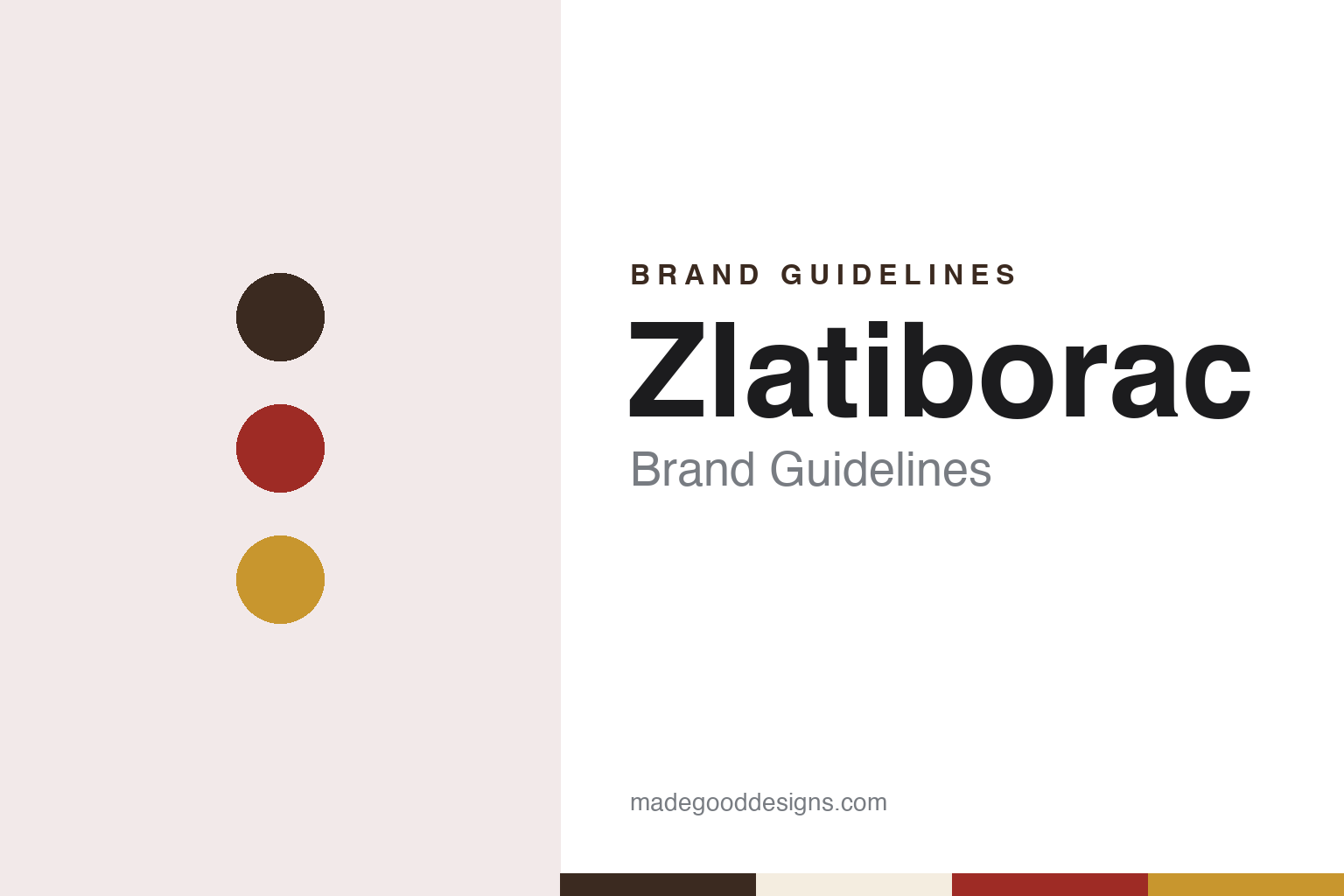
Two constants: a beech smoke, pršuta red and beech gold palette and a traditional bookish serif register. Abstract homage — not a Zlatiborac product or mark; no pack, logo or product is reproduced.
A village and a family
Mačkat, the Stojanović family and the year 1885.
Zlatiborac is a maker of dried and smoked meats from Mačkat, a village on the slopes of Zlatibor, the mountain region of western Serbia. Serbian Wikipedia says the village is widely known for its meat products, above all Zlatibor pršuta, the region’s air-dried ham. The brand name is itself a regional word: in Serbian a Zlatiborac is a person from Zlatibor, as Serbian Wikipedia’s page on the name notes.
The company tells its story through the Stojanović family. Its website traces the family’s meat-drying tradition to Jovo Stojanović, whom it calls the originator of the family practice, and says that in 1885 the family began salting, smoking and drying meat in Mačkat. A 2015 version of the site said the Stojanović ancestors were among the first people in Mačkat to do so, and that the family had refined its recipes over six generations. The company says the family’s first smoking chamber — more than 130 years old, according to that 2015 page — still stands at the heart of its production site in Mačkat.
The company itself was set up in the early 1990s, and its own accounts of the start differ in detail. Archived pages of its website from 2012 give the year of foundation as 1992, while the same site’s tradition page said that in 1993 “granddad” Milomir Stojanović led his family into industrial production and founded the firm; the 2015 site also named 1993 and captioned photographs of Milomir Stojanović as the founder of Zlatiborac. The current website dates the company to 1992 and says Aleksandar Stojanović established it, combining family heritage with the area’s natural advantages. Serbian Wikipedia, citing the company’s website, gives 1992 and names Milomir Stojanović. Its website has given the business’s name as Zlatiborac d.o.o., a Serbian limited company.
Colour
Pršuta, beech smoke and a shelf of medals.
Zlatiborac’s range is built around the cured meats of the Zlatibor region. The company lists beef and pork pršuta (dry-cured ham), a Zlatibor pršut it says is matured for more than 12 months, smoked pork loin, kulen and other dry sausages, bacon and pork crackling, and a heritage line called Specijalna selekcija 1885, named after the year the family dates its tradition from. It groups its products into traditional, modern and hospitality selections and says it makes more than 60 specialities.
Smoke is central to how the company describes its products. Its website says its meats are gently smoked over beech wood, and its 2012 site said dry beech wood was the only wood on which dried meat had been smoked in the region for centuries. That earlier site also recounted how, before modern equipment, local people stored hams and sausages buried in grain to manage humidity and protect them from animals — a story the company tells as part of its heritage.
The company has made awards a large part of its public face. Its 2012 website said its products won an award at an international food and drink fair in Madrid in 1993, a year after the company was founded, and listed gold, silver and bronze medals from the DLG, the German Agricultural Society, in its 2009 international quality competition for ham and sausage. Today it says it has won more than 100 DLG medals, the hundredth in 2019, and more than 100 quality medals at the Novi Sad agricultural fair, and that it has received the consumer award “Moj izbor” (“My Choice”) twelve years in a row. Several of the honours it listed concerned design rather than taste: the company’s 2012 awards page names a Novi Sad fair award in 2007 for the design of bulk packaging, a Great Champion Cup in 2008 for its corporate appearance and the design on its packaging, a good-design charter in 2009 and a Great Champion Cup for best brand in 2010. The company says it has held HACCP certification since 2009 and IFS Food certification since 2016.
Typography
Design and documentation.
The seven brands in this group all make food or drink, and all of them come from Serbia: Jaffa, Takovo, Štark, Swisslion, Knjaz Miloš, Imlek and Zlatiborac. Serbian food and drink brands in general sit at many different points in the trade, from family firms that still carry a founder’s name to names that now belong to much larger food groups, and a single brand can be sold everywhere from a village shop to a supermarket shelf.
A food or drink brand’s identity is usually carried less by a single product than by a pack, a name and the taste or occasion it promises, because the company behind the name may have changed hands, moved its factory or grown far beyond the town where it started. That makes the questions behind each name worth asking plainly: who started it, who owns it now, and where its products are actually made and packed.
Each guide separates what independent sources record from what the company says about itself — its founding story, its owners over time, where its products are made and how its packaging has changed — and marks plainly what rests only on the company’s own word.
Aa
A traditional bookish serif for a brand built on a family date. (Specimen set in Lora, a serif STAND-IN; NOT the Zlatiborac logo.)
Zlatiborac
One village, many markets.
Zlatiborac presents itself as a family business: its current website speaks of six generations of one family. It keeps its business head office in Belgrade, while production stays in Mačkat. The company says it runs one production facility there, built around the original nineteenth-century drying house, with 45,000 square metres of capacity, and that more than 650 people work for it. Its 2012 website said it was continuously increasing production and building new plants in Mačkat to meet demand.
Its growth beyond the village came in stages. In 2012 the company said its products were sold at more than 3,500 points of sale in Serbia, delivered by its own vehicle fleet through regional sales centres in Belgrade, Novi Sad, Niš and Mačkat, and it described itself as the market leader in Serbian smoked and cured meat delicatessen. Its export page dates its first export market, North Macedonia, to 2006, followed by Montenegro in 2007, Bosnia and Herzegovina in 2010, Russia in 2012, Slovenia in 2019, Romania in 2020 and Germany in 2021, with further markets including Austria, Spain and the Netherlands added in 2023. The company says it is approved to export to the European Union and the Eurasian Economic Union.
For a design guide, Zlatiborac shows how a village, a family name and a founding date can carry a cured-meat brand from a mountain smokehouse to export markets. Compare Campofrío, the Burgos charcuterie maker, and ElPozo, the Alhama de Murcia meat brand. For this guide we use beech smoke, pršuta red and beech gold with a serif, an unofficial interpretation; no product or logo is reproduced.
Explore & save
Keep Zlatiborac’s identity on hand — save it to a board in the Made Good inspiration library.
Zlatiborac identity set
Pin the Zlatiborac beech smoke, pršuta red and beech gold palette and the traditional bookish serif register to your own board.