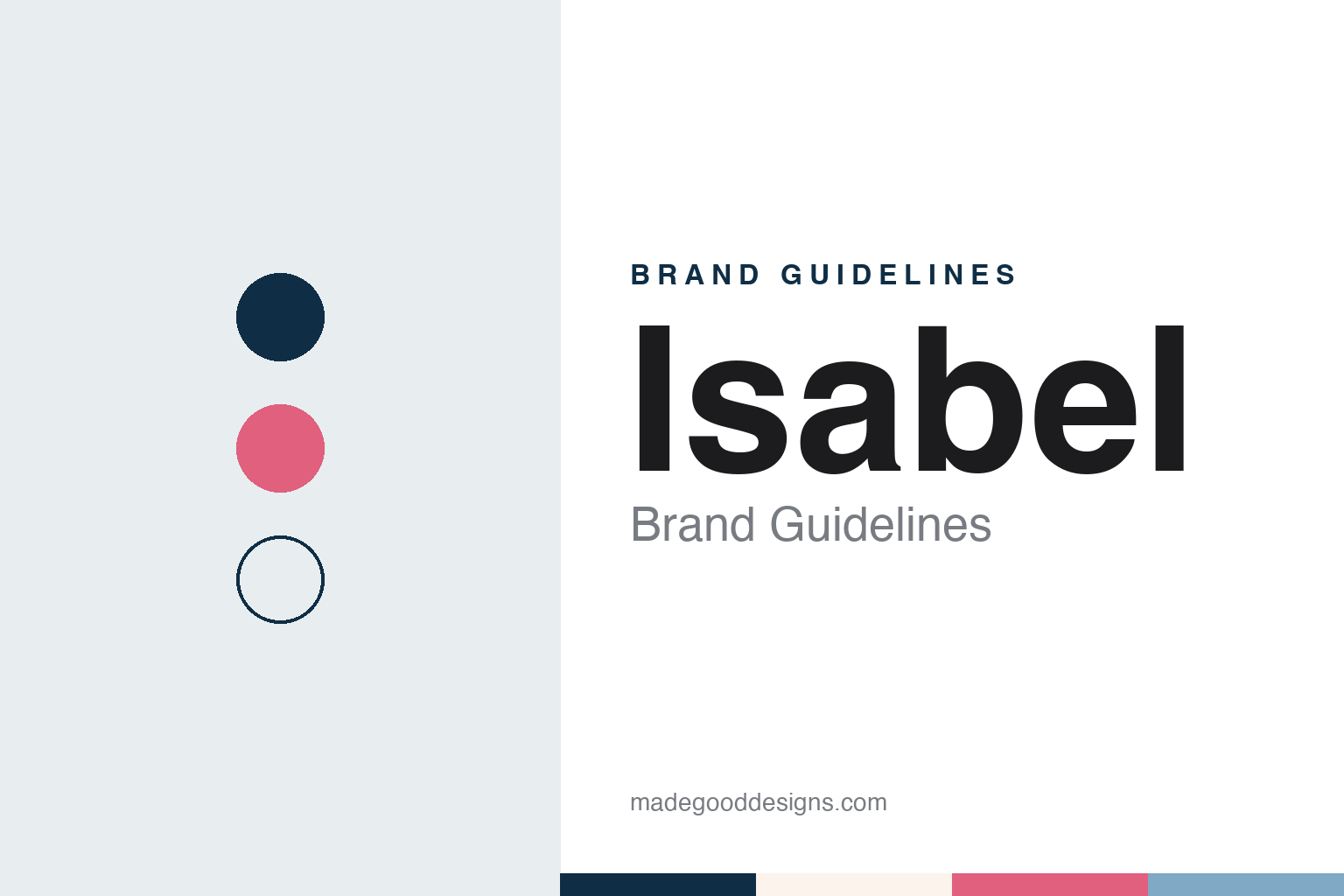
Isabel Brand Guidelines
The Basque canner that taught Spain a jingle.
Aa
Two constants: a Biscay blue, coral pink and sea mist palette and a warm display serif register. Abstract homage — not an Isabel product or mark; no can, logo or pack is reproduced.
Garavilla
A Biscay fishing village, a factory called La Equitativa and a family that came back.
Isabel is the consumer brand of Conservas Garavilla, a Basque canned-fish company. The company says it was founded in 1887 by José de Garavilla y Quintana in Elantxobe, a fishing village on the Biscay coast east of Bermeo, and that it laid the foundations of what it now describes as one of Europe’s largest fishing and fish-canning groups. Italy’s Bolton, which owns the brand today, gives the same founder and founding year. Spanish Wikipedia’s article on Elantxobe, in a passage marked as needing a citation, names Conservas Garavilla (Isabel) among the escabeche and canning factories of the village’s nineteenth-century fishing boom.
The business grew in the early twentieth century. In 1917, the company says, the family founded a factory called La Equitativa, which it describes as one of the best and most modern canneries in Europe at the time. Bolton’s brand page repeats the point, calling it one of Europe’s most advanced canning factories of the early twentieth century.
Then came a long setback. The company says the business suffered in the years of war and its aftermath, and that Estanislao Garavilla Landeta had to try his luck abroad. On his return, it says, the experience he had gained there let him rebuild the company slowly and steadily. The company does not give the dates of his time abroad.
The Isabel brand itself dates from the 1960s, the company says. In that decade Garavilla opened up to eleven factories across mainland Spain and the Canary Islands, following a rule it sums up as “se enlata donde hay pescado” — you can where the fish are. A third generation of the family led the business through the 1970s, 1980s and 1990s, building a national sales network, a modern fishing fleet and, above all, a presence in the media.
Colour
“Qué bien, qué bien, hoy comemos con Isabel.”
For most Spaniards, Isabel is a song. The company says its adverts have run on Spanish television since the end of the 1950s, and it dates its best-known jingle to 1960: “Qué bien, qué bien, hoy comemos con Isabel” — “How lovely, today we eat with Isabel” — sung over tins of sardines, bonito, anchovies and tuna. The company calls Isabel the first brand in the canning sector with a major media presence and says the jingle had the whole country humming. A version of the line, “Hoy comemos con Isabel,” is still the tagline of the brand’s Spanish website, isabel.net.
The visual identity has been renewed twice in this century. In 2003, the company says, Isabel introduced a new logo and a new pack design, part of a new brand positioning. After the Bolton takeover, it says, the brand image was renewed again to signal a higher-quality product. The company has not published the colour values or typefaces of either version, so the palette here is our own interpretation.
Later advertising leaned on new products and familiar faces. In 2015, the company says, the blogger Isabel Llanos, known online as Isasaweis, was the brand’s ambassador, fronting a campaign for its Naturfresh tuna range, which won a Producto del Año award that year. In 2017, the company says, Isabel launched a range of grilled mackerel, which the television presenter Eva González introduced in its advertising, and it later extended the grill range to tuna and sardines. In 2018 it introduced what it calls a patented easy-open system, “isy fast,” and a line of tuna with mayonnaise.
Traceability has become part of the pitch. Isabel says that for any can of its tuna or bonito produced from 1 January 2018, buyers can enter the barcode and batch number on its website to learn where the fish came from, and that a similar service covers its mussels, down to the Galician ría where they were farmed.
Typography
Design and documentation.
The seven brands in this group are all food brands, and all of them come from Spain: Calvo, Isabel, Cola Cao, Nocilla, ElPozo, Campofrío and Pescanova. Spanish food brands in general sit at many different points in the trade, from family firms that still carry a founder’s surname to names that now belong to much larger food groups, and a single brand can be sold everywhere from a neighbourhood shop to a supermarket shelf.
A food brand’s identity is usually carried less by a single product than by a pack, a name and the meal or snack it promises, because the company behind the name may have changed hands, moved its factory or grown far beyond the town where it started. That makes the questions behind each name worth asking plainly: who started it, who owns it now, and where its food is actually made and packed.
Each guide separates what independent sources record from what the company says about itself — its founding story, its owners over time, where its food is made and how its packaging and advertising have changed — and marks plainly what rests only on the company’s own word.
Aa
A warm display serif for a brand that sings its own name. (Specimen set in DM Serif Display, a serif STAND-IN; NOT the Isabel logo.)
Conservas Garavilla
Private equity, an Italian owner and plants on three continents.
The family era ended in two steps. In 2010 the Spanish private-equity firm MCH Private Equity invested in Conservas Isabel, Spanish Wikipedia says. In 2015 the Italian group Bolton, owner of Rio Mare, took a 75% stake in Conservas Garavilla, and it bought the remaining 25% in October 2016, Italian Wikipedia says; Isabel’s own history dates the acquisition to 2015. Bolton now lists Isabel among its food brands alongside Rio Mare and Saupiquet, and news items on isabel.net appear under the name of its food division, Bolton Food.
The group is run from the Bizkaia Science and Technology Park in Zamudio, near Bilbao, the company says, and it has two production plants in Spain, sited near the main fishing ports. Abroad, it says, Morocco was one of its first export markets in the 1970s; Isabel products for that market are made at a plant in Agadir run by its partner Cosarno. In Ecuador, Conservas Isabel Ecuatoriana was set up in 1976 in Manta, which the company calls the main tuna port of the eastern Pacific, and it says that subsidiary exports to more than 30 countries. Isabel has been sold in Colombia since the late 1970s, the company says, with products made in the group’s plants in Spain, Morocco and Ecuador. Bolton describes the brand as having leading positions in Spain, Ecuador and Morocco, and a range that runs from tuna to mussels and sardines.
The names are layered: “Isabel” is the brand, “Conservas Garavilla” the company behind it, and Bolton the owner of both.
For a design guide, Isabel shows how a jingle can do the work of a logo for more than sixty years. Compare Calvo, the Galician canner whose tuna shares its shelf, and John West, the British canned-fish brand. For this guide we use a Biscay blue, a coral pink and a sea mist with a warm display serif, an unofficial interpretation; no product or logo is reproduced.
Explore & save
Keep Isabel’s identity on hand — save it to a board in the Made Good inspiration library.
Isabel identity set
Pin the Isabel Biscay blue, coral pink and sea mist palette and the warm display serif register to your own board.