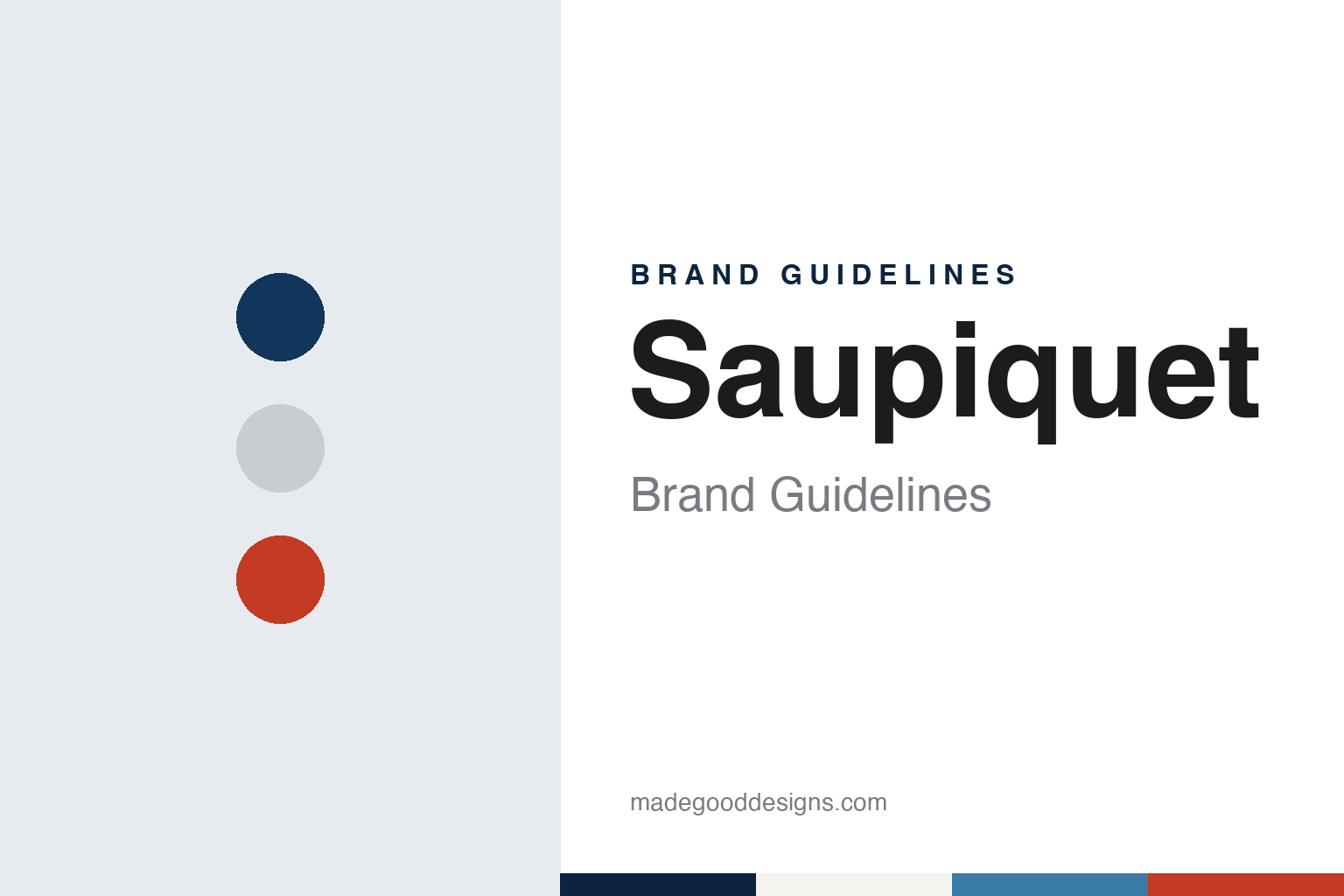
Saupiquet Brand Guidelines
The Nantes sardine canner behind the Jockey-Club tin.
Aa
Two constants: an Atlantic navy, tin silver and Catalan red palette and a nineteenth-century label serif register. Abstract homage — not a Saupiquet product or mark; no tin, label or logo is reproduced.
A Cantal tinsmith’s son in Nantes
Sardines, a quality campaign and a company of 51 shareholders.
Saupiquet takes its name from Arsène Saupiquet, born in 1849 at Jussac in the Cantal, in the Auvergne. The Nantes heritage encyclopedia Patrimonia, in an entry written in 2024 by Brigitte Blesteau, Brigitte Haye and Laurent Venaille of the association La conserve des Salorges à la Lune, says he came from a family of merchants and tinsmiths, was recorded as a commercial traveller in 1869 and had settled in Nantes before 1872. The company says he began his career there as a foreman for the tinsmith Alfred Riom; Patrimonia adds that a short partnership with the canner Jacquier, from 1875 to 1877, taught him the trade.
In 1877 he went into business on his own, canning sardines. With his own money, his wife’s dowry and probably help from his mother, Patrimonia says, he built a factory on the rue de Crucy in Nantes and another at Les Sables-d’Olonne, and acquired four sites in Brittany. He built his name on quality: for a long time the brand was accompanied by the “eye of providence,” he showed at exhibitions in France and abroad, in 1883 he wrote a work on food adulteration, and in 1889 he joined the Nantes biscuit maker Lefèvre-Utile to publish a trade review for grocers.
On 29 May 1891, with his wife, he turned the business into a joint-stock company, the Société Anonyme des Établissements Arsène Saupiquet, backed by 51 shareholders; the company counts 1891 as the birth of the Saupiquet brand. Within weeks, Patrimonia says, his banker failed and the rue de Crucy factory burned down, but partners from the Docks Nantais helped him recover, and he kept control of the firm although he was a minority shareholder. He introduced an 8% share of profits for staff. In March 1901, after a public clash with one of the directors, Arsène Saupiquet resigned. He later moved to Paris; Jules Gauquelin ran the company from 1901 to 1920.
Colour
A tin with a key, and a lawsuit over its shape.
Saupiquet’s most lasting design is a tin. The company dates to 1889 its patent for a can opened with a key, used on its Jockey-Club sardines. The tin was rectangular and, the company says, opened on the side “as one opens a packet of cigarettes”; the lid rolled up around the key. It became a standard for sardine tins across the industry, and the company says its opening instructions were printed on every Jockey-Club tin in four languages — French, English, German and Spanish. A later refinement, a tear-off band, appeared on the brand’s Diplomates sardines; the company dates it to 1904.
Arsène Saupiquet defended the shape in court. Patrimonia says the longest of his disputes was against the tin maker Dauché, which had supplied similar containers to competitors, and that the argument over whether a shape could be protected became an example in French case-law textbooks. Other cases dragged on without success, even against blatant imitations of the Jockey tin sold under the name “Soupiquet.”
Advertising followed the same independent line. The company says Saupiquet stood out early for unconventional advertising, and that the caricaturist Henri Gustave Jossot signed one of its first posters. Later, the brand sponsored football and sailing; Saupiquet appeared as main sponsor on the shirts of FC Nantes, Patrimonia notes.
The range grew well beyond sardines. Short of fishermen and hit by repeated sardine crises during the First World War, the company says, Saupiquet began canning tuna and mackerel; it launched its thon à la catalane, tuna in a Catalan-style sauce, in 1936, its Saladières, salads of fish and vegetables, in 1982, and sardine fillets in 1990. Patrimonia lists other products from pineapples to ready meals, and packaging changes from bowl-shaped cans to peel-off lids.
Typography
Design and documentation.
The seven brands in this group all make food, and all of them come from France: Herta, Fleury Michon, Banania, Tipiak, Cassegrain, Saupiquet and Bjorg. French food brands in general sit at many different points in the trade, from family firms that still carry a founder’s surname to names that now belong to much larger food groups, and a single brand can be sold everywhere from a village grocer to a hypermarket shelf.
A food brand’s identity is usually carried less by a single product than by a pack, a name and the meal or snack it promises, because the company behind the name may have changed hands, moved its factory or grown far beyond the town where it started. That makes the questions behind each name worth asking plainly: who started it, who owns it now, and where its food is actually made and packed.
Each guide separates what independent sources record from what the company says about itself — its founding story, its owners over time, where its food is made and how its packaging has changed — and marks plainly what rests only on the company’s own word.
Aa
A high-contrast serif for a label from the age of the sardine tin. (Specimen set in DM Serif Display, a serif STAND-IN; NOT the Saupiquet logo.)
Saupiquet
From Nantes consolidator to an Italian group’s French brand.
In the mid-twentieth century Saupiquet became the great consolidator of Nantes canning. Patrimonia says it absorbed some twenty companies between 1955 and 1970, among them Teyssonneau of Bordeaux, Tertrais of Nantes and Griffon of Cholet, which the company describes as the leading maker of canned ready meals when it bought it in 1955. In 1960 the businesses became the Compagnie Saupiquet, and in 1966 it bought Cassegrain, the vegetable canner.
Then it narrowed again. The shipping group Compagnie mixte de navigation became the majority shareholder in 1985, Patrimonia says. In 1989 Saupiquet sold its vegetable canning and Cassegrain to Bonduelle, and in 1994 its ready meals, to concentrate on fish. English and French Wikipedia say the company belonged to the investment firm Paribas Affaires Industrielles before the trade weekly LSA reported, in December 1999, that the Italian company Trinity Alimentari was taking it over; Patrimonia dates the change of control to 2000, and the company says it has been part of the Bolton group since 2000.
French manufacturing has wound down since. The Saint-Gilles-Croix-de-Vie factory closed in 2001, the Nantes factory and head office in 2005 and the Saint-Avé plant in Morbihan in 2010, French Wikipedia says; Ouest-France reported in 2010 that the company had gone from ten production sites in 1987 to one. That last French factory, at Quimper in Finistère, closed on 20 December 2024, and Ouest-France reported in June 2024 that two of its lines would move to Spain and Morocco. Today the brand is published by Bolton Food SAS, based in Courbevoie, near Paris, and the company groups it with Rio Mare and Isabel in Bolton’s food business. The company says its tuna and mackerel traceability system is certified to ISO 22005 by DNV GL.
The name has an older, unrelated meaning: in French cooking a saupiquet is a spiced sauce, traditionally served with roast hare, French Wikipedia says. The brand’s own site is saupiquet.com.
For a design guide, Saupiquet shows how a single tin format can outlive the company’s own factories in its home town. Compare Isabel, its Spanish stablemate in the Bolton group, and Calvo, the Galician tuna canner. For this guide we use an Atlantic navy, a tin silver and a Catalan red with a serif, an unofficial interpretation; no product or logo is reproduced.
Explore & save
Keep Saupiquet’s identity on hand — save it to a board in the Made Good inspiration library.
Saupiquet identity set
Pin the Saupiquet Atlantic navy, tin silver and Catalan red palette and the nineteenth-century label serif register to your own board.