Bonduelle Brand Guidelines
From a Lille distillery to canned peas and a family vegetable group.
Aa
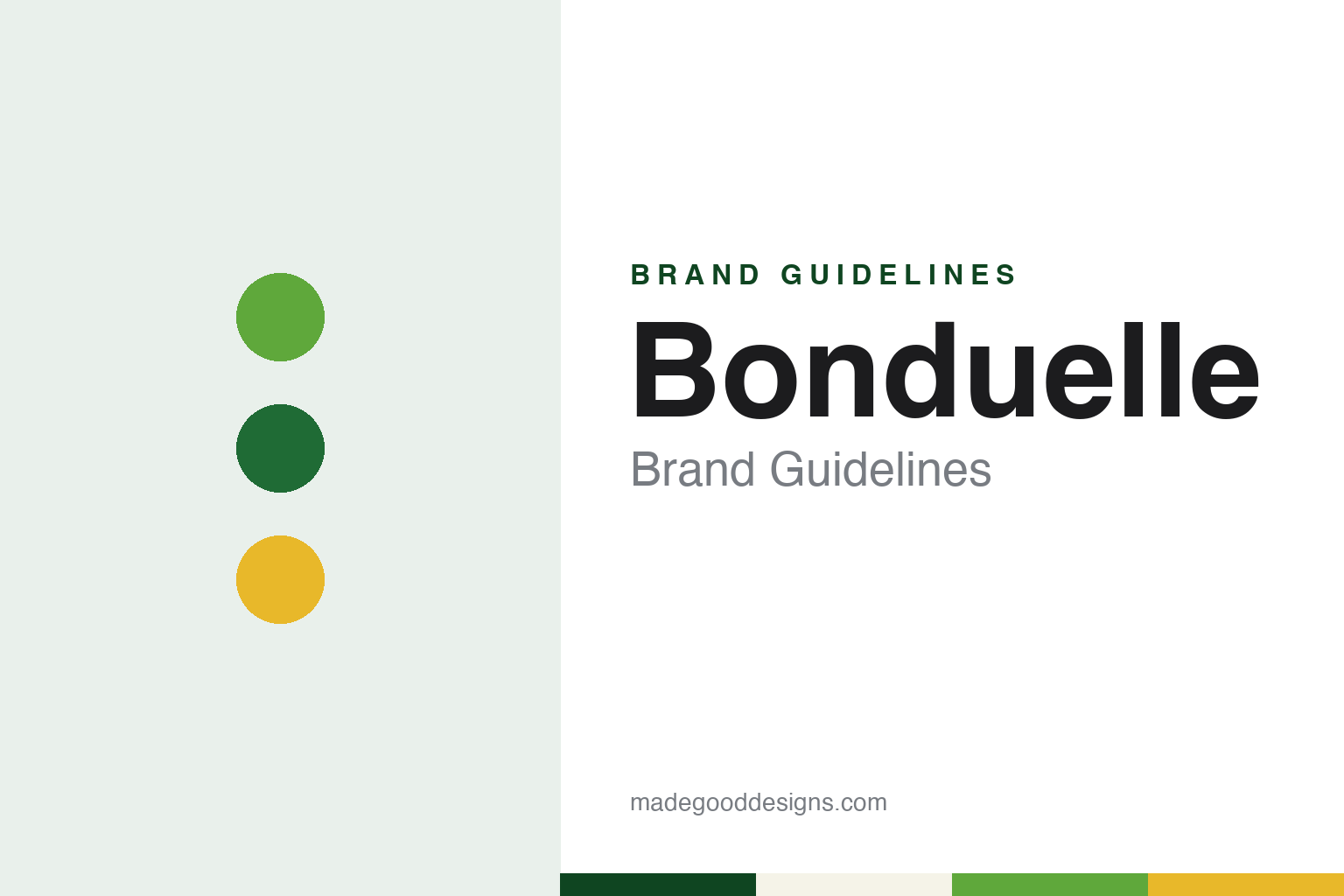
Two constants: a pea green, leaf green and sweetcorn yellow palette and a clean humanist sans register. Abstract homage — not a Bonduelle product or mark; no can, logo or label is reproduced.
Spirits, then peas
A distillery, an abbey farm and a barn turned cannery.
Bonduelle started out making spirits, not vegetables. In 1853, French Wikipedia and the company say, Louis-Antoine Bonduelle-Dalle, a farmer and oil maker, joined his friend Louis Lesaffre-Roussel, a distiller, to found “Lesaffre et Bonduelle, Alcools de l’Abbaye,” a grain and juniper distillery at Marquette-lez-Lille, just north of Lille. On 17 June 1862 the partners bought the farm of a former Cistercian abbey at Renescure, near Saint-Omer, which became a grain-spirit distillery and malt house. By 1901 the business had seven plants, and the founders’ heirs, unable to agree, divided it into three family companies: Bonduelle, Lemaître and Lesaffre, the last of which became the yeast group Lesaffre.
The vegetable business began at Renescure in the 1920s. French Wikipedia says that in 1925 Pierre Bonduelle, then 23, visited a cannery in Zwevezele, Belgium, and ordered a pea thresher. With his brother Benoît, the company says, he converted a disused barn into a canning workshop, sowed 16 hectares of peas and, in July 1926, finished the first Bonduelle pea campaign, with 90,000 cans. At first the cans were not sold under the family name: from 1936 their marketing was handled by Société La Rochefortaise, a meat canner, French and German Wikipedia say.
The Second World War stopped production in 1940. German Wikipedia, citing Bruno Bonduelle’s 2003 company history, says Allied bombs damaged part of the site in June 1944, and the company says canning could not resume until 1945. Rebuilding brought the decision that made the brand: the family would sell its cans under its own name. In 1947, the company says, mock-ups were drawn up for printing on tinplate, and in July of that year Bonduelle-branded cans reached French shelves. The distillery closed in 1954, French Wikipedia says.
Colour
Peas and carrots, a slogan and a children’s illustrator.
The product that made the name known across France came ten years later. In 1957, French and German Wikipedia say, Bonduelle launched a can of peas and carrots; at the time, French Wikipedia adds, the carrots were peeled by hand. German Wikipedia credits the mix with bringing the brand nationwide recognition. The company says its first advertising appeared in the 1950s, on local sports team jerseys, blotters and delivery trucks, proclaiming that the best canned food was Bonduelle.
Frozen vegetables followed in 1968, when a French wholesaler looking for frozen peas led the company to install a packing machine at Renescure, the company says. French Wikipedia, citing Jean Watin-Augouard’s 2008 history of the brand in La revue des marques, says Bonduelle created the first peas sold in trays. Fresh salads came in 1997 with the purchase of Salade Minute, and the Bonduelle name went onto fresh products in France from 1998.
The brand’s best-known line in France arrived in 1985: “Quand c’est bon, c’est Bonduelle” — “when it’s good, it’s Bonduelle” — German Wikipedia says, citing Watin-Augouard. About ten years earlier, Bonduelle had advertised in Germany with the rhyme “Bonduelle ist das famose Zartgemüse aus der Dose,” calling itself the famous tender vegetable from the can. It was created by the agency Robert Pütz, which held the German account for 23 years, the trade magazine Horizont reported in 1999, and the verse was illustrated by Tomi Ungerer, the Alsatian artist and children’s-book author. Since 2016 Bonduelle Germany has used the line “Gemüse lecker leicht gemacht.” The brand also went to sea: from 1999 it sponsored a racing multihull skippered by Jean Le Cam, followed by a monohull for the 2004 Vendée Globe, the company says.
Typography
Design and documentation.
The seven brands in this group all make food, and all of them come from Germany or France: Dr. Oetker, Hengstenberg, Leibniz, Kühne, Seitenbacher, Bonduelle and Lesieur. German and French food brands in general sit at many different points in the trade, from family firms that still carry a founder’s surname to names that now belong to much larger food groups, and a single brand can be sold everywhere from a village grocer to a supermarket shelf.
A food brand’s identity is usually carried less by a single product than by a pack, a name and the meal or snack it promises, because the company behind the name may have changed hands, moved its factory or grown far beyond the town where it started. That makes the questions behind each name worth asking plainly: who started it, who owns it now, and where its food is actually made and packed.
Each guide separates what independent sources record from what the company says about itself — its founding story, its owners over time, where its products are made and how its packaging has changed — and marks plainly what rests only on the company’s own word.
Aa
A clean humanist sans for a family vegetable brand. (Specimen set in Nunito Sans, a sans STAND-IN; NOT the Bonduelle logo.)
Bonduelle
Seven generations, a listed share and a group across three continents.
Bonduelle grew from Picardy outward. A plant begun in 1963 at Estrées-Mons grew, the company and French Wikipedia say, into the largest vegetable cannery in the world, with 200,000 square metres under cover. Subsidiaries followed in Germany in 1969, Italy in 1972 and Britain in 1973, and by 1973 exports made up half of sales. Bonduelle bought the Belgian canner Marie Thumas in 1980 and its main French rival, Cassegrain, in 1989 — the brand, the company says, “with the little white rabbit.” In the 1990s it moved into central and eastern Europe, Russia and South America.
The family kept control while opening the capital. Bonduelle became a partnership limited by shares in 1995 and listed its shares on the Paris stock exchange on 26 June 1998, German Wikipedia and the company say. On 1 July 2025, the company says, its statutory general partner held 22.09% and other Bonduelle families 33.05%, with 37.08% held by the public. Christophe Bonduelle, a great-great-great-grandson of the founder according to French Wikipedia, took charge in 2001 and is now chairman; Xavier Unkovic became chief executive on 1 June 2023. The company says the group is certified as a B Corp across all its activities.
North America has been built and partly sold. Bonduelle bought Aliments Carrière, owner of the Canadian brand Arctic Gardens, in 2007; the US fresh-salad maker Ready Pac Foods in 2017; and Conagra’s Del Monte processed fruit and vegetable business in Canada in 2018. In 2022 it sold 65% of Bonduelle Americas Long Life, its canned and frozen business in the US and Canada, to the Quebec investors Fonds de solidarité FTQ and Caisse de dépôt et placement du Québec, the company says. Today it names three brands — Bonduelle, Cassegrain and Globus — and gives its head office as Villeneuve-d’Ascq, near Lille.
For a design guide, Bonduelle shows how a family name painted onto tinplate in 1947 became the brand for a whole vegetable aisle. Compare Birds Eye, the frozen-food name, and Andros, another French family food group. For this guide we use a pea green, a leaf green and a sweetcorn yellow with a humanist sans, an unofficial interpretation; no product or logo is reproduced.
Explore & save
Keep Bonduelle’s identity on hand — save it to a board in the Made Good inspiration library.
Bonduelle identity set
Pin the Bonduelle pea green, leaf green and sweetcorn yellow palette and the clean humanist sans register to your own board.